Maddy summaryThis bill establishes new registration fees for electric and plug-in hybrid vehicles in Minnesota while creating a tax credit for installing home charging equipment. Electric vehicle owners will pay an annual surcharge based on vehicle price or age, with exemptions for those who charge at home using electricity already taxed for vehicle fuel. Plug-in hybrids face a lower surcharge, and the revenue from both fees goes to the highway user tax distribution fund. Additionally, the bill provides a refundable tax credit to offset costs of installing residential electric meters for vehicle charging.
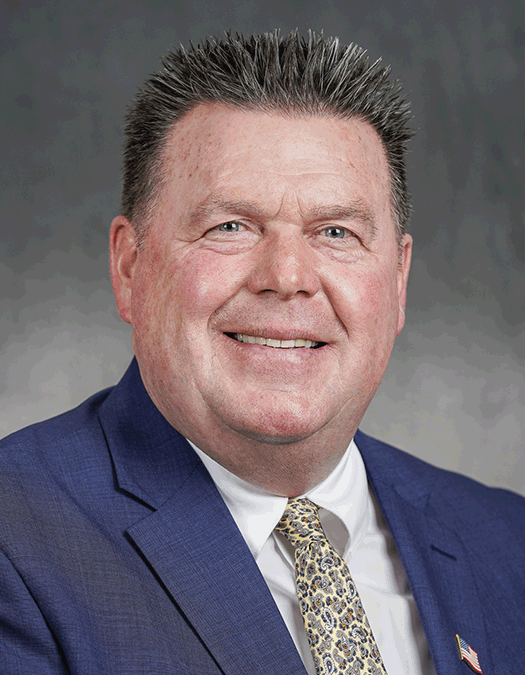
Rep. Tom Murphy
Sponsored bills
Maddy summaryThis bill establishes a new taxpayer refund account in Minnesota to hold undesignated money returned to the state through restitution, fraud recovery, overpayment recovery, administrative fines, or other reimbursements. State agencies must transfer these recovered funds to the commissioner of management and budget within 60 days of receipt, and the funds must be used exclusively for issuing refunds to individual taxpayers who filed Minnesota income tax returns. The commissioner will distribute the accumulated funds as direct payments to eligible taxpayers once the account balance exceeds $300 million, with refunds issued within 120 days after the legislative session ends. The bill also requires the commissioner to create rules for administering the account and determining the refund distribution formula, with provisions taking effect on July 1, 2026.
Maddy summaryThis bill makes Minnesota's paid family and medical leave program optional for both employers and employees. It allows employers to opt out of the program by submitting a form to the state, with the option to change their decision once every 12 months. Employees of opting-out employers can still participate as self-employed individuals, while all employees retain the ability to opt out individually using a state form. The changes modify existing requirements in Minnesota Statutes chapter 268B to provide this flexibility.
Maddy summaryThis bill modifies Minnesota's tax on electricity sold as vehicle fuel at retail charging stations and creates a new licensing requirement for charging station operators. Starting July 1, 2027, operators of retail charging stations must obtain a license from the state commissioner and will be taxed at five cents per kilowatt hour of electricity sold, with the rate potentially adjusted annually based on highway construction costs. The law exempts older charging stations installed before October 1, 2023, from the tax until December 31, 2031, and requires new charging stations to be able to charge customers based on the amount of electricity delivered.
Maddy summaryThis bill authorizes the city of Vergas in Minnesota to impose a local sales and use tax of 0.5 percent if approved by voters in a special election. The tax revenue must be used to cover the costs of collecting and administering the tax, as well as to fund up to $200,000 for the Vergas Park Improvement Plan. The tax would automatically expire after five years or earlier if the city council determines sufficient funds have been collected, with any remaining money going to the city's general fund. The legislation follows existing state laws governing local sales taxes and requires voter approval before the tax can be implemented.
Maddy summaryHF 3436 requires drivers approaching a stopped school bus displaying flashing red lights to stop at least 20 feet away. The bill amends Minnesota Statutes section 169.444 to mandate this stop until the bus retracts its stop arm and turns off the red lights. It also adds a new provision requiring drivers to prepare to stop within 20 feet when a bus shows prewarning amber lights, signaling red lights are about to activate. This law directly affects all drivers operating vehicles near school buses in Minnesota, aiming to improve safety for children boarding or exiting buses. The bill takes effect the day after final enactment.
Maddy summaryHF 3219, the "mRNA Bioweapons Prohibition Act," designates all mRNA-based medical products - including vaccines like those for COVID-19 - as "weapons of mass destruction" under Minnesota law. The bill prohibits possession, distribution, or manufacturing of these products, with criminal penalties for violations, and requires state/local officials to enforce the ban. It broadly defines "mRNA injections and products" to include any mRNA therapy, gene-altering agents, or nanoparticles, excluding only naturally occurring mRNA. The law takes effect August 1, 2025, and would directly affect individuals receiving mRNA-based medical treatments in Minnesota.
Maddy summaryHF 2081 removes income-based limits on deducting Social Security benefits from Minnesota state income tax. It eliminates the current phaseout thresholds and maximum deduction amounts (e.g., $5,840 for joint filers), allowing taxpayers to subtract the full amount of their Social Security benefits. This change applies to Minnesota residents receiving Social Security benefits who file state tax returns. The bill takes effect for taxable years beginning after December 31, 2024.
Maddy summaryHF 485 amends Minnesota law to allow the Public Utilities Commission to issue certificates of need for new nuclear power plants with a maximum capacity of 300 megawatts. This change permits the construction of smaller-scale nuclear facilities, which were previously prohibited under existing statute. The bill specifically modifies Minnesota Statutes section 216B.243 to add this exception while maintaining the ban on larger nuclear projects. It directly affects nuclear developers seeking to build these smaller plants and the commission responsible for reviewing such applications.
Maddy summaryThis bill requires Minnesota's social studies standards to include information about the dangers and perils of communism and socialism, specifically during the 2030-2031 review and revision of state academic standards. The legislation mandates that the state commissioner incorporate details about estimated lives lost and negative outcomes associated with these ideologies into the updated curriculum. It directly affects Minnesota public school systems by setting a specific requirement for future social studies education content. The bill takes effect on July 1, 2026, and does not change current curriculum requirements but establishes a mandate for future revisions.