Maddy summaryHF 377 establishes a two-year income tax exemption for eligible teachers in Minnesota, effective for tax years 2025-2026. To qualify, teachers must have worked at least 1,000 hours in Minnesota as defined by state law during the tax year and earned under $95,000 (or $190,000 for joint filers). The bill exempts qualifying teachers from Minnesota's individual income tax for those years, meaning they would pay no state income tax on their earnings. This directly affects teachers meeting the work-hour and income thresholds, with no tax liability for the specified period.
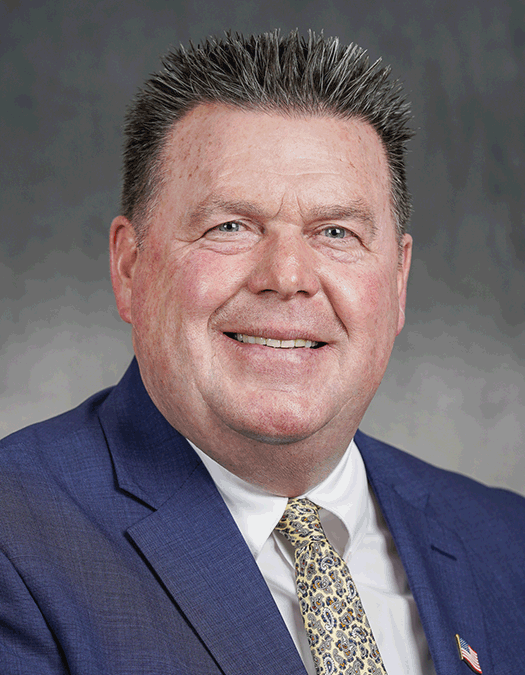
Rep. Tom Murphy
Sponsored bills
Maddy summaryHF 490 appropriates $25 million from state bond proceeds to fund Phase One improvements for the Alexandria Lake Area Sanitary District's (ALASD) regional water reclamation facility. The funds will cover design, engineering, construction, and equipment for upgrades to the facility. The state will issue bonds to raise the required funds, with the money granted to ALASD through the Public Facilities Authority. This directly affects ALASD's infrastructure operations and service delivery to its community.
Maddy summaryHF 373 creates tax exemptions for Minnesota businesses that received Paycheck Protection Program (PPP) loans and for all businesses, effective for taxable years beginning after December 31, 2025. Businesses with PPP loans will be exempt from corporate franchise tax and individual income tax on business income once cumulative tax paid equals their total PPP loan amount, with calculations starting in 2026. All other businesses receive a blanket exemption from these taxes beginning in 2026. The bill defines "trade or business income" using federal tax terms and requires businesses to provide documentation to verify eligibility.
Maddy summaryHF 486 requires coal-fired electric generation facilities scheduled for retirement in 2027 or 2031, located within the Mississippi River - St. Cloud Watershed, to submit a decommissioning and repurposing plan by February 1, 2027. The bill mandates that public utilities provide this plan to the Public Utilities Commission and share it with the local municipality where the facility is located. The plan must include specific details on how the facility will be repurposed (if possible) and a timeline for the retirement process. This applies only to coal plants in the specified watershed and does not cover other energy sources or facilities outside that geographic area. The requirement is tied to the utility's next resource plan filing or a separate filing if needed before the deadline.
Maddy summaryThis bill modifies Minnesota's individual income tax code to clarify that compensation for National Guard and reserve military service qualifies for a tax subtraction. It specifically defines "active service" to include state-activated duty (e.g., disaster response), federally funded service under Title 32, and Active Guard Reserve (AGR) program pay. The change directly affects Minnesota National Guard members, members of neighboring state National Guard units (North Dakota, South Dakota, Iowa, Wisconsin), and other U.S. military reservists performing qualifying service. The policy takes effect for tax years starting after December 31, 2024.
Maddy summaryHF 288 requires the Minnesota legislature to approve any extension of a declared emergency beyond five days. It mandates that certain executive orders and rules must be enacted by the legislature to have legal effect, rather than taking effect automatically under current rules. The bill defines key terms like "public health emergency" and "bioterrorism" to clarify when emergency powers apply. Additionally, it repeals specific criminal penalties related to emergency management procedures.
Maddy summaryHF 183 repeals a tax on retail delivery services and changes how transportation tax revenue is distributed. It creates a "Transportation Advancement Account" to allocate funds from sales taxes, directing 36% to metropolitan counties, 28% to county highway funds, and smaller shares to city and town road programs. The bill modifies several tax statutes (including sections 297A.94 and 270C.15) to implement these changes, effective July 1, 2025. This directly affects how Minnesota distributes transportation funding from sales tax revenues.
Maddy summaryHF 193 requires Minnesota's Commissioner of Veterans Affairs to provide grave markers for veterans' graves upon request from county veterans service officers or congressionally chartered veterans organizations. The bill amends Minnesota Statutes section 197.23 to change the commissioner's authority from "may" to "shall," making marker provision mandatory within available funds. It appropriates unspecified funds for fiscal years 2026 and 2027 to cover this program, which directly affects veterans' families and local veterans service offices in Minnesota. The markers must permanently mark graves of veterans buried within the state, as defined by statute.