

Maddy summaryThis bill makes it a crime in Minnesota to intentionally create or share images that digitally alter a person to appear nude or engaging in a sexual act without their consent. It specifically targets realistic images generated from original photos or videos where the individual was not originally depicted in that state. The law applies to anyone who knows or should know the person did not agree to the image being made or shared, and it covers cases where the person can be identified from the image or accompanying information. Violations are classified as felonies punishable by up to five years in prison or a $10,000 fine, with harsher penalties of up to ten years or a $20,000 fine for aggravating factors like intent to profit, harassment, or operating a website dedicated to this activity.
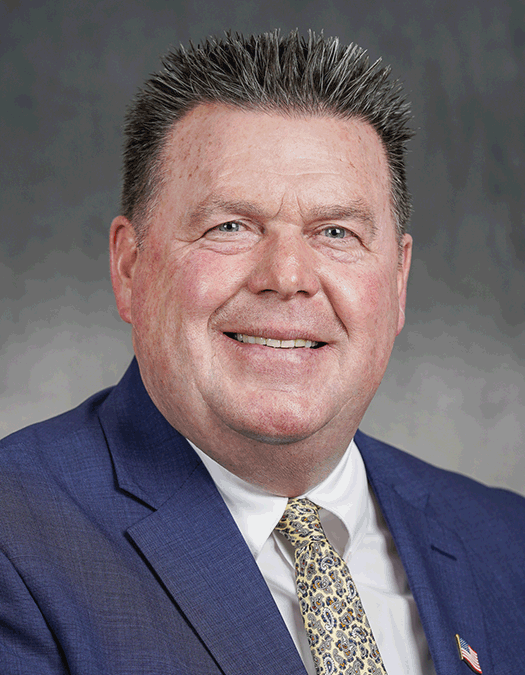
Rep. Tom Murphy
Sponsored bills
Maddy summaryHF 1849 proposes a constitutional amendment to limit Minnesota's governor and lieutenant governor to two terms each. If approved by voters in 2026, the amendment would change the state constitution to state that no person may be elected more than twice to either office. The amendment requires a statewide vote at the 2026 general election with a specific ballot question asking voters to approve term limits beginning in 2030. This change would affect all future governors and lieutenant governors, but would not apply to terms served before 2030.
Maddy summaryThis bill proposes adding a new section to the Minnesota Constitution that explicitly states a preborn child has a right to life. It defines a preborn child as a living human fetus from fertilization until live birth and requires voter approval at the 2026 general election for the amendment to take effect in 2027. The text includes specific language ensuring that medical treatment to save a pregnant person's life or the removal of a nonviable or deceased fetus remains allowed.
Maddy summaryThis bill temporarily suspends the state motor fuels tax in Minnesota for a specific period in 2026, directly affecting drivers, fuel retailers, and businesses that purchase gasoline and diesel. Under the legislation, the tax rate is set to zero cents per gallon or per thousand cubic feet for all fuel types during the designated timeframe, which begins shortly after the bill is enacted and ends in early September 2026. To offset the lost revenue from this suspension, the state will transfer money from its general fund to the Department of Transportation to cover the costs that would have been collected from fuel taxes. The bill also allocates a one-time appropriation to the Department of Revenue to cover the administrative expenses required to implement this temporary tax pause.
Maddy summaryThis bill requires Minnesota counties and cities to lose state funding if they reject development projects that would have increased their local property tax base. Under the law, the state Department of Revenue would calculate a penalty equal to the lost tax growth and cut the affected government's financial aid for the following year. Local officials must report the details of denied projects to the state by July 1, and the funding penalty continues until the jurisdiction's tax capacity grows enough to offset the lost value. The measure is designed to financially discourage local governments from blocking projects that expand the tax base, with an effective date of June 30, 2027.
Maddy summaryThis bill allows Minnesota counties to create official lists of agricultural lands that should be protected from electric power facility development. Counties can designate parcels as agricultural priority land if they have high crop productivity ratings or have been classified as prime farmland by the Natural Resources Conservation Service. Once a county submits its list to the state Public Utilities Commission, the commission cannot issue site permits for large power plants on those designated lands unless the county board specifically approves an exception. Landowners have the right to opt out of having their property included on the list before the county submits it to the state. The new rules would take effect on January 1, 2027.
Maddy summaryHF 482 establishes "Choose Life" special license plates for Minnesota motor vehicle owners. To obtain these plates, applicants must pay a $25 initial fee and $25 annual contribution to a dedicated "Choose Life account," in addition to standard registration fees. Funds collected are deposited into this account and distributed by Choose Life Minnesota, Inc., to non-profit agencies within each county that assist pregnant women making adoption plans - excluding any agencies involved in abortion services or charging fees for services. The bill also specifies plate design requirements (featuring the "Choose Life" logo and inscription) and limits administrative costs for the program to 15% of funds. The program becomes effective January 1, 2026.
Maddy summaryThis bill establishes the SAVE Minnesota Act, which requires voters to present a specific photo identification card to register to vote and to cast their ballots. To obtain this new voter identification card, applicants must provide proof of their U.S. citizenship and may receive certain vital records, such as birth certificates, without a fee. The legislation also creates a new voter identification card program, modifies existing driver's license requirements, and sets up a process for handling provisional ballots. Additionally, the bill includes funding provisions to support the administration of these new election procedures and establishes a children's trust fund.
Maddy summaryThis bill is a House resolution that formally impeaches Minnesota Governor Timothy J. Walz for alleged corrupt conduct in office. It directly affects the Governor by charging him with four specific articles of misconduct, including concealing fraud in state programs, obstructing oversight investigations, prioritizing political narratives over transparency, and failing to enforce laws protecting public funds. If adopted by the House, the resolution would immediately suspend the Governor's duties while the Senate conducts a trial to determine whether he should be removed from office. The bill also requires the Speaker of the House to serve formal notice of the charges to the Governor and directs the Chief Clerk to send copies of the resolution to relevant state officials.
Maddy summaryThis bill directs the Minnesota School Safety Center to create and distribute evidence-based model safety plans for K-12 schools, requiring districts to adopt similar plans by May 2028. It establishes strict criteria for what counts as "evidence-based," mandating that safety strategies be backed by strong research or well-designed studies before they are implemented. The legislation also enables anonymous threat reporting systems in schools and requires the safety center to consult with licensed mental health professionals when developing these plans. Additionally, the bill modifies grant programs for school buildings and cybersecurity while increasing funding for safe schools initiatives.