Issue · Labor & Employment

Labor & Employment

Every labor & employment bill, vote, and legislator stance in Pennsylvania, automatically classified by Maddy, our AI policy reader.

Total bills
30
2025-2026 Regular Session
Top supporter
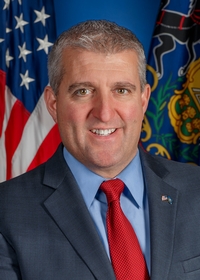
Frank Farry
93% support rate
Top opponent
Dawn Keefer
15% support rate
Ranked legislators
10
5 support · 5 oppose
Key legislators

Who's moving labor & employment in Pennsylvania

Legislators moving labor & employment in Pennsylvania
Legislator Party Stance Support rate Votes
Frank Farry
Frank Farry Senate · District 6
R
Strong +
93% 45
Devlin Robinson
Devlin Robinson Senate · District 37
R
Strong +
90% 52
Camera Bartolotta
Camera Bartolotta Senate · District 46
R
Strong +
89% 51
Joe Pittman
Joe Pittman Senate · District 41
R
Strong +
89% 55
Elder Vogel
Elder Vogel Senate · District 47
R
Strong +
88% 56
Dawn Keefer
Dawn Keefer Senate · District 31
R
Strong −
15% 46
Scott Hutchinson
Scott Hutchinson Senate · District 21
R
Oppose
29% 46
Charity Krupa
Charity Krupa House · District 51
R
Oppose
29% 256
Jarrett Coleman
Jarrett Coleman Senate · District 16
R
Oppose
29% 54
Stephanie Borowicz
Stephanie Borowicz House · District 76
R
Oppose
31% 214
Showing 21–30 of 30 bills

All labor & employment bills

in committee · Pennsylvania · Senate Jun 24, 2025

SB 894: An Act amending the act of June 2, 1915 (P.L.736, No.338), known as the Workers' Compensation Act, in liability and compensation, providing for registration of status as independent contractor.

SB 894 creates a formal process for businesses to register workers as independent contractors under Pennsylvania's Workers' Compensation Act. To register, a business must obtain a worker's signed waiver and affidavit confirming they are not an employee, agree to forgo workers' compensation benefits, and understand they cannot access the Uninsured Employers Fund if injured. If registered, the business is not liable for benefits or required to provide insurance coverage for that worker, and the worker loses eligibility for those benefits. Registration is valid annually unless the worker revokes it by filing a request with the department, which takes effect 10 days after submission.
in committee · Pennsylvania · Senate Jun 24, 2025

SB 893: An Act amending the act of October 13, 2010 (P.L.506, No.72), known as the Construction Workplace Misclassification Act, further providing for independent contractors.

SB 893 amends Pennsylvania's Construction Workplace Misclassification Act to clarify that construction workers registered under the Home Improvement Consumer Protection Act (2008) are considered independent contractors by default. This change directly affects construction workers and contractors in disputes over misclassification, shifting the burden of proof in such cases. The key provision states that current registration under the Home Improvement Act serves as strong evidence that a worker is an independent contractor, not an employee. This simplifies verification for employers and the Department of Labor but does not alter worker rights or create new registration requirements.
Sub-Topics Gig Economy
in committee · Pennsylvania · House Jan 16, 2025

HB 160: An Act amending the act of August 15, 1961 (P.L.987, No.442), known as the Pennsylvania Prevailing Wage Act, further providing for definitions.

HB 160 amends Pennsylvania's prevailing wage law by raising the cost threshold for public construction projects subject to prevailing wage requirements from $25,000 to $257,000 (adjusted annually for inflation). The new threshold uses the Consumer Price Index for urban wage earners in Pennsylvania, New Jersey, Delaware, and Maryland to account for inflation each March. This change exempts smaller public projects (under $257,000) from prevailing wage rules, while larger projects remain covered. The amendment applies to contracts entered into 60 days after the law's effective date.
in committee · Pennsylvania · Senate Apr 9, 2025

SB 545: An Act amending the act of January 17, 1968 (P.L.11, No.5), known as The Minimum Wage Act of 1968, further providing for exemptions and for duty of employer.

SB 545 amends Pennsylvania's Minimum Wage Act to exempt minor league baseball players covered by collective bargaining agreements (CBAs) from minimum wage and overtime rules. It adds a specific exemption (Section 5(a)(13)) for players under CBAs detailing their wages and working conditions. The bill also modifies employer recordkeeping requirements (Section 8), exempting these players from needing employers to maintain certain records or allow inspections regarding their pay. This change directly affects minor league baseball teams and players in Pennsylvania under applicable CBAs. The bill takes effect 60 days after enactment.
in committee · Pennsylvania · House Jul 1, 2025

HB 1690: An Act amending the act of December 5, 1936 (2nd Sp.Sess., 1937 P.L.2897, No.1), known as the Unemployment Compensation Law, in compensation, further providing for qualifications required to secure compensation.

HB 1690 amends Pennsylvania's Unemployment Compensation Law to require claimants to report certain disability-related benefits when applying for unemployment benefits. It directly affects unemployed Pennsylvanians who receive disability benefits from workers' compensation, federal disability insurance, private disability insurance, or unpaid leave under federal family medical leave laws. The bill adds a new requirement that claimants must disclose these benefits to the Department of Labor to determine eligibility for unemployment compensation. The change takes effect six months after enactment.
in committee · Pennsylvania · House Jul 1, 2025

HB 1691: An Act amending the act of December 5, 1936 (2nd Sp.Sess., 1937 P.L.2897, No.1), known as the Unemployment Compensation Law, in compensation, further providing for qualifications required to secure compensation.

HB 1691 amends Pennsylvania's unemployment compensation law to adjust the earnings requirement for workers seeking benefits after certain job separations. It increases the required earnings from six to fifteen times the weekly benefit rate in the 10 weeks following a disqualifying separation (e.g., quitting for personal reasons or being terminated). The bill also adds a provision exempting workers who took a leave of absence and made reasonable efforts to return to work. This change directly affects unemployed workers who left jobs under disqualifying circumstances but meet the new earnings threshold. The bill takes effect six months after enactment.
Sub-Topics Unemployment
in committee · Pennsylvania · Senate Jul 31, 2025

SB 961: An Act prohibiting certain practices and discrimination by the Commonwealth and its political subdivisions under contracts for public works; and providing for a private right of action.

SB 961, the Freedom in Public Contracting Act, prohibits Pennsylvania state and local governments from requiring contractors on public works projects to use union-represented workers, pay union dues, recognize unions, or follow specific apprenticeship or wage/benefit programs. It directly affects contractors bidding on government construction projects (like roads or buildings) by banning discriminatory contract terms based on union status or participation in union programs. The law allows affected contractors to sue a government body in court to stop violations and seek damages or legal fees. It takes effect 60 days after enactment, with exceptions only for federally mandated prevailing wages or state minimum wage laws.
in committee · Pennsylvania · House Aug 19, 2025

HB 1808: An Act amending the act of June 13, 1967 (P.L.31, No.21), known as the Human Services Code, in public assistance, further providing for workfare program.

HB 1808 establishes a workfare pilot program for Temporary Assistance for Needy Families (TANF) recipients in Pennsylvania's fourth and fifth class counties. The program requires recipients to work 40 hours per week for an employer while gradually reducing cash assistance: initially receiving benefits alongside pay for 20 hours of work, then up to 70% of benefits with pay for 30 hours after six months, and finally full pay for 40 hours with cash assistance termination after 12 months. It applies only to the pilot counties and does not alter existing TANF eligibility rules. The bill mandates the department to implement the program within six months of its effective date.
passed · Pennsylvania · Senate Jan 29, 2025

SB 153: An Act amending the act of December 5, 1936 (2nd Sp.Sess., 1937 P.L.2897, No.1), known as the Unemployment Compensation Law, in compensation, further providing for ineligibility for compensation.

SB 153 amends Pennsylvania's 1936 Unemployment Compensation Law to clarify when unemployed workers may lose benefits. It adds specific rules making workers ineligible if they unreasonably discourage their own hiring - such as skipping job interviews without good cause or refusing referrals before discussing job details. Employers can now report such behavior to the state, and the Department of Labor must create forms for this process within 90 days. The bill directly affects workers claiming unemployment benefits by tightening eligibility standards around job search efforts.
Sub-Topics Unemployment
passed · Pennsylvania · House Nov 24, 2025

HB 1995: An Act amending the act of December 5, 1936 (2nd Sp.Sess., 1937 P.L.2897, No.1), known as the Unemployment Compensation Law, in compensation, further providing for rate and amount of compensation.

HB 1995 amends Pennsylvania's unemployment compensation law to adjust benefit calculations based on a trigger percentage tied to state unemployment conditions. If the trigger percentage remains below 250% as of July 1, 2027, then for 2028 and later, the highest quarterly wages used to calculate benefits will be determined by averaging the highest quarter wage and 130% of the second highest quarter wage (capped at the highest amount). If the trigger reaches or exceeds 250% on July 1, 2028, the standard calculation method reverts to the prior formula. This change directly affects unemployed workers in Pennsylvania who receive unemployment benefits under the state's program.
Sub-Topics Unemployment
Showing 21 to 30 of 30 bills