Alaska Offshore Parity Act This bill requires the Department of the Treasury to share more revenues derived from energy and mineral development in the Alaska Outer Continental Shelf (OCS) region with Alaska and its coastal political subdivisions. Currently, only revenue generated by certain nearshore areas of the OCS is shared with Alaska. Alaska may use the funding from such revenue for coastal protection, coastal infrastructure, systems to reduce energy costs and greenhouse gas emissions, programs at institutions of higher education, and other related purposes.
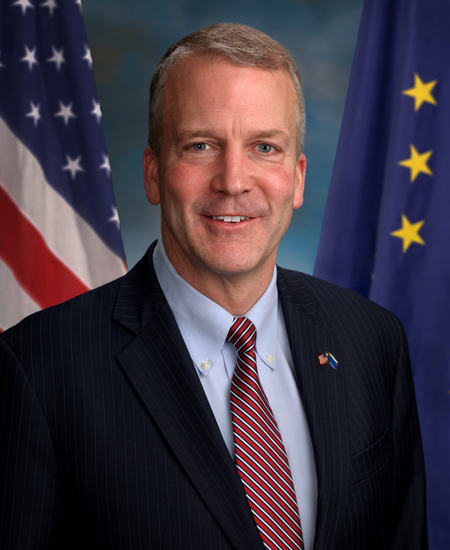
Sen. Dan Sullivan
Sponsored bills
250th Anniversary of the United States Marine Corps Commemorative Coin Act This bill directs the Department of the Treasury to mint and issue not more than 50,000 $5 gold coins, 400,000 $1 silver coins, and 750,000 half-dollar clad coins emblematic of the 250th anniversary of the United States Marine Corps. All surcharges received by Treasury from the sale of such coins must be paid to the Marine Corps Heritage Foundation and shall only be used for the purposes of supporting the mission of the Marine Corps Heritage Center.
This bill recognizes Alexander Creek, Incorporated, as an Alaska Native village corporation, subject to certain conditions, and Alexander Creek village as an Alaska Native village. Alexander Creek, Incorporated, must submit to the Department of the Interior any amendments to its state corporate charter that are necessary to convert from a group corporation to a village corporation. The bill requires Interior to offer to enter into negotiations with Alexander Creek, Incorporated, to settle aboriginal land claims and any other claims against the United States. As a condition of recognition as a village corporation, Alexander Creek, Incorporated must enter into such an agreement with Interior no later than 13 months after this bill's enactment. Alexander Creek, Incorporated, must notify its members that (1) they will cease to receive benefits from Cook Inlet Region, Incorporated, individually as at-large shareholders, and (2) all future resource payments shall be retained by Alexander Creek, Incorporated.
Omnibus Travel and Tourism Act of 2021 This bill addresses measures to support the U.S. travel and tourism industry with a specific focus recovery from the COVID-19 pandemic. The bill establishes the office of Assistant Secretary of Commerce for Travel and Tourism. Among other responsibilities, the Assistant Secretary must develop and implement a strategy to assist the U.S. travel and tourism industry to recover from the COVID-19 pandemic. The bill also provides statutory authority for the United States Travel and Tourism Advisory Board and directs the board to assist with the recovery strategy. Additionally, the Department of Commerce must study the effects of the COVID-19 pandemic on employment, revenue, and other aspects of the travel and tourism industry and provide policy recommendations to promote the industry. Commerce must also publish trends in domestic travel and tourism. Further, the Department of Health and Human Services must establish a joint federal task force to address health, safety, security, and other logistical issues affecting air travel during and after the COVID-19 pandemic. The bill establishes a committee comprised of representatives of airports and other aviation stakeholders to advise the task force. In addition, the Transportation Security Administration (TSA) must study the feasibility of using dogs to detect the presence of the virus that causes COVID-19 as part of airport security screenings. The TSA may also establish a pilot program at up to six foreign airports to allow passengers departing from those airports to bypass domestic security rescreening at a connecting airport in the United States.
This resolution commemorates the 75th anniversary of the Marine Corps Reserve Toys for Tots Program and recognizes the Marine Corps Reserve Toys for Tots Foundation for its efforts.
Replenishing Our American Reserves Act or the ROAR Act This bill requires the Strategic Petroleum Reserve (SPR) to only include petroleum products produced in the United States. It also directs the Department of Energy to only sell petroleum products from the SPR to entities within the United States.
Ending China's Unfair Advantage Act of 2022 This bill prohibits implementation of the Montreal Protocol on Substances that Deplete the Ozone Layer until the agreement is amended to remove China from the list of developing countries .
DHS Restrictions on Confucius Institutes and Chinese Entities of Concern Act This bill restricts funding to an institution of higher education (IHE) that has a relationship with a Chinese entity of concern or Confucius Institute. A Confucius Institute is a cultural institute directly or indirectly funded by the Chinese government. Specifically, the Department of Homeland Security (DHS) must ensure that an IHE that has awarded a contract to, entered into an agreement with, or received an in-kind donation or gift from a Chinese entity of concern or Confucius Institute is ineligible to receive specified funds from DHS. The IHE may regain eligibility for these funds if it terminates the relationship.
Kickstarting Innovative Demonstrations Supporting Kids Health Act of 2022 or the KIDS Health Act of 2022 This bill requires the Centers for Medicare & Medicaid Services (CMS) to implement a demonstration program that supports a whole child health model for children under Medicaid and the Children's Health Insurance Program (CHIP). Specifically, the CMS must award grants to up to 15 states to plan and implement a health care model that supports the physical, behavioral, social, and other needs of children who qualify for Medicaid or CHIP through care coordination and integrated supportive services. States must implement models for 4-6 years. The CMS must provide technical assistance and guidance to states for the demonstration program. The bill also provides for an 80% federal matching rate for program costs. The Government Accountability Office must report on program outcomes.
Good Samaritan Remediation of Abandoned Hardrock Mines Act of 2022 This bill promotes the remediation of abandoned hardrock mine sites by Good Samaritans. A Good Samaritan means a person that is (1) not a past or current owner or operator of the abandoned site; (2) had no role in the creation of the historic mine residue; and (3) is not potentially liable under any law for the remediation, treatment, or control of the historic mine residue. The bill requires the Environmental Protection Agency (EPA) to establish a Good Samaritan pilot program. Under the program, the EPA may issue permits to allow Good Samaritans to remediate historic mine residue at abandoned hardrock mine sites without assuming liability under specified environmental laws for past, present, or future releases, threats of releases, or discharges of hazardous substances or other contaminants at or from the abandoned mine site. In addition, the bill establishes a Good Samaritan Mine Remediation Fund for land management agencies that authorize Good Samaritans to conduct remediation projects on federal land.