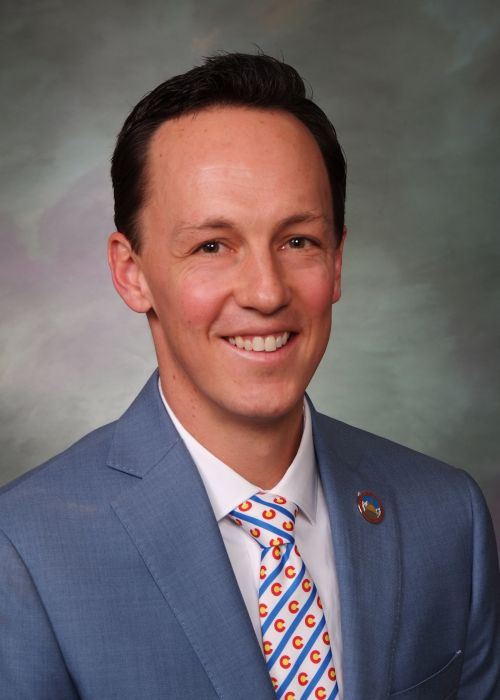
Photo of Dylan Roberts
D Colorado Senate · District 8 On the 2026 ballot

Sen. Dylan Roberts

Compare
Total votes
4,741
all sessions
Attendance
94%
282 missed
Near the chamber average
With party
94%
of cast votes
Lower than 95% of chamber peers
Bipartisan score
3%
crosses aisle rarely
Higher than 86% of chamber peers
Sponsored
635
bills & resolutions
Near the chamber average
Committees
7
assignments
635 bills and resolutions

Sponsored bills

Total
635
Primary
369
Co-sponsor
266
This page
635
matching current filters
Primary HB 1433
Signed into law Jun 1, 2026 0 co-sponsors
Co-sponsor SB 142
Signed into law · Colorado Senate · Co-sponsor
Development of Thermal Energy Resources

The act authorizes a local government or a special district (local government) to enter into an agreement with one or more entities for the purpose of providing the local government with service from a thermal energy network. A local government that is authorized by law to issue bonds may issue bonds for the purpose of financing thermal energy infrastructure, interconnections, or customer connections within the jurisdiction of the local government.     The act increases the net electric generating capacity of a community geothermal garden from 5 megawatts to 25 megawatts.     The act requires the Colorado energy and carbon management commission (commission) and the Colorado geological survey to collect data and information related to geological resources in the state. The commission shall make recommendations to encourage safe and effective development of geothermal resources and report those recommendations to the general assembly on or before November 15, 2026.     The act requires investor-owned electric utilities (utilities) to identify small-scale geothermal projects and large-scale geothermal projects (geothermal projects). The utility must solicit proposals for the development of small-scale geothermal projects of up to 25 megawatts of net electric generating capacity and large-scale geothermal projects that are greater than 25 megawatts of net electric generating capacity. The utility shall submit applications for the development of the geothermal projects to the public utilities commission if the utility receives a bid in response to the request for proposals. The public utilities commission must review the application and approve, conditionally approve, deny, or modify the application within 120 days after receiving the application.(Note: This summary applies to this bill as enacted.)

Signed into law Jun 1, 2026 1 co-sponsor
Co-sponsor HB 1314
Signed into law · Colorado House · Co-sponsor
Family Stability & Kinship Care

The act expands the definitions of 'grandparent' and 'great-grandparent' in the context of court-ordered family time to account for situations in which the child's father or mother is deceased.     To align with changes enacted in 2023 that address kinship and relative placements more broadly, the act repeals language specific to grandparent placements in child welfare cases and the types of evidence a court considers in connection with a grandparent's past abusive or neglectful conduct.     When a child or youth is removed from the home, the act requires the court to prioritize the child's or youth's temporary placement with a relative or kin, unless the court finds by a preponderance of the evidence that temporary placement with the relative or kin is not in the best interests of the child.(Note: This summary applies to this bill as enacted.)

Signed into law Jun 1, 2026 1 co-sponsor
Co-sponsor HB 1322
Signed into law · Colorado House · Co-sponsor
Civil Actions for Conversion Therapy Survivors

The act allows an injured person to bring a cause of action for claims of injury caused by sexual orientation or gender identity change efforts (efforts) against a licensed mental health professional and allows the cause of action to be commenced at any time without limitation.     Specifically, the act applies to a civil cause of action brought against a licensed mental health professional who seeks to direct a patient toward a predetermined sexual orientation or gender identity outcome or eliminate or reduce sexual or romantic attractions or feelings toward individuals of a particular sex or gender.     The act permits the injured individual, or the individual's personal representative or estate if the individual is deceased, to recover economic, noneconomic, and exemplary damages, and any other damages deemed appropriate by the court.     A cause of action may be brought as a survival action within 5 years after the death of the person who underwent efforts.(Note: This summary applies to this bill as enacted.)

Signed into law Jun 1, 2026 1 co-sponsor
Primary HB 1230
Signed into law · Colorado House · Lead sponsor
Extend Conservation Easement Tax Credit

The act extends the availability of the conservation easement tax credit from income tax year 2031 through income tax year 2036. The act also prohibits the division of conservation from issuing any additional credit certificates or amending previously issued credit certificates as a result of the additional authority granted by the act for a donation made prior to the effective date of the act.(Note: This summary applies to this bill as enacted.)

Signed into law Jun 1, 2026 0 co-sponsors
Co-sponsor HB 1282
Signed into law · Colorado House · Co-sponsor
Eliminate Duplicative Regulation of School Child Care Centers

The act allows child care centers for school-age children operated on school district, district charter school, or institute charter school property to satisfy requirements for staff training or minimum square footage of floor space per child by providing to the Colorado department of early childhood (CDEC) documented evidence of compliance with substantially similar requirements imposed by the Colorado department of education (CDE) unless CDE's requirements do not meet federal grants-in-aid requirements, in which case, CDEC shall require the child centers to meet federal grants-in-aid requirements.     The act adds a public health agency to the list of entities that CDEC shall accept certification from as satisfactory proof of valid certification of a playground facility.     The act directs CDEC to review the process regarding materials waivers and the process for undue hardship appeals at least annually.(Note: This summary applies to this bill as enacted.)

Signed into law Jun 1, 2026 1 co-sponsor
Primary HB 1006
Signed into law · Colorado House · Lead sponsor
Thriving Institution Designations for Higher Education

On or before December 31, 2027, the act requires the department of higher education (department) to establish thriving institution designations and, on or before January 1, 2027, to establish an advisory committee to provide input to the department on the outcome and recognition standards and continuous improvements set by the department to identify institutions of higher education (institutions) that meet the requirements for one or more thriving institution designations.     The act requires the department, with input from the advisory committee, to:Identify institutions that meet the outcome and recognition standards to be designated as a thriving institution;Notify each institution that meets the outcome standards to be designated as a thriving institution and request the institution to respond within 10 calendar days with the institution's decision of whether to be recognized as a thriving institution;Post on the department's website the names of the institutions that earn a thriving institution designation and agree to be listed as a thriving institution; andNotify the general assembly of the names of the institutions that are recognized as thriving institutions.(Note: This summary applies to this bill as enacted.)

Signed into law Jun 1, 2026 0 co-sponsors
Primary SB 163
Signed into law · Colorado Senate · Lead sponsor
Regulation of Gaming & Sports Betting

Under current law, the Colorado limited gaming control commission (commission), at its discretion, may delegate only certain licensing duties described under the 'Limited Gaming Act of 1991' (gaming act) to the division of gaming (division). The act allows the commission to delegate to the division licensing duties that appear elsewhere in the gaming act.     The act authorizes investigators of the division and their supervisors to inspect, examine, investigate, hold, or impound any premises in the state where an investigator or supervisor suspects that unlicensed gaming or unlicensed sports betting is conducted.     Under current law, the division is required to operate a program that allows individuals to voluntarily exclude themselves from gaming activities in the state. The act expands the program to allow individuals to voluntarily exclude themselves from sports betting in the state.     The act clarifies the definition of 'race meet' for purposes of the regulation of racing events. The act also adds other definitions of terms used in laws concerning gaming.     The act states that a designee of the director is a peace officer while engaged in the performance of their duties whose primary authority includes the enforcement of all laws of the state.     Current law prohibits a licensee from offering certain games without acquiring prior approval from the commission. The act changes this requirement so that a licensee must acquire prior approval from the division.     The act clarifies the process by which the commission and the Colorado bureau of investigation conduct fingerprint-based criminal background checks of applicants for gaming licenses.(Note: This summary applies to this bill as enacted.)

Signed into law May 29, 2026 0 co-sponsors
Primary SB 165
Signed into law · Colorado Senate · Lead sponsor
Species Conservation Measures

For state fiscal year 2026-27, the act appropriates $5,000,000 from the species conservation trust fund (trust fund) in the state treasury for various wildlife conservation programs directed at conserving candidate species or species that are likely to become candidate species, as determined by the United States fish and wildlife service. The executive director of the Colorado department of natural resources, after consulting with the Colorado water conservation board, the parks and wildlife commission, and the director of the division of parks and wildlife, has submitted to the general assembly a list of programs and associated costs that are eligible to receive funding from the trust fund as follows:$2,380,000 for the upper Colorado river endangered fish recovery program and San Juan river basin recovery implementation program;$60,000 for Rio Grande native fish protection and habitat improvements;$60,000 for selenium management, research, monitoring, evaluation, and control;$1,250,000 for native terrestrial wildlife conservation; and$1,250,000 for native aquatic wildlife conservation.     Trust fund money made available for native terrestrial wildlife conservation is not available for purposes of importing new wolves for reintroduction into the state for state fiscal year 2026-27.(Note: This summary applies to this bill as enacted.)

Signed into law May 29, 2026 0 co-sponsors
Co-sponsor SB 147
Vetoed · Colorado Senate · Co-sponsor
Lobbyist Regulation

The act requires a volunteer lobbyist to register and file a registration statement attesting they are not being compensated. The act exempts volunteer lobbyists from registration fees.     The act provides that the judicial department may designate one individual for the judicial department and one individual for each independent agency in the judicial department who may lobby on behalf of the judicial department or an independent agency in the judicial department (judicial lobbyist). A person designated by a principal executive department to be responsible for lobbying a state official or employee on behalf of the department (legislative liaison), a judicial lobbyist, or an individual who lobbies on behalf of the offices of the governor or lieutenant governor as a member of the governor's cabinet or as a personal staff employee in the offices of the governor or the lieutenant governor (governor's lobbyist) must register with the secretary of state annually.     In addition to annually registering with the secretary of state, a legislative liaison, judicial lobbyist, or a governor's lobbyist must file a monthly disclosure statement with the secretary of state (disclosure statement). The act provides that a legislative liaison, judicial lobbyist, or a governor's lobbyist must indicate on the disclosure statement the bill number of any legislation for which they have lobbied or will lobby a covered official and their position regarding the legislation. The legislative liaison, judicial lobbyist, or a governor's lobbyist must update their position on the disclosure statement within 72 hours of a change in position.     The act prohibits a statewide elected official or member of the general assembly from being a legislative liaison or governor's lobbyist for a period of 2 years following vacation of office.     $91,000 is appropriated from the department of state cash fund to the department of state.(Note: This summary applies to this bill as enacted.)

Vetoed May 29, 2026 1 co-sponsor
Showing 31 to 40 of 635 bills
Previous 1 3 4 5 64 Next