

Effective January 1, 2028, the act repeals a requirement that requires motor-vehicle license plates to be retired and reissued in certain circumstances and authorizes the owner to transfer the plates to a new motor vehicle. The act requires the department of revenue (department) to develop, implement, and maintain a comprehensive contingency plan to ensure continuity of operations and the protection of critical services in the event of a disruption in vehicle licensing operations. Standards are set for the contingency plan. The governor's office of information technology must provide the appropriate network and equipment support to the department. To implement this act, $18,170 is appropriated to the department from the Colorado DRIVES vehicle services account in the highway users tax fund.(Note: This summary applies to this bill as enacted.)
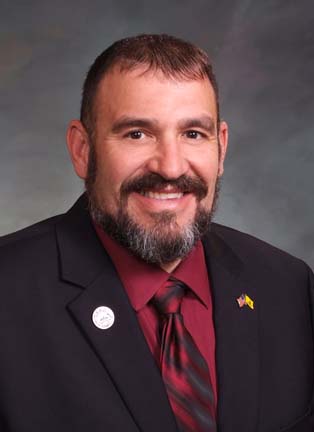
Rep. Ty Winter
Sponsored bills
The act changes terminology related to child prostitution to commercial sexual activity with a child in the crimes of soliciting for child prostitution, pandering of a child, keeping a place of child prostitution, pimping a child, inducement of child prostitution, and patronizing a prostituted child, including changing the name of the offenses for soliciting for child prostitution, keeping a place of child prostitution, inducement of child prostitution, and patronizing a prostituted child. A court is required to sentence an offender convicted of one of the listed offenses, other than soliciting for commercial sexual activity with a child, to at least the minimum of the presumptive range for the level of offense associated with the crime. For an offense of soliciting for commercial sexual activity with a child, if the court sentences the person to probation, the court shall order as a condition of probation that the person serve 364 days in the county jail. In the crime of soliciting for commercial sexual activity with a child, the act adds knowingly soliciting a child for commercial sexual activity as a means of committing the offense and requires that when arranging or offering to arrange a meeting, the offender must know that meeting will facilitate commercial sexual activity with a child. The act removes the spousal exception from the crime of engaging in commercial sexual activity with a child. The act makes the penalty for internet luring of a child a class 3 felony when the offense is committed with the intent to meet for the purpose of engaging in commercial sexual activity. In this circumstance, a court is required to sentence the offender to at least the minimum of the presumptive range for the class 3 felony.(Note: This summary applies to this bill as enacted.)
The act creates the 'Colorado Mandatory Lethality Assessment Act', which requires peace officers to conduct a lethality assessment when responding to a domestic violence incident and include the completed lethality assessment in the incident report. A peace officer is not required to administer a lethality assessment if a victim is unavailable, not at the scene, incapacitated, or if circumstances otherwise make the administration of the lethality assessment impossible or impracticable. If the lethality assessment indicates that an individual is a high-risk victim, or if the lethality assessment does not indicate a victim is high-risk but a peace officer determines an individual is a high-risk victim based on the totality of the circumstances, the peace officer is required to immediately contact a community-based victim's advocate either by phone or in person and provide the high-risk victim the opportunity to speak with the advocate. The act requires the attorney general's office, in consultation with a Colorado-based coalition that advocates for survivors of domestic violence, to develop a mandatory training for peace officers to learn how to administer the lethality assessment and provide victim referrals. No later than June 1, 2027, the attorney general is required to make the training available and offer assistance to law enforcement agencies in providing the training. Beginning July 1, 2027, the act requires each law enforcement agency to ensure that each peace officer employed by the agency has completed the mandatory training; except that a law enforcement agency that has provided training on the administration of lethality assessments prior to July 1, 2027, is not required to provide additional training. Beginning January 2028, and each January thereafter, the act requires the attorney general's office to report to the general assembly certain information related to lethality assessments conducted in the previous calendar year. No later than January 31, 2030, the domestic violence fatality review board shall evaluate the effectiveness of mandatory lethality assessments and referrals to resources and submit the evaluation to the general assembly. The act does not impose criminal, administrative, or civil liability on any person for an act or omission made in good faith related to administering a lethality assessment.(Note: This summary applies to this bill as enacted.)
For purposes of the 'Victim Rights Act', the act prohibits a defendant or alleged offender in the underlying case from being the 'lawful representative' of a victim or the victim's designee if the victim is a child or an at-risk adult. The act creates new rights for a victim under the 'Victim Rights Act', including the right to:Be notified by the district attorney if the district attorney receives a notice that a crime laboratory employee engaged in a wrongful action that includes a crime against the victim and a notice that an evidentiary hearing on post-conviction petition for relief is held;Request to be referred to by an abbreviation, pseudonym, initials, or another preferred name during hearings; andBe heard at a restitution assessment hearing.(Note: This summary applies to this bill as enacted.)
The act defines 'first responder' to include:A peace officer;A firefighter;A volunteer firefighter;An emergency medical service provider; orA mental health professional who responds in a professional capacity to a justifiable medical emergency. Existing law requires the emergency medical and trauma services advisory council (council) to review and approve new rules and modifications to rules prior to the adoption of such rules or modifications by the state board of health. The act requires the council to make recommendations for, instead of approve, rules and modifications to rules concerning emergency medical and trauma services prior to the adoption of such rules or modifications by the state board of health. Beginning January 1, 2027, the act requires the department of health care policy and financing (state department) to reimburse the following entities under the 'Colorado Medical Assistance Act':An ambulance service for ground transportation by an ambulance or other vehicle to a hospital or other destination as deemed appropriate by the ambulance service's medical director;An ambulance service for treatment on the scene of a medical emergency, which treatment does not result in ground transportation; andA qualified provider, an ambulance service, or an agency for evaluation by telemedicine of a person being treated by an ambulance service or an agency for the purpose of preventing the need to transport the person to a hospital.(Note: This summary applies to this bill as enacted.)
In current law, a person who is a member of the Colorado National Guard who is accepted for enrollment at a designated institution of higher education (member) has all their tuition costs waived. All tuition waiver costs are currently funded by the state from money in the Colorado National Guard tuition fund. The act changes the funding mechanism of the Colorado National Guard tuition waiver program by requiring each designated institution of higher education to waive the remaining balance of a member's tuition cost in excess of the amount of any private, state, or federal financial assistance received. The act requires the department of military and veterans affairs to reimburse each institution for 50% of the cost of tuition waived by the institution and requires the general assembly to appropriate money to the Colorado National Guard tuition fund to cover the reimbursement.(Note: This summary applies to this bill as enacted.)
The act requires a volunteer lobbyist to register and file a registration statement attesting they are not being compensated. The act exempts volunteer lobbyists from registration fees. The act provides that the judicial department may designate one individual for the judicial department and one individual for each independent agency in the judicial department who may lobby on behalf of the judicial department or an independent agency in the judicial department (judicial lobbyist). A person designated by a principal executive department to be responsible for lobbying a state official or employee on behalf of the department (legislative liaison), a judicial lobbyist, or an individual who lobbies on behalf of the offices of the governor or lieutenant governor as a member of the governor's cabinet or as a personal staff employee in the offices of the governor or the lieutenant governor (governor's lobbyist) must register with the secretary of state annually. In addition to annually registering with the secretary of state, a legislative liaison, judicial lobbyist, or a governor's lobbyist must file a monthly disclosure statement with the secretary of state (disclosure statement). The act provides that a legislative liaison, judicial lobbyist, or a governor's lobbyist must indicate on the disclosure statement the bill number of any legislation for which they have lobbied or will lobby a covered official and their position regarding the legislation. The legislative liaison, judicial lobbyist, or a governor's lobbyist must update their position on the disclosure statement within 72 hours of a change in position. The act prohibits a statewide elected official or member of the general assembly from being a legislative liaison or governor's lobbyist for a period of 2 years following vacation of office. $91,000 is appropriated from the department of state cash fund to the department of state.(Note: This summary applies to this bill as enacted.)
The act requires a water right owner that changes the use of their water right in water division 2 from agricultural irrigation purposes to another beneficial use on or after January 1, 2027, to engage in revegetation or a conversion to dryland farming with effective erosion control and weed management on the formerly irrigated agricultural land. The act implements a procedure that includes:The identification of site-specific criteria and an associated scientific and objective evaluation methodology to measure and determine the success of the revegetation or conversion to dryland farming;A requirement that the water court appoint a third-party revegetation or dryland farming expert to conduct annual field reviews and issue reports concerning the success of the revegetation or conversion to dryland farming until the revegetation or conversion is successfully established; andA requirement that the water court:Order the water right owner to provide financial assurance to the local land use authority to cover the anticipated cost to achieve successful revegetation;Place limitations on the timing of use or percentage of the water that may be used for the new beneficial use during the revegetation or conversion to dryland farming process; orIf the water right owner has obtained a permit or entered into an intergovernmental agreement that requires financial assurance or establishes requirements governing the timing of use or percentage of the water that may be used for the new beneficial use, incorporate those requirements into the change-of-use decree.(Note: This summary applies to this bill as enacted.)
If certain conditions are met, the act requires health benefit plans that provide hospital, surgical, or medical expense insurance to provide reimbursement for health-care services provided by a pharmacist that are within the pharmacist's scope of practice without entering into a collaborative pharmacy practice agreement. Similarly, under the medical assistance program (medicaid), the act authorizes reimbursement for services that are within a pharmacist's scope of practice and not duplicative of other pharmacist services or programs reimbursed by medicaid. Further, solely on the basis of the type of license or certification, a health benefit plan or health insurance company (carrier) shall not discriminate against a pharmacist who is acting within the scope of the pharmacist's license or certification under state law, with respect to participation, referral, reimbursement of covered services, or indemnification, or prohibit a pharmacist from membership in a provider network; except that, in selecting pharmacist providers, the act does not:Prohibit a health benefit plan or carrier from including providers in its provider network only to the extent necessary to meet the needs of the plan or from limiting referrals or establishing quality control measures;Require a health benefit plan or carrier to contract with any provider willing to abide by the terms and conditions for participation established by the health benefit plan or carrier; orRequire coverage for any health-care service that is not otherwise covered. The act makes changes to the definitions in the pharmacy practice statutes to include a definition for 'final product verification'. For drug, device, or product orders that are not for controlled substances, final product verification may be delegated by a supervising pharmacist to a certified pharmacy technician or pharmacy intern. A pharmacy or other outlet shall have a continuous quality assessment system in place to periodically verify the accuracy of the final drug, device, or product and must create a plan for final product verification, including how pharmacists' hours will be maintained to provide direct patient care. The state board of pharmacy is required to adopt rules relating to final product verification no later than December 31, 2026. Under current law, a pharmacist may administer certain tests to patients who are 12 years old or older for certain conditions and prescribe drugs to treat the tested conditions. The act adds to the definition of the 'practice of pharmacy' independent prescriptive authority for drugs that are not controlled substances, drug categories, or devices that are prescribed to patients who are 5 years old or older but under 12 years old for conditions that do not require a new diagnosis, that are minor and self-limiting, or that have a test that guides diagnosis and are not medications that may only be prescribed pursuant to a certified education program and a limited distribution network. If a pharmacist tests or treats any patient who is under 18 years old, the act requires a pharmacist to notify the patient's primary care provider consistent with health-care privacy laws or, if the patient does not have or disclose a primary care provider, refer the patient to a primary care provider for further care.(Note: This summary applies to this bill as enacted.)
The act appropriates the following amounts for the 2026-27 state fiscal year from the Colorado water conservation board (CWCB) construction fund to the CWCB or the division of water resources in the department of natural resources for the following projects:Continuation of the satellite monitoring system, $380,000 (section 1 of the act);Continuation of the floodplain map modernization program, $500,000 (section 2);Continuation of the weather modification permitting program, $500,000 (section 3);Continuation of the Colorado Mesonet project, $200,000 (section 5);Continuation of the water forecasting partnership project, $2,500,000 (section 6);Continuation of Colorado decision support system operation and maintenance, $750,000 (section 7);Support for water plan agency actions, $1,350,000 (section 9);Continuation of the Colorado watershed restoration and flood mitigation projects, $5,000,000 (section 10); andContinuation of the upper Colorado river commission planning, $750,000 (section 11). Section 4 directs the state treasurer to transfer up to $6,000,000 from the CWCB construction fund to the CWCB litigation fund on or before July 1, 2026. Section 8 restores the fish and wildlife resources fund balance by transferring $2,000,000 from the CWCB construction fund to the fish and wildlife resources fund. Section 12 authorizes the CWCB to make a loan in an amount of $151,500,000 from the severance tax perpetual base fund to the city of Fort Collins to support the Halligan water supply project. Section 13 authorizes the CWCB to make a loan in an amount of $20,166,670 from the severance tax perpetual base fund to the Lower Latham Reservoir Company for the Jurgens reservoir construction project. Section 14 appropriates $37,700,000 from the water plan implementation cash fund to the CWCB to award grants that will help implement the state water plan. Section 15 clarifies that the money that is currently in the turf replacement fund is appropriated for designated purposes to the CWCB until June 30, 2028. Any money remaining in the turf replacement fund on July 1, 2028, is transferred to the CWCB construction fund. Section 16 makes technical corrections so that money appropriated in 2025 is available to the department of natural resources executive director's office for the purpose of paying for a study by the Colorado water center at Colorado state university. Under current law, the CWCB may authorize loans up to $10 million from the CWCB construction fund or severance tax perpetual base fund without legislative authorization. The act increases that amount to $30 million (section 17).(Note: This summary applies to this bill as enacted.)