Maddy summaryThis bill clarifies that the federal Consumer Financial Protection Bureau (CFPB) cannot enforce its rules on insurance companies regulated by state insurance departments when those companies are engaged in insurance activities. It directly affects insurance companies operating under state regulation by limiting the CFPB's authority over their insurance-related business. The key provision amends federal law to state that the CFPB may not enforce its rules regarding insurance business, and requires federal enforcement of related laws to be narrowly construed when insurance is involved. A new rule of construction explicitly favors state insurance regulators' authority over such companies.
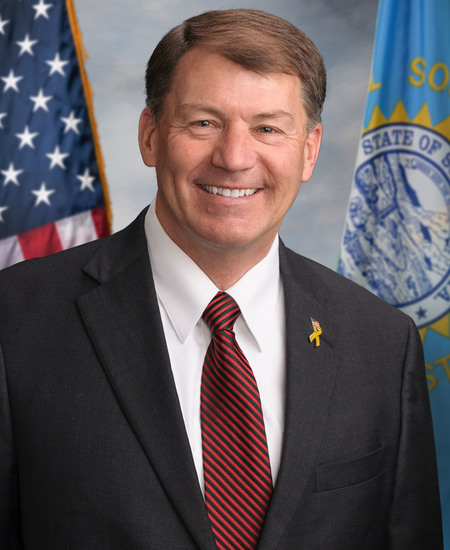
Sen. Mike Rounds
Sponsored bills
Halt All Lethal Trafficking of Fentanyl Act or the HALT Fentanyl Act This act permanently places fentanyl-related substances as a class into schedule I of the Controlled Substances Act. A schedule I controlled substance is a drug, substance, or chemical that has a high potential for abuse; has no currently accepted medical value; and is subject to regulatory controls and administrative, civil, and criminal penalties under the Controlled Substances Act. Under the act, offenses involving fentanyl-related substances are triggered by the same quantity thresholds and subject to the same penalties as offenses involving fentanyl analogues (e.g., offenses involving 100 grams or more trigger a 10-year mandatory minimum prison term). Additionally, the act establishes a new, alternative registration process for certain schedule I research. The act also makes several other changes to registration requirements for conducting research with controlled substances, including permitting a single registration for related research sites in certain circumstances, waiving the requirement for a new inspection in certain situations, and allowing a registered researcher to perform certain manufacturing activities with small quantities of a substance without obtaining a manufacturing registration. Finally, the act expresses the sense that Congress agrees with the interpretation of the Controlled Substances Act in United States v. McCray , a 2018 case decided by the U.S. District Court for the Western District of New York. In that case, the court held that butyryl fentanyl, a controlled substance, can be considered an analogue of fentanyl even though, under the Controlled Substances Act, the term controlled substance analogue specifically excludes a controlled substance.
Maddy summaryThis bill authorizes the minting of commemorative coins for the 2028 Los Angeles Olympic and Paralympic Games and the 2034 Salt Lake City Olympic and Paralympic Winter Games. It specifies four coin types ($5 gold, $1 silver, half-dollar, and proof silver $1) with defined quantities and designs reflecting U.S. athletic participation. A surcharge on each coin sale (e.g., $35 for $5 coins) funds the respective Olympic committees' legacy programs, including youth sports initiatives. The coins are legal tender but intended solely for commemoration, with surcharges directed to the organizing committees after covering minting costs.
Maddy summaryThis bill requires beef products labeled "Product of U.S.A." to be made exclusively from cattle born, raised, and slaughtered entirely within the United States. It creates a new labeling standard under the Federal Meat Inspection Act, applying to all beef sold domestically. The rule does not apply to beef intended for export to foreign countries. This directly affects beef producers, processors, and retailers who market products with this specific label.
Maddy summaryThe Reducing Homelessness Through Program Reform Act amends the McKinney-Vento Homeless Assistance Act to reform key HUD homeless assistance programs. Key provisions include increasing administrative costs for Emergency Solutions Grants from 7.5% to 10%, establishing 2-year funding cycles for Continuum of Care programs with renewal options, and allowing housing choice vouchers to cover security deposits and holding fees. The bill also creates an Advisory Committee on Homelessness with lived experience members and requires improved coordination between healthcare systems and homeless services. These changes aim to streamline service delivery, reduce administrative barriers, and better serve people experiencing or at risk of homelessness.
Maddy summaryS 2227, the SPIES Act, removes time limits for prosecuting specific espionage-related offenses under federal law. It eliminates statutes of limitations for violations of sections 951 (espionage), 794 (procurement of citizenship unlawfully), or 1425 (harboring persons to facilitate espionage), as long as the 1425 violation was used to aid a 951 offense. This change directly affects federal prosecutors, who can now bring charges for these crimes at any time, and individuals accused of such offenses. The bill amends Title 18 of the U.S. Code to add "Espionage offenses" as section 3302, clarifying the scope of these time-free prosecutions. It does not alter the definitions of the underlying crimes but changes the procedural timeline for their prosecution.
Maddy summaryThis bill reorganizes the U.S. Intelligence Community by transferring several centers to different agencies, reducing staff size for the Office of the Director of National Intelligence, and eliminating various positions and units. Key changes include moving the National Counterintelligence Center to the FBI, redesignating the National Counterterrorism Center as the National Counterterrorism and Counternarcotics Center, and terminating the National Intelligence University. The bill also restricts funding for certain entities and prohibits intelligence community diversity, equity, and inclusion programs that could be considered discriminatory. These changes aim to streamline operations, reduce bureaucracy, and refocus intelligence efforts on core national security priorities. The bill directly affects the intelligence community's structure, staffing, and operational focus, with implementation dates ranging from 30 days to 180 days after enactment.
Maddy summaryThis bill prohibits using automatic dependent surveillance-broadcast (ADS-B) data to identify aircraft for charging fees or assessments. It also restricts air traffic controllers from using ADS-B data except for safety purposes or with public input for other uses. For airports charging general aviation aircraft (personal/recreational flights, not commercial airlines) landing or takeoff fees, the bill requires public disclosure of how fees will fund only airside safety projects, efforts to reduce other costs, and assessments of impacts on local aviation. The law applies to airport operators, the FAA, and government agencies handling aircraft data. It aims to prevent misuse of tracking data and ensure fee transparency for general aviation users.
Maddy summaryThis bill changes tax rules to help intelligence community employees who relocate for work. It allows these employees (excluding military members) to deduct moving expenses and exclude relocation reimbursements from taxable income when moving due to a required assignment change. The key change modifies two sections of the tax code to treat intelligence community relocations similarly to other federal employee moves. This directly affects current or new intelligence community staff who must move for mission-critical assignments. The policy aims to reduce tax burdens when these employees relocate for work.
Maddy summaryThis bill requires the Committee on Foreign Investment in the United States (CFIUS) to maintain and annually update a list of U.S. government facilities and property considered sensitive for national security - such as intelligence sites and National Laboratories. It mandates that each CFIUS committee member review their agency’s properties on this list each year by January 31 and submit recommended updates to the chairperson after agency approval. The committee must also report annually on all real estate transactions reviewed under this list, including completed reviews and any classified briefings requested by Congress. This formalizes an existing process into a structured annual requirement, directly affecting federal agencies and CFIUS oversight of foreign investments involving sensitive government sites.