National Right-to-Work Act This bill repeals those provisions of the National Labor Relations Act and the Railway Labor Act that permit employers to make an agreement with a labor union to require employees to join such union as a condition of employment. Currently, at least 27 states have enacted laws prohibiting employers from compelling employees to become members of a union as a condition of employment.
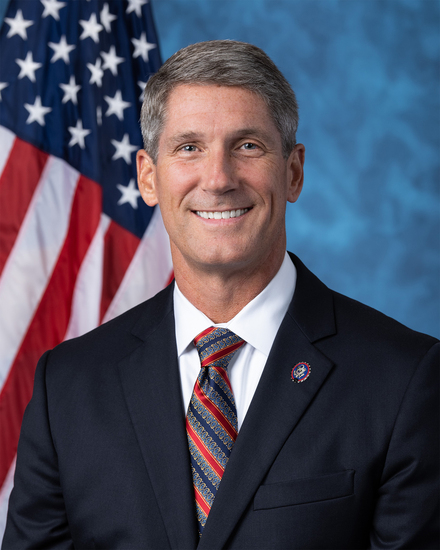
Rep. Scott Franklin
Sponsored bills
Fair and Open Competition Act or the FOCA Act This bill prohibits federal construction contracts or controlling documents for federally supported construction projects from requiring or prohibiting project labor agreements. Such documents also may not discriminate against or give preference to a bidder or contractor who signs or refuses to sign a project labor agreement. An agency may exempt a project from this prohibition to avert an imminent threat to public health or safety or to serve the national security.
American Innovation and R&D Competitiveness Act of 2021 This bill eliminates the five-year amortization requirement for research and experimental expenditures scheduled to begin in 2022, thus allowing continued expensing of such expenditures in the taxable years in which they are incurred.
Iran Hostages Congressional Gold Medal Act This bill requires the Speaker of the House of Representatives and the President pro tempore of the Senate to arrange for the award of a Congressional Gold Medal commemorating the bravery and endurance of the 53 hostages of the Iran Hostage Crisis. Following its award, the medal shall be given to the National Museum of American History of the Smithsonian Institution for display and research. The Department of the Treasury must strike duplicate medals in silver for presentation to a hostage (or the personal representative of a deceased hostage), and Treasury may also strike and sell duplicate medals in bronze.
Improving Confidence in Veterans' Care Act This bill prescribes oversight requirements for the Department of Veterans Affairs (VA) regarding health care professionals at VA medical centers. Specifically, the bill requires the VA to ensure each VA medical center consistently compiles, verifies, and reviews specified documentation for each VA health care professional (including contractors). The VA shall ensure that specified health care professionals hold an active Drug Enforcement Administration registration. Each VA medical center must implement (1) monitoring of the performance and quality of the health care delivered by each health care professional at the center, and (2) reviews of such care if an individual notifies the VA of any potential concerns relating to a failure to meet generally accepted standards of clinical practice. The bill imposes notification requirements in situations where the VA substantiates a concern relating to the clinical competency of, or quality of care delivered by, a current or former VA health care professional. The VA is prohibited from entering into a settlement agreement relating to an adverse action against a VA health care professional if such agreement includes terms that require the VA to conceal certain information from the employee's personnel file. Such prohibition does not apply to adverse actions determined to be prohibited personnel practices. The VA must provide mandatory training, at least biannually, to employees of each medical center who are responsible for specified tasks (e.g., those who are responsible for compiling, validating, or reviewing the credentials of VA health care professionals).
This resolution requests that the President transmit to the House of Representatives documents related to the amount of funding that was provided in specified laws regarding COVID-19 (i.e., coronavirus disease 2019) and is currently unspent. The specified laws include the Coronavirus Preparedness and Response Supplemental Appropriations Act, 2020; the Families First Coronavirus Response Act; the Coronavirus Aid, Relief, and Economic Security Act (CARES Act); the Paycheck Protection Program and Health Care Enhancement Act; and Division N of the Consolidated Appropriations Act, 2021.
No Social Security for Illegal Aliens Act of 2021 This bill prohibits an individual from collecting Social Security benefits based on wages and income earned for services illegally performed in the United States while the individual was an alien.
Education Freedom Scholarships and Opportunity Act This bill allows individual and corporate taxpayers a tax credit for cash contributions to tax-exempt scholarship-granting organizations for elementary and secondary education expenses. It imposes a cap of $5 billion on the amount of contributions that qualify for a tax credit. The bill directs the Department of Education, in coordination with the Department of the Treasury, to establish, host, and maintain a web portal that (1) lists all eligible scholarship-granting organizations; (2) enables contributions to such organizations; (3) provides information about the benefits of this bill; and (4) enables a state to submit and update information about its programs and scholarship-granting organizations, including information on student eligibility and allowable educational expenses.
United States-Israel PTSD Collaborative Research Act This bill establishes a grant program for collaborative efforts between the United States and Israel to advance research on post-traumatic stress disorders. The Department of Defense, in coordination with the Department of Veterans Affairs and the Department of State, shall award grants to eligible academic institutions or nonprofit entities in the United States. Work shall be conducted by the eligible entity and an entity in Israel under a joint research agreement.
Free Speech Fairness Act This bill permits a tax-exempt organization to make certain statements related to a political campaign without losing its tax-exempt status. An organization may not lose its tax-exempt status under section 501(c)(3) of the Internal Revenue Code or be deemed to have participated in, or intervened in any political campaign on behalf of (or in opposition to) any candidate for public office, solely because of the content of any statement that (1) is made in the ordinary course of the organization's regular and customary activities in carrying out its exempt purpose, and (2) results in the organization incurring not more than de minimis incremental expenses.