Maddy summaryThis bill, S 1613 (Tax Relief for New Businesses Act), simplifies tax deductions for new businesses forming corporations or partnerships. It combines "start-up" and "organizational" expenses into one deductible category, increasing the annual deduction limit from $5,000 to $50,000 (and the phaseout threshold from $50,000 to $150,000). It also creates special rules allowing new businesses to treat start-up/organizational losses separately when calculating net operating loss carryforwards, with more favorable tax treatment for these losses. The changes apply to expenses paid or incurred in taxable years beginning after December 31, 2025.
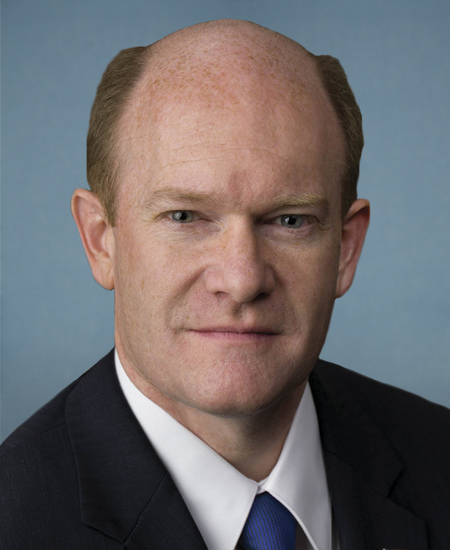
Sen. Christopher A. Coons
Sponsored bills
Maddy summaryS 1609, "Ellie’s Law," authorizes $10 million annually (2026-2030) for the National Institute of Neurological Disorders and Stroke to fund comprehensive research on unruptured brain aneurysms. The bill directly affects patients - particularly women, African Americans, and Hispanic individuals who face higher rupture risks - and medical researchers studying prevention and treatment. Key provisions require the research to diversify study populations by age, sex, and race, while ensuring new funds supplement, not replace, existing brain aneurysm research funding. This addresses a critical gap, as current federal spending averages just $2.94 per patient annually despite the condition affecting 6.8 million people and costing $2 billion yearly in direct medical expenses.
Maddy summaryS 1611 expands a federal grant program to fund research-based public service announcement (PSA) campaigns targeting youth substance use prevention. The bill adds a new grant category allowing funding for TV, radio, digital, and youth-submitted PSA contests using age-appropriate materials. Grantees (like schools or community groups) must report annually on campaign details, research used, regional messaging, alignment with other prevention efforts, and campaign effectiveness in reducing youth drug use. The Attorney General oversees this program and publishes annual reports on all funded campaigns.
Maddy summarySRES 201 is a non-binding Senate resolution designating the week of May 4-10, 2025, as "National Small Business Week." It honors small businesses and entrepreneurs across all U.S. communities for their economic contributions, citing that small businesses support over 59 million jobs. The resolution recognizes their resilience and celebrates their role in strengthening local economies. This symbolic gesture, consistent with annual presidential proclamations since 1963, does not create new laws or affect any specific group through policy changes.
Maddy summaryThis Senate resolution (SRES 204) symbolically recognizes global threats to press freedom, including violence against journalists in conflict zones and under authoritarian regimes. It reaffirms the U.S. government’s commitment to press freedom as a priority for promoting democracy and human rights, specifically commemorating World Press Freedom Day on May 3, 2025. The resolution does not create new laws or policies but expresses support for journalists worldwide and calls on the President and Secretary of State to advance press freedom efforts. It highlights documented risks like journalist killings (124 globally in 2024) and imprisonment (361 in 2024), emphasizing press freedom’s role in accountability and informed societies. As a non-binding resolution, it focuses on diplomatic reaffirmation rather than concrete legislative action.
Maddy summaryThe Captive Primate Safety Act bans the import, export, sale, transport, breeding, or possession of specific nonhuman primates - including chimpanzees, gorillas, orangutans, and their hybrids - in interstate or foreign commerce. It directly affects individuals, businesses, and facilities involved in trading or owning these primates, with exceptions for pre-existing owners who register animals with the Fish and Wildlife Service within 180 days and agree to no breeding, sales, or public contact. Research facilities with valid Department of Agriculture registrations may continue using these primates for research. The law requires the Secretary of the Interior to issue implementing regulations within 180 days, but the prohibitions take effect immediately regardless of regulation timing.
Maddy summaryThis Senate resolution expresses formal support and appreciation for Romania and Moldova's efforts to defend democracy and counter Russian interference in eastern Europe. It specifically recognizes Romania's NATO leadership, defense spending, and aid to Ukraine, as well as Moldova's EU accession progress and humanitarian support for Ukraine. The resolution condemns Russian tactics like cyber operations, energy weaponization, and election interference, and urges the U.S. and international community to strengthen security and election integrity support ahead of Romania's May 2025 presidential and Moldova's September 2025 parliamentary elections. As a symbolic gesture, it does not create new laws or funding but reinforces diplomatic backing for these nations' democratic resilience.
Maddy summaryThe Patent Eligibility Restoration Act of 2025 clarifies patent eligibility under U.S. law by eliminating judicial exceptions to Section 101 of the Patent Code. It makes most inventions eligible for patents unless they fall into specific excluded categories: mathematical formulas not tied to a practical invention, mental processes, unmodified human genes or natural materials, or purely economic/business processes (unless requiring machine use). This directly affects inventors, patent applicants, and courts by restoring clear eligibility rules after years of judicial confusion. The bill ensures business method patents remain eligible if they require practical machine implementation, while maintaining existing requirements for novelty and non-obviousness under Sections 102, 103, and 112.
Maddy summaryThe PREVAIL Act (S 1553) aims to improve the U.S. patent system by making patent review processes more efficient and fair. It requires 3-member panels for patent reviews at the Patent Trial and Appeal Board, establishes a code of conduct for board members, and prevents repetitive patent challenges by creating a "single forum" for patent validity disputes. The bill also clarifies who counts as a "real party in interest" to stop strategic filings, changes the burden of proof in patent reviews to require "clear and convincing evidence" for unpatentability, and ensures patent fees are properly used for patent-related activities through a new Innovation Promotion Fund. These changes directly affect patent owners, patent challengers, and the U.S. Patent and Trademark Office (USPTO).
Maddy summaryThis bill establishes uniform standards for electronic and remote notarizations across state lines. It requires notaries to use communication technology for remote notarizations, verify identities through two methods (like ID checks or witness testimony), and create audio-visual recordings of the process. The law ensures courts and states recognize valid remote notarizations performed under these rules, treating them as equivalent to in-person notarizations. It explicitly preserves state authority over notary practices and does not force notaries to offer remote services.