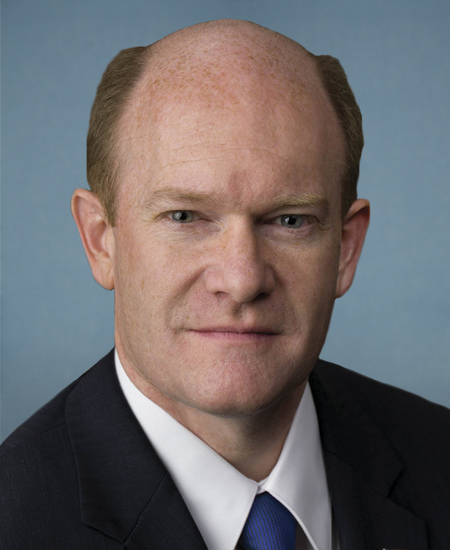
Photo of Christopher A. Coons
D United States Senate · Delaware On the 2026 ballot

Sen. Christopher A. Coons

Compare
Total votes
1,044
all sessions
Attendance
96%
37 missed
Lower than 83% of chamber peers
With party
98%
of cast votes
Near the chamber average
Bipartisan score
2%
crosses aisle rarely
Near the chamber average
Sponsored
1,692
bills & resolutions
Higher than 89% of chamber peers
Committees
19
assignments
1,692 bills and resolutions

Sponsored bills

Total
1,692
Primary
218
Co-sponsor
1,474
This page
1,692
matching current filters
Co-sponsor S 1736
In committee · Utah Senate · Co-sponsor
Improving Training for School Food Service Workers Act of 2025

Improving Training for School Food Service Workers Act of 2025  This bill adds requirements regarding the availability of training that the Department of Agriculture provides under current law for local food service personnel in schools.   The training must be scheduled during regular, paid working hours; provided at no cost to food service personnel; offered in-person whenever appropriate; and incorporate experiential learning. If the training is scheduled outside of working hours, food service personnel must be informed about the necessity of scheduling the program, consulted to schedule the program, and compensated for attending the program. Personnel may not be penalized for failing to attend a program outside of working hours.

In committee May 13, 2025 1 co-sponsor
Co-sponsor S 1739
In committee · Utah Senate · Co-sponsor
International Nuclear Energy Financing Act of 2025

Maddy summaryThis bill directs U.S. representatives at multilateral banks (like the World Bank and European Bank for Reconstruction and Development) to advocate for removing restrictions on financing nuclear energy projects that meet U.S. or allied quality standards. It establishes "Nuclear Energy Assistance Trust Funds" at these banks to provide competitive financial and technical support for nuclear projects in borrowing countries, specifically countering non-U.S. financing. The bill applies to countries seeking nuclear energy development and requires annual progress reports for seven years. It includes a 10-year sunset provision, ending all provisions after 2035.

In committee May 13, 2025 1 co-sponsor
Co-sponsor S 1716
In committee · Utah Senate · Co-sponsor
Vision Lab Choice Act of 2025

Maddy summaryThis bill, S 1716 (Vision Lab Choice Act of 2025), modifies vision care coverage under health plans by limiting agreements between optometrists and vision plans to two-year terms (with possible two-year extensions) and prohibiting plans from restricting optometrists' choices of labs or suppliers for patient vision care. It directly affects optometrists and health insurance issuers offering limited-scope vision benefits, ensuring they cannot force optometrists to use specific labs or materials. The bill requires annual state enforcement notifications by the Secretary and clarifies that state laws governing vision plans take precedence if they conflict with this law. It does not change overall coverage requirements but focuses on provider choice and contract terms within vision benefit plans.

In committee May 12, 2025 1 co-sponsor
Co-sponsor S 1705
In committee · Utah Senate · Co-sponsor
Chip Security Act

Maddy summaryS 1705, the Chip Security Act, requires U.S. companies exporting specific advanced integrated circuits (used in AI systems and high-performance computing) to install location verification technology before shipping them abroad. It directly affects manufacturers and exporters of chips classified under U.S. export control numbers like 3A090 or 4A090. The bill mandates that these chips include security mechanisms to verify their location and prevent diversion or tampering, with companies needing to report suspicious activity like unauthorized location changes. The Commerce Secretary must implement these requirements within 180 days and conduct annual assessments to update security standards. This aims to strengthen compliance with export laws and protect national security by securing chip supply chains.

In committee May 8, 2025 1 co-sponsor
Co-sponsor S 1686
In committee · Utah Senate · Co-sponsor
Neighborhood Homes Investment Act

Maddy summaryThe Neighborhood Homes Investment Act creates a new tax credit to increase affordable homeownership in distressed communities by closing financing gaps. It allows developers to claim a credit equal to the difference between development costs and affordable sale prices, capped at 40% of development costs or 32% of the national median home price. To qualify, homes must be sold to individuals with incomes at or below 140% of area median income in designated distressed census tracts, with specific requirements for rehabilitation and affordability. The credit is designed to address housing shortages in low-income areas while requiring repayment if homes are resold within five years.

In committee May 8, 2025 1 co-sponsor
Co-sponsor S 1639
In committee · Utah Senate · Co-sponsor
American Innovation and Jobs Act

Maddy summaryThis bill allows businesses to immediately deduct research and development (R&D) costs instead of spreading them over 60 months, directly benefiting companies investing in innovation. It increases the refundable R&D credit cap for small businesses from $250,000 to $750,000 over time, with specific phase-in amounts starting in 2025. Additionally, it expands access for startups by raising the gross receipts threshold for eligibility from $5 million to $15 million and increasing credit rates for qualified small businesses. These changes aim to make R&D tax incentives more accessible and valuable for smaller companies and new ventures.

In committee May 7, 2025 1 co-sponsor
Co-sponsor S 1664
In committee · Utah Senate · Co-sponsor
RESEARCHER Act

Maddy summaryThe RESEARCHER Act (S 1664) requires federal research agencies to develop guidelines addressing financial instability for graduate students and postdoctoral researchers at universities receiving federal funding. It mandates agencies to establish policies - within 6 months of enactment - to increase stipends (including location-based indexing), improve access to healthcare, housing, childcare, and reduce food insecurity for these researchers. The bill also requires collecting demographic data on researcher finances and directs the National Academies to assess financial challenges, including costs for housing, healthcare, and childcare, over the past five years. Agencies must report progress to Congress annually for the first year and every five years thereafter, with a Government Accountability Office review due within three years.

In committee May 7, 2025 1 co-sponsor
Co-sponsor S 1642
In committee · Utah Senate · Co-sponsor
SEMI Investment Act

Maddy summaryThe SEMI Investment Act expands a federal tax credit for businesses investing in semiconductor manufacturing facilities. It defines qualifying facilities as those primarily producing semiconductors, semiconductor equipment, or semiconductor materials - including both direct materials (like silicon substrates physically incorporated into chips) and indirect materials (such as chemicals and equipment used in manufacturing but not in the final product). The bill requires the Treasury Department, in consultation with Commerce, to publish a list of qualifying materials within 180 days of enactment and allows companies to petition for material inclusions not on the list. This credit applies to property placed in service after the bill's enactment, aiming to incentivize domestic semiconductor supply chain investment.

In committee May 7, 2025 1 co-sponsor
Co-sponsor S 1663
In committee · Utah Senate · Co-sponsor
Therapeutic Fraud Prevention Act of 2025

Maddy summaryThis bill bans the commercial provision of conversion therapy - defined as paid attempts to change a person's sexual orientation or gender identity - as it is deemed ineffective and harmful. It directly affects therapists, clinics, and any commercial entity offering such services, while exempting gender transition support and non-discriminatory counseling. Key mechanisms include prohibiting paid conversion therapy, banning deceptive advertising (e.g., claiming it’s harmless), and empowering the Federal Trade Commission and state attorneys general to enforce penalties. The law focuses on preventing fraud by stopping profit-driven practices with no scientific basis, aligning with professional consensus on the risks.

In committee May 7, 2025 1 co-sponsor
Primary S 1660
In committee · Utah Senate · Lead sponsor
Research Advancing to Market Production for Innovators Act

Maddy summaryS 1660, the Research Advancing to Market Production for Innovators Act, improves the Small Business Innovation Research (SBIR) and Small Business Technology Transfer (STTR) programs to help small businesses commercialize federally funded research. It requires federal agencies to include commercialization potential in peer reviews (adding specialized reviewers), creates a dedicated Technology Commercialization Official role in each agency, and expands funding for business/technical assistance (including cybersecurity support) for grant recipients. The bill also mandates annual commercialization impact reports tracking metrics like post-award revenue, patents, and Phase III contract success for businesses receiving multiple Phase II awards. These changes directly affect small businesses receiving SBIR/STTR grants and the federal agencies administering these programs.

In committee May 7, 2025 0 co-sponsors
Showing 461 to 470 of 1,692 bills
Previous 1 … 46 47 48 … 170 Next