Maddy summarySRES 237 is a ceremonial Senate resolution honoring Army Staff Sgt. Jose Dueñez Jr., Staff Sgt. Edvin Franco, Staff Sgt. Troy Knutson-Collins, and Pfc. Dante Taitano, who died during a vehicle recovery mission in Lithuania while supporting a NATO training exercise. The resolution expresses the Senate’s gratitude for their service, acknowledges the multinational recovery effort involving U.S., Lithuanian, Polish, and Estonian personnel, and reaffirms commitment to NATO deterrence in the Baltic region. It has no policy impact - it solely commemorates the soldiers’ sacrifice and their role in a U.S.-led NATO mission.
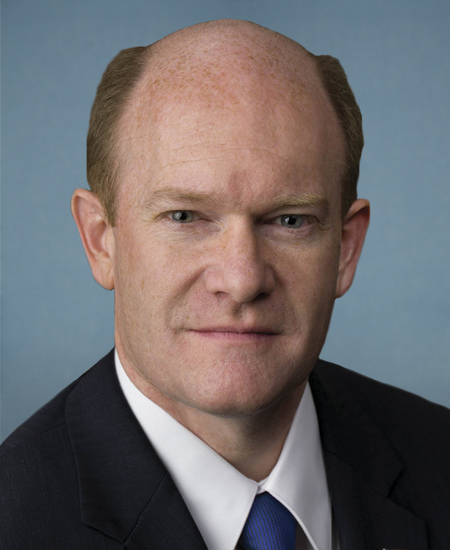
Sen. Christopher A. Coons
Sponsored bills
Maddy summaryThe Supreme Court Ethics, Recusal, and Transparency Act of 2025 would establish a formal code of conduct for Supreme Court justices and require them to disclose gifts and financial interests. It creates procedures for filing complaints about justices' conduct, including a judicial investigation panel to review allegations of misconduct. The bill expands circumstances requiring justices to recuse themselves from cases, such as when they or their family received gifts from parties involved in a case. These provisions aim to increase transparency and accountability in the Supreme Court's operations, with new disclosure requirements for parties and amici curiae in court cases.
Maddy summaryThis bill requires Medicare Advantage plans to implement electronic prior authorization systems by 2028 and report detailed transparency data starting in 2027. Plans must publicly disclose approval/denial rates, average processing times (including for appeals), technology use, and other metrics for covered medical services. It mandates 24-hour response standards for expedited requests and routinely approved services, with data collection to analyze access patterns and potential disparities in rural/low-income communities. These changes directly affect Medicare Advantage plans, providers, and seniors enrolled in these plans by standardizing and increasing visibility into prior authorization processes.
Maddy summaryThis bill creates a federal grant program allowing state, local, tribal, and territorial law enforcement agencies to hire retired officers for specific non-enforcement tasks like crime scene analysis, forensics, cyber investigations, and reviewing evidence. Agencies can use funds to train civilian staff and have retired officers perform these defined tasks, such as analyzing camera footage or providing IT expertise. The program includes accountability measures requiring annual audits by the Justice Department Inspector General, mandatory exclusion of agencies with unresolved audit findings for two years, and priority for applicants with clean audit histories. It directly affects law enforcement agencies seeking to leverage retired officers' skills while preventing misuse of grant funds.
Maddy summaryThe Strong Communities Act of 2025 creates a new federal grant program to fund law enforcement training for officers and recruits. Local police departments and sheriff's offices can receive grants to send officers to training programs at eligible colleges or police departments, with the requirement that officers serve at least 4 years in their local community after training. To qualify, officers must live within specific distances (7 or 20 miles) of their long-term residence (5+ years) and provide proof of employment. The program requires annual reports to Congress detailing grant recipients, training participants, and retention rates.
Maddy summaryThis bill reauthorizes the PROTECT Our Children Act of 2008 with updated requirements. It mandates a National Strategy for child exploitation prevention to be reviewed every four years (instead of every two), requiring detailed analyses of trends, resource needs, and ICAC task force performance. The bill modifies ICAC task force operations to include prioritizing victim identification, expands coordination with tribal/military agencies, and adds limited liability protections for task forces regarding investigative decisions. It increases annual funding for the program from $70 million (2026) to $90 million (2028), directly affecting federal agencies (DOJ, FBI, ICE), state/local law enforcement, and ICAC task forces nationwide.
Maddy summaryThis bill reauthorizes funding for existing mental health support programs designed to assist law enforcement officers experiencing crisis. It extends the authorization period for these programs from 2020-2024 to 2025-2029 under Section 1001(a)(21) of the 1968 Omnibus Crime Control and Safe Streets Act. The bill directly affects law enforcement officers who access these crisis support services, ensuring continued availability of the established program. It does not create new programs but maintains current funding for existing mental health treatment and support resources for officers.
Maddy summaryThis bill expands benefits for public safety officers (like police and firefighters) who develop certain cancers linked to their work. It creates a presumption that specific cancers - such as lung, bladder, or mesothelioma - were caused by job-related exposure to carcinogens, if the officer served at least 5 years, was diagnosed within 15 years of leaving active duty, and the cancer caused death or permanent disability. The list of covered cancers will be updated every 3 years based on medical evidence from agencies like the National Institute for Occupational Safety and Health. Claims must be filed within 3 years of the bill’s enactment, applying to cases involving deaths or disabilities occurring after January 1, 2020.
Maddy summaryS 180, the Protecting First Responders from Secondary Exposure Act of 2025, requires the federal government to provide training and resources for first responders on using containment devices to prevent accidental exposure to fentanyl and other dangerous substances. It mandates the purchase of these containment devices for first responder use. The bill amends existing law (34 U.S.C. 10701(a)) by adding a new provision (paragraph (4)) that specifically addresses this safety measure. This directly affects police, firefighters, and emergency medical personnel who may encounter fentanyl during their duties. The key mechanism is the federal funding and requirement for both training and procurement of protective equipment.
Maddy summaryThis resolution designates May 29, 2025, as "Mental Health Awareness in Agriculture Day" to raise public awareness about mental health challenges in farming and ranching. It directly affects farmers and farmworkers, who face significantly higher suicide rates (3.5x the general population for farmers, 1.4x for farmworkers) and unique stressors like weather, labor shortages, and market fluctuations. The resolution highlights existing USDA resources like the Farm and Ranch Stress Assistance Network and encourages the public to observe the day to reduce stigma and promote mental well-being in the agricultural workforce. As a ceremonial resolution, it does not create new programs but aims to foster awareness during National Mental Health Awareness Month.