

Maddy summaryThis bill restricts federal law enforcement's use during protests by requiring officers to visibly display their agency and name or rank during crowd control, riot control, or arrests at demonstrations. It limits federal involvement to Federal property or immediate adjacent areas (sidewalks/public streets), with exceptions for written state/local requests or when the Insurrection Act is invoked. The bill also prohibits unmarked vehicles for civilian arrests and mandates public websites publish deployment details within 24 hours, including locations of detained individuals. It makes arrests unlawful if officers violate these identification or location rules. The bill directly affects federal law enforcement officers and military personnel responding to public demonstrations.
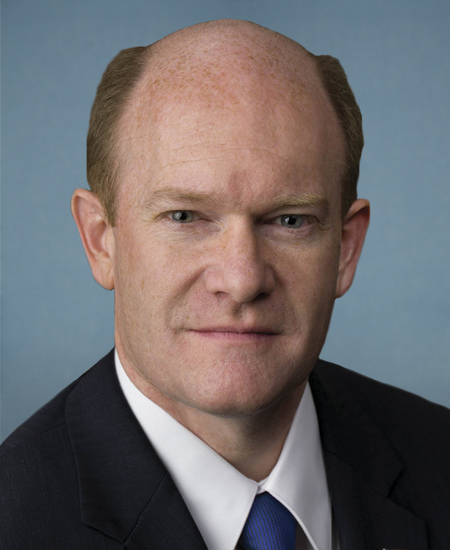
Sen. Christopher A. Coons
Sponsored bills
Maddy summaryThis resolution designates July 2025 as "National Anti-Counterfeiting and Consumer Education and Awareness Month" to highlight the dangers of counterfeit products. It aims to raise public awareness about how fake goods - such as unsafe electronics, pharmaceuticals, and cosmetics - threaten consumer health, safety, and the economy. The Senate resolution does not create new laws or funding but supports existing efforts to educate consumers about identifying and avoiding counterfeit items in both physical and online markets.
Maddy summaryThis bill requires the Department of Homeland Security (DHS) to keep all personal information from DACA applications confidential. It prohibits sharing this data with U.S. Immigration and Customs Enforcement (ICE), U.S. Customs and Border Protection (CBP), or state/local law enforcement for any purpose other than administering the DACA program. Limited exceptions allow sharing only to prevent fraud, address specific national security threats, or investigate felonies unrelated to immigration status. The law directly protects DACA applicants and recipients by preventing their personal details from being used against them by law enforcement.
Maddy summaryThis bill creates a federal grant program to help schools recruit and retain paraprofessionals - school support staff like teaching assistants - who work directly with students but lack full teaching credentials. It allocates funds to states based on prior Title I education funding, requiring states to prioritize schools serving high numbers of low-income students or designated "high-need" schools. Funds can be used for mentoring programs, professional development, credentialing (like special education or English learner certificates), and wage increases or bonuses for paraprofessionals. The program mandates annual reporting on wage baselines, paraprofessional numbers, and how funds were used to address shortages.
Maddy summaryS 2337, the Providing Child Care for Police Officers Act of 2025, establishes a federal grant program to help law enforcement agencies provide child care for the minor children of officers during nontraditional work hours. It allocates $24 million annually from 2026 to 2030 for competitive grants to lead agencies (state or local child care administrators), which will fund child care programs through covered entities like law enforcement agencies or consortia. At least 20% of funds are reserved for small agencies (fewer than 200 officers) or consortia including them, with recipients required to provide increasing matching funds over three years (10%, 25%, and 33.3%). The bill specifies allowable uses of funds, including startup costs, provider training, sick child care, and facilities, and mandates two studies to evaluate program effectiveness after 2 and 4 years.
Maddy summaryThis bill creates a federal program providing child care assistance to working families with children under age 6 through direct child care certificates that parents can use to pay for high-quality child care services. States must develop plans with payment rates covering provider costs and wages, sliding fee scales based on family income (with no copayment for families earning under 85% of state median income), and policies prioritizing vulnerable children including those with disabilities, experiencing homelessness, or from low-income families. The program requires providers to meet quality standards, prohibit suspensions/expulsions, and implement quality improvement activities while ensuring accessibility for underserved populations. It is funded through significant federal appropriations for fiscal years 2026-2031.
Maddy summaryThis bill authorizes the minting of commemorative coins for the 2028 Los Angeles Olympic and Paralympic Games and the 2034 Salt Lake City Olympic and Paralympic Winter Games. It specifies four coin types ($5 gold, $1 silver, half-dollar, and proof silver $1) with defined quantities and designs reflecting U.S. athletic participation. A surcharge on each coin sale (e.g., $35 for $5 coins) funds the respective Olympic committees' legacy programs, including youth sports initiatives. The coins are legal tender but intended solely for commemoration, with surcharges directed to the organizing committees after covering minting costs.
Maddy summaryThis symbolic resolution (SCONRES 16) recognizes the persistent wage gap affecting Black women in the U.S., specifically noting they earn just 66 cents for every dollar paid to White, non-Hispanic men for full-time work. It highlights that Black women face compounded racial and gender-based pay discrimination, with data showing the gap would take over 200 years to close at current rates. The resolution does not create new laws but formally acknowledges the economic impact on Black women - such as lost lifetime earnings and reduced family financial security - and reaffirms congressional support for equal pay principles. It was introduced to coincide with Black Women’s Equal Pay Day (July 10, 2025), using Census and EEOC data to underscore the disparity.
Maddy summaryThe Trafficking Survivors Relief Act of 2025 provides a legal process for survivors of human trafficking who were convicted of certain federal crimes to have their convictions vacated or arrests expunged. It allows survivors to file motions with courts to prove their crimes were directly related to their trafficking victimization, requiring courts to consider evidence from anti-human trafficking service providers. The law establishes a "human trafficking defense" in criminal cases, permitting survivors to argue they committed crimes under duress from trafficking. Additionally, it mandates reporting on implementation and tracks how many survivors access this relief through the courts.
Maddy summarySRES 312 is a non-binding Senate resolution designating June 2025 as "LGBTQ Pride Month" to honor the LGBTQ community's historical struggles and contributions to U.S. society. The resolution expresses symbolic support for LGBTQ rights and highlights ongoing challenges like discrimination in housing, employment, and healthcare, without creating new laws or policies. It serves as a formal acknowledgment by the Senate to promote awareness of LGBTQ history and advocacy, but has no legal effect on government actions or individual rights. The resolution was introduced by multiple senators and includes a preamble detailing key milestones in LGBTQ equality efforts.