Maddy summaryThis bill establishes a new grant program to improve real-time tracking of opioid overdoses and reversal medication use. It authorizes grants for states, local governments, law enforcement coalitions, and tribes to develop mobile-friendly data tools that map locations of both fatal/nonfatal overdoses and where first responders administered reversal medication (like naloxone). The program requires these tools to work with existing systems, focus on high-overdose areas, and share data with federal, state, tribal, and local agencies. It amends the Comprehensive Opioid Abuse Grant Program to include this data collection component under Section 3021.
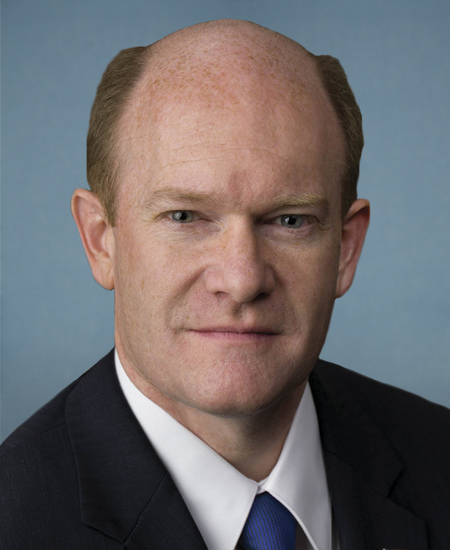
Sen. Christopher A. Coons
Sponsored bills
Maddy summarySRES 338 is a non-binding Senate resolution recognizing how the Americans with Disabilities Act (ADA) of 1990 enables independent living and economic self-sufficiency for people with disabilities. It highlights that over one-third of disabled individuals rely on Medicaid for health coverage and community-based care, yet many remain in segregated institutions due to Medicaid limitations and insufficient community services. The resolution calls for bipartisan action to strengthen Medicaid funding, oppose cuts or work-reporting requirements that hinder access to care, and expand home-based services to support employment and community living. It specifically urges federal agencies to improve accessibility in housing, transportation, emergency services, and competitive employment opportunities for people with disabilities, particularly those of color facing systemic barriers. This resolution does not create new law but advocates for policy changes to fulfill the ADA’s promise.
Maddy summaryThe Resident Physician Shortage Reduction Act of 2025 adds 14,000 new residency training positions over seven years (2027-2033), distributing 2,000 annually through a structured application process. It directly affects hospitals applying for these positions, requiring them to commit to filling the new spots and prioritizing rural hospitals, those serving health shortage areas, and hospitals affiliated with historically Black medical schools. Key mechanisms include seven annual application rounds, rules for carrying over unused positions, and minimum distribution quotas (e.g., 10% to rural hospitals). The bill also mandates a study on increasing diversity in the health workforce, with a report due to Congress within two years.
Maddy summaryThis bill expands Medicare Part B coverage to include specific pharmacist services, directly affecting Medicare beneficiaries and pharmacists who provide these services. It defines "pharmacist services" as evaluations and treatments for illnesses like COVID-19, flu, RSV, or strep throat, or services addressing public health emergencies, requiring collaboration with physicians as state law permits. Medicare would pay 80% of the lower of the actual charge or 85% of the physician payment rate (100% for public health emergencies), and prohibits balance billing for these services. The changes take effect January 1, 2026.
Maddy summaryThis bill extends tax deferral for company stock sold to employee stock ownership plans (ESOPs) and fixes a rule that previously caused small businesses to lose government benefits after 49% ownership transferred to an ESOP. It creates a new Treasury Department office to provide education and technical assistance for companies adopting ESOPs, and establishes a Labor Department Advocate for Employee Ownership to coordinate federal efforts and promote employee ownership. These changes directly affect S corporations considering ESOPs, current ESOP-owned businesses, and small businesses seeking to maintain eligibility for government programs. The bill focuses on removing barriers to employee ownership through concrete tax, eligibility, and support mechanisms.
Maddy summarySRES 334 is a symbolic Senate resolution designating the week of August 25-29, 2025, as "National Community Health Worker Awareness Week." It recognizes community health workers - frontline professionals who connect underserved communities to health services through culturally appropriate outreach, education, and advocacy - as vital to improving public health. The resolution encourages collaboration across local, state, and federal levels to raise awareness of their role but does not create new laws, funding, or requirements. It is a non-binding gesture supporting existing efforts to highlight this workforce, which serves communities through roles like health education, care coordination, and community advocacy.
Maddy summaryThe LEAD Act of 2025 reclassifies specific reusable drones previously treated as missile technology under export controls as standard "manned aircraft systems" for export purposes. It directly affects drone manufacturers and exporters dealing with unmanned aircraft systems that were previously subject to missile-related restrictions under the Missile Technology Control Regime. The bill requires the President to amend federal regulations within 180 days to ensure these drones are reviewed under the same criteria as manned aircraft, not missile technology. This change aims to streamline export approvals for these specific drone systems by removing unnecessary missile-related controls.
Maddy summaryThis bill would require health insurance plans that cover obstetrical services to also cover fertility treatment, including procedures like in vitro fertilization, artificial insemination, embryo preservation, and related medications. It applies to private insurance plans, federal employee health benefits, TRICARE, VA benefits, Medicaid programs, and Medicare. The law mandates coverage regardless of whether a patient has been diagnosed with infertility, prohibits cost-sharing exceeding what's applied to other medical services, and requires plans to provide clear notice about the coverage to participants. The goal is to make fertility treatment more accessible and affordable for people who need it.
Maddy summaryThis resolution urges the U.S. Senate to give its advice and consent for the United States to ratify the United Nations Convention on the Law of the Sea (UNCLOS), a 1994 treaty currently ratified by 170 nations including all major maritime powers. The U.S. is not a party to UNCLOS despite being a signatory to related 1958 conventions, which limits its ability to participate in international ocean governance forums and defend its maritime interests. Ratification would allow the U.S. to formally participate in disputes over Exclusive Economic Zones, Arctic resource claims, and South China Sea activities, while strengthening legal standing in cases like the 2016 South China Sea arbitration. It does not alter current U.S. military operations, as officials confirm the Navy already aligns with UNCLOS provisions.
Maddy summaryS 2377, the EACH Act of 2025, requires all federal health programs - including Medicaid, Medicare, the Children’s Health Insurance Program (CHIP), and the Indian Health Service - to cover abortion services without restrictions based on income or insurance type. It repeals the Hyde Amendment (Section 1303 of the ACA), which previously barred federal funds from covering most abortions, and prohibits state or private insurance plans from restricting abortion coverage. This directly affects millions enrolled in federal health programs, particularly low-income individuals, women of color, and young people, who face barriers to abortion access under current laws. The bill mandates that all federally funded health programs provide comprehensive abortion coverage as a standard benefit.