

Maddy summaryThe IEIS Act requires U.S. Customs and Border Protection, Immigration and Customs Enforcement, and other authorized immigration enforcement personnel to visibly display their last name, a unique identifier, agency name, and face during public immigration enforcement activities like stops, arrests, or raids. This applies to officers performing "immigration enforcement functions" but excludes undercover operations, high-risk tactical situations (e.g., active shooter responses), or mandated face coverings. The bill also allows federal agencies to reimburse covered employees - defined as immigration officers and their immediate family members living with them - for privacy-enhancing services (e.g., software masking personal information) up to 100% of costs. It directly affects immigration enforcement staff and their families by mandating transparency during public duties while providing tools to protect their personal data.
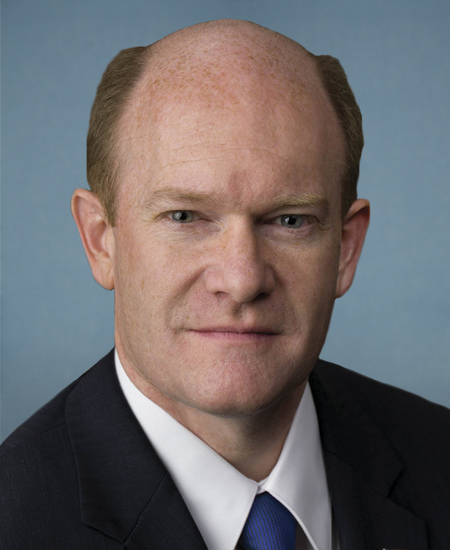
Sen. Christopher A. Coons
Sponsored bills
Maddy summaryThis bill requires the U.S. Department of State to produce annual Country Reports on Human Rights Practices that include more comprehensive, fact-based coverage of internationally recognized rights. It mandates specific new reporting requirements, such as describing restrictions on internet freedom, protections for marginalized groups (including LGBTQI+ individuals and indigenous peoples), arbitrary detention, and government corruption's human rights impact. The bill also explicitly prohibits political influence in the reports, ensuring they remain credible tools for holding violators accountable. These changes directly affect how the State Department compiles and publishes its annual human rights reports, which inform U.S. foreign policy and global accountability efforts.
Maddy summaryS 2557, the Epstein Files Transparency Act, requires the Department of Justice to make publicly available, within 30 days of enactment, all unclassified records related to Jeffrey Epstein's investigations, associates (like Ghislaine Maxwell), travel logs, immunity deals, and DOJ internal communications. It mandates the release in a searchable format while prohibiting redactions based on embarrassment or political sensitivity. The bill allows limited redactions only for victim privacy, child pornography, active investigations, graphic content, or national security classifications, with detailed justifications required for any withholdings. The Attorney General must also submit a report to Congress listing all released materials, redactions, and names of officials referenced in the documents. This bill directly affects the DOJ's handling of Epstein-related records and provides the public access to previously withheld information.
Maddy summaryS 2549, the Time Off to Vote Act, requires employers with 25 or more employees to provide workers with 2 hours of paid leave during open voting hours for federal elections. This covers voting in person, returning mail ballots, or other voting activities, with employers allowed to set the specific 2-hour window (excluding lunch breaks) but not denying the leave. The law prohibits retaliation against employees who take this leave and authorizes the Department of Labor to enforce it, imposing civil penalties of up to $10,000 per violation for noncompliance. It does not override stricter state voting leave laws but takes effect before the next federal election after enactment.
Maddy summaryThis bill permanently extends the enhanced premium tax credit for Affordable Care Act marketplace insurance plans, directly affecting millions of lower-income households (earning 150%-400% of the federal poverty level) who purchase coverage through state or federal marketplaces. It establishes a sliding-scale percentage system where the tax credit reduces monthly premiums based on income, starting at 0% for households earning up to 150% of poverty and increasing to 8.5% for those earning 300%-400% of poverty. The bill replaces temporary provisions with permanent rules, ensuring consistent cost-sharing support for eligible buyers. The changes apply to tax years beginning after December 31, 2025.
Maddy summaryThe Food Date Labeling Act of 2025 establishes uniform phrases for food date labels to reduce consumer confusion: "BEST If Used By" (or "BB" for small packages) for quality dates (when food quality may decline but it remains safe) and "USE By" (or "UB") for discard dates (when food should not be consumed). Food manufacturers must display these labels prominently in clear type on packaging, with optional use of technologies like QR codes. The bill preempts state laws requiring different labeling standards but allows states to enforce the uniform phrases, while excluding infant formula from its requirements. It mandates consumer education on label meanings within two years and takes effect for labels on products two years after enactment.
Maddy summaryThe Servicemembers and Veterans Empowerment and Support Act of 2025 improves support for veterans who experienced military sexual trauma by reforming how disability claims are processed and expanding access to care. It establishes specialized teams to review claims, changes evidence standards to include non-military sources like counseling records, and requires VA communications to include trauma resources. The bill expands eligibility for counseling and treatment to all former reserve members, ensures veterans get connected to health care services when submitting claims, and provides care options for those who withdraw from service academies. It also mandates annual accuracy reviews of claim processing and requires improved training for VA staff handling these cases.
Maddy summaryThe John R. Lewis Voting Rights Advancement Act of 2025 strengthens voting rights protections by requiring preclearance for certain voting changes in jurisdictions with a history of discrimination. It establishes new preclearance requirements for changes to election methods, district boundaries, voter ID rules, and polling locations. The bill updates standards for determining when voting practices deny or abridge rights, particularly for racial, ethnic, and language minority groups. It also requires transparency about voting changes through public notices and strengthens enforcement mechanisms for voting rights violations. The bill directly affects states and localities with documented histories of voting discrimination, aiming to protect minority voters' rights.
Maddy summaryThis bill authorizes $50 million annually from 2026 through 2031 for the Centers for Disease Control and Prevention (CDC) to fund research on firearms safety and gun violence prevention. It directly affects the CDC and researchers by providing dedicated funding to study these topics under the Public Health Service Act. The key mechanism is a specific annual funding allocation, added to existing resources, to support new or ongoing research initiatives. The bill does not create new regulations or restrict gun ownership but focuses solely on enabling evidence-based research. This is a funding measure, not a policy change affecting the public directly.
Maddy summaryThe Restoring Essential Healthcare Act repeals a provision that blocked Medicaid payments to certain healthcare providers. Specifically, it removes a restriction from Public Law 119-21 that prevented Medicaid from paying "prohibited entities" for services provided between the law's enactment and this bill's effective date. Payments for those services will now be made retroactively, as if the restriction had never existed. This directly affects Medicaid programs and the healthcare providers previously excluded from receiving these payments.