Maddy summaryThe West Bank Violence Prevention Act of 2025 imposes U.S. sanctions on foreign individuals or entities responsible for specific actions threatening peace in the West Bank. It targets those who commit violence against civilians, threaten violence to force relocation, destroy private property without consent, or engage in terrorism. Sanctions include freezing U.S. assets, banning visas, and restricting entry for designated individuals. Exceptions cover humanitarian aid (food, medicine, agricultural commodities) and activities required for U.S. intelligence or international obligations. The law requires regular reports to Congress on implementation and West Bank violence assessments.
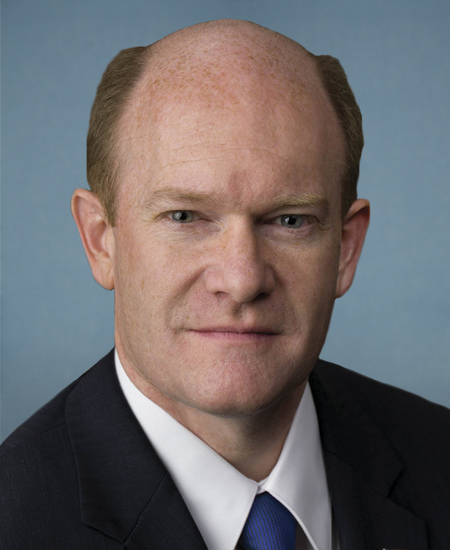
Sen. Christopher A. Coons
Sponsored bills
Maddy summaryThis bill would require the U.S. Treasury to terminate the existing U.S.-China tax treaty if the President certifies that China's military (the People's Liberation Army) attacks Taiwan. The termination process would begin with a 30-day written notice to China after the President notifies Treasury. It also mandates that the President inform the Senate Foreign Relations and Finance Committees about such termination. The bill directly affects the U.S.-China tax treaty, which governs how income taxes are handled for businesses and individuals between the two countries.
Maddy summaryThe International Trafficking Victims Protection Reauthorization Act of 2025 reauthorizes U.S. efforts to combat human trafficking globally. It requires U.S. representatives at multilateral development banks to ensure anti-trafficking strategies are included in projects in countries identified as having significant trafficking problems (Tier 2 Watch List, Tier 3, or Special Cases in the annual Trafficking in Persons Report). The bill clarifies which foreign assistance can be withheld from countries not meeting anti-trafficking standards and expands protections for domestic workers employed by diplomatic personnel (A-3 and G-5 visa holders), including requiring wage reporting and providing information about workers' rights. It also extends funding for programs to end modern slavery and mandates regular congressional briefings on trafficking reports and waiver decisions.
Maddy summaryThe Access to Birth Control Act (S 2302) requires pharmacies to provide contraception without delay when available and to help customers obtain it if out of stock - either by referring to another pharmacy or expediting an order. It prohibits pharmacies from intimidating customers, misrepresenting availability, breaching confidentiality, or refusing to return valid prescriptions for contraception. Exceptions allow pharmacists to decline service only if a prescription is missing, the customer cannot pay, or they use professional clinical judgment. Violations may result in civil penalties of up to $1,000 per day or private lawsuits by affected individuals.
Maddy summaryThis bill establishes federal standards for trauma kits used by police departments receiving federal grant funding. It requires all such kits to include specific components like tourniquets, bleeding control bandages, and instructional materials from recognized medical sources, and mandates training for officers on their use. Police departments must follow these standards when purchasing kits with federal funds, though they can still assemble kits from approved components. The bill also sets requirements for maintaining and strategically placing these kits in patrol vehicles and agency facilities.
Maddy summaryThis bill amends the Public Safety Officers' Death Benefits Program to include retired law enforcement officers who die or become permanently disabled due to targeted attacks related to their past service. It adds a new eligibility provision (Section 1201(p)) defining "retired law enforcement officer" and covering injuries from attacks specifically motivated by their former role. The law applies retroactively to pending claims and new filings after enactment, with exceptions for cases occurring before 2012. It directly affects retired officers whose service led to targeted violence, expanding their access to death and disability benefits under existing federal law.
Maddy summarySRES 350 is a non-binding Senate resolution introduced by Senators Durbin, Schiff, and Coons. It formally recognizes decades of systemic human rights abuses in Eritrea, including indefinite imprisonment, inhumane prison conditions, and the absence of democratic elections or independent institutions. The resolution condemns these abuses and calls on Eritrea’s government to release political prisoners, implement its constitution, allow UN access, and enable free elections. It expresses U.S. support for the Eritrean people’s aspirations for democratic governance and freedom.
Maddy summaryThis bill reauthorizes the Weatherization Assistance Program through 2030, extending its current authorization period. It updates the definition of "fully weatherized" to require both approved energy efficiency measures from an audit and a final quality control inspection for a dwelling unit. The bill significantly increases funding limits, raising the maximum per-unit assistance from $6,500 to $15,000 and adjusting related cost thresholds (e.g., from $3,000 to $6,000 for certain services). These changes directly affect low-income households receiving weatherization services through state and local agencies administering the program. The bill focuses on concrete program adjustments without altering core service delivery.
Maddy summaryThis bill reauthorizes funding for state-level maternal mortality review committees, which analyze pregnancy-related deaths to identify preventable causes. It requires the Health and Human Services Secretary to share annual best practices for preventing maternal mortality with hospitals, medical societies, and maternity care groups. The bill increases annual funding for these programs from $58 million to $100 million, extending support through fiscal years 2026-2030. These changes directly affect state health agencies, hospitals, and medical professionals working on maternal health. The focus is on improving death record accuracy and implementing proven prevention strategies.
Maddy summaryThe Fresh Start Act of 2025 provides federal grants to states with existing laws allowing automatic expungement or sealing of criminal records without requiring individuals to pay fees, fines, or take action. States meeting these criteria can apply for grants of up to $5 million to build technology infrastructure enabling automatic record clearance for eligible individuals. Grants cover up to 75% of infrastructure costs, with states required to report annually on clearance numbers disaggregated by race, ethnicity, and gender. The program is funded at $50 million per year from 2026 through 2030.