

Maddy summaryThis bill would make several administrative changes to the Social Security Administration, including exempting it from the jurisdiction of the Department of Government Efficiency (DOGE) and certain executive orders, restricting political appointees from accessing beneficiary data systems, and preventing closure of field offices while requiring maintenance of staff levels. It also creates new offices within the SSA for civil rights, transformation, and analytics, and provides additional funding for administrative costs and customer experience improvements. These provisions would directly affect how the SSA manages its operations, protects beneficiary data, and delivers services to beneficiaries. The bill's title is misleading as it does not address billionaires or their relationship with Social Security.
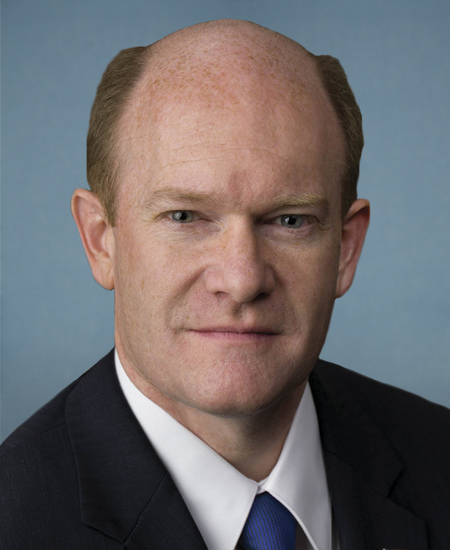
Sen. Christopher A. Coons
Sponsored bills
Maddy summaryThis bill expands eligibility for family and medical leave under the FMLA for paraprofessionals and education support staff (ESP) in schools. It lowers the required work hours for eligibility from 1,250 hours per year to 60% of the expected monthly hours for their specific role (based on the previous school year’s schedule). Employers must document each employee’s expected monthly hours in a file for the Secretary’s review. The law specifically covers school staff providing services like clerical work, food services, custodial duties, or student health support, aligning with existing definitions from education law.
Maddy summarySRES 374 is a non-binding Senate resolution expressing that Secretary of Health and Human Services Robert F. Kennedy Jr. lacks the confidence of the Senate and American people to serve in his role. The resolution cites specific actions including the termination of $11 billion in public health funding, mass firings of scientists (notably eliminating 8 Offices of Minority Health), replacing all 17 members of the vaccine advisory committee (ACIP) with critics of vaccines, and dismantling programs supporting maternal health, disability services, and chronic disease research. It alleges these actions violated federal law, undermined scientific integrity, and endangered public health during a measles outbreak. The resolution calls for the Secretary’s removal but has no legal effect, as it is a symbolic statement of disapproval.
Maddy summaryThe Telehealth Modernization Act extends Medicare telehealth flexibilities through 2027, allowing more patients to access care remotely without geographic restrictions. It expands who can provide telehealth services (including audio-only visits), extends telehealth use for hospice recertification, and updates coverage for in-home cardiopulmonary rehabilitation. The bill also extends "acute hospital care at home" program flexibilities through 2030 and requires a study on this program's effectiveness. Additionally, it includes provisions to improve telehealth access for patients with limited English proficiency and enhances Medicare coverage for virtual diabetes prevention programs. These changes primarily affect Medicare beneficiaries, healthcare providers, and telehealth service companies.
Maddy summaryS 1038, the TRACE Act, requires the Attorney General to add a data field to the National Missing and Unidentified Persons System (NMIPS) indicating whether a missing person’s last known location was confirmed or suspected to be on federal land (like national parks or military bases). It also mandates annual reports to Congress starting in 2025, detailing the number of cases in NMIPS where federal land was involved. This directly affects law enforcement agencies using NMIPS by standardizing how they track missing persons on federal property. The bill creates no new funding or penalties but improves data collection for cases involving federal lands.
Bankruptcy Administration Improvement Act of 2025 This bill makes several changes to the administration of bankruptcy cases, particularly by increasing certain fees, extending the sunset date of various fees, and extending the term of specified bankruptcy judgeships. The bill increases the fees paid to the trustee in Chapter 7 (liquidation) cases. The bill extends for an additional five years the fees paid quarterly to the U.S. trustee in Chapter 11 (reorganization) cases. The bill also increases the fee percentage for cases with large disbursements, subject to limitations. Finally, temporary bankruptcy judgeships in various districts are extended for an additional five years.
Maddy summaryThe Lowering Electric Bills Act extends federal tax credits for clean energy adoption through 2034, directly affecting homeowners installing solar panels or heat pumps and businesses producing clean electricity. It modifies three key tax provisions: (1) extends the residential clean energy credit deadline from 2025 to 2034, (2) adjusts the clean electricity production credit to expire based on U.S. emissions reaching 25% of 2022 levels or 2032 (whichever comes later), and (3) simplifies the clean electricity investment credit rules. These changes aim to maintain financial incentives for clean energy projects beyond current law, reducing administrative complexity. The bill does not create new programs but prolongs existing tax benefits to support ongoing adoption.
Maddy summaryThis bill reauthorizes the Global Fragility Act of 2019, extending funding for the Prevention and Stabilization Fund and Complex Crises Fund through 2030 to support conflict-affected regions. It requires annual coordination meetings among U.S. agencies to align foreign assistance with global fragility strategy, mandates reports on country selection criteria, and specifies which countries will continue or discontinue U.S. assistance programs. The bill discontinues programs in Haiti and Libya (which no longer meet fragility criteria) while continuing programs in Coastal West Africa, Mozambique, and Papua New Guinea. It also establishes requirements for monitoring, evaluation, and learning activities related to U.S. foreign assistance in fragile regions to improve coordination and effectiveness.
Maddy summaryThis bill creates a pathway for Afghan allies who supported U.S. operations in Afghanistan to obtain conditional permanent resident status in the United States. It defines "Afghan allies" as individuals who served in Afghan security forces or provided direct support to U.S. missions during the period from 2001-2021. The bill establishes a process for reviewing applications, conducting security assessments, and referring eligible individuals to the U.S. Refugee Admissions Program, with conditional permanent resident status that can be converted to full permanent residency after 4 years if certain conditions are met.
Maddy summaryThis bill amends the Foreign Assistance Act to require the U.S. Department of State to include detailed reporting on reproductive rights in its annual Country Reports on Human Rights Practices. Specifically, it mandates that reports describe each country’s policies on access to contraception, abortion services, and comprehensive reproductive health care, including rates of pregnancy-related deaths, discrimination against women/LGBTQI+ individuals, and disparities based on race, disability, or other factors. The bill also requires consultation with civil society organizations and experts during report preparation. This affects how the U.S. government documents and assesses reproductive rights policies in other countries, without altering domestic U.S. law or funding.