

Trillion Trees Act This bills establishes a variety of requirements and incentives to plant trees and conduct other land management practices for the purposes of capturing and storing carbon in domestic and international trees and forests. Additionally, the bill provides incentives to research or develop other carbon sequestration tools. Specifically, the bill directs the Department of Agriculture (USDA) to set targets to increase forest carbon stock through January 1, 2100, for the purposes of sequestering and storing carbon in U.S. forests. It also establishes and provides funding for the Trillion Trees Challenge Fund to provide grants to nonfederal entities for activities related to reforestation efforts on public or private lands. In addition, it raises the cap on the Reforestation Trust Fund to enhance forest health in the National Forest System and requires the USDA to establish a Tree City USA Grant Program. The bill also allows the U.S. Agency for International Development to enter into an agreement with a nonprofit organization to establish an International Forest Foundation to promote reforestation and prevent deforestation. Additionally, it establishes requirements and incentives to address seedling shortages and support nurseries. Finally, the bill provides market incentives to research or develop other carbon sequestration tools relating to biochar, sustainable building practices, biochemical and bioplastic products, and biomass energy.
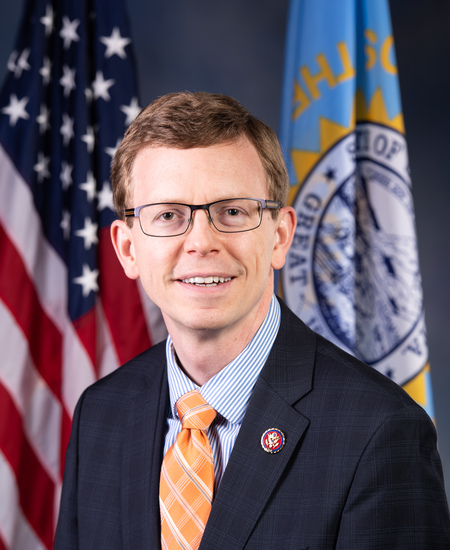
Rep. Dusty Johnson
Sponsored bills
Forestry Improvements to Restore the Environment Act of 2021 or the FIRE Act of 2021 This bill provides for salvage activities after a wildfire is contained on certain National Forest System lands. No later than 60 days after a wildfire is contained on such lands (1) the Forest Service, to the maximum extent practicable, shall complete a survey of the lands that were impacted by such wildfire; and (2) the Department of Agriculture (USDA) shall convert the timber sales applicable to such lands that were impacted by such wildfire to salvage sales. The bill designates a categorical exclusion for forest management activities where the primary purpose of the activity is for roadside salvage activities that allow for the removal of hazard trees that are within 200 feet of a roadway center line. Activities carried out pursuant to this bill shall be subject to judicial review in the same manner as authorized hazardous fuels reduction projects. A court may not order a preliminary injunction enjoining the USDA from proceeding with timber sales authorized under this bill.
Flexible Financing for Rural America Act This bill allows rural utility service providers to submit to the Department of Agriculture (USDA) a request to adjust the interest rate or modify the terms of certain loans. The request shall include a report summarizing how the adjustment or modification will assist the borrower in providing critical utility services to a rural community. Specifically, on receipt of a request, USDA or the Department of the Treasury (in the case of a loan owned by the Federal Financing Bank) must adjust the interest rate on the loan to match certain interest rates for obligations of comparable maturity to the term remaining on the loan (or a higher rate requested by the borrower), and make modifications to the loan terms as necessary to address changes in the financial position of the borrower due to the COVID-19 public health emergency and to promote the financial sustainability of the borrower. In carrying out the adjustments or modifications, USDA or Treasury shall not impose or collect any fee from, or impose any penalty on, a borrower. The bill also provides funding to implement the adjustments and modifications and for the liquidation of residual intragovernmental amounts owed by the Federal Financing Bank in connection with certain loans.
Accountable Care in Rural America Act This bill requires the Centers for Medicare & Medicaid Services (CMS) to exclude certain components from a methodology used under the Medicare Shared Savings Program. The program enables accountable care organizations (ACOs) to receive payments for savings stemming from care coordination and management. Specifically, the bill requires the CMS to exclude an ACO's assigned Medicare fee-for-service beneficiaries from certain regional adjustments to the ACO's benchmark for savings determinations, and to otherwise ensure that an ACO is not in a less favorable financial position due to its share of assigned beneficiaries in the region.
Adopt the Greenhouse gases, Regulated Emissions, and Energy use in Transportation model Act or the Adopt GREET Act This bill requires the Environmental Protection Agency (EPA) to update the methodology used in life-cycle analyses of greenhouse gas emissions that result from the production and use of corn-based ethanol and biodiesel fuel. The EPA must update its methodology within 90 days and every five years thereafter. In the first update, the EPA must adopt the most recent Greenhouse gases, Regulated Emissions, and Energy use in Transportation model (commonly referred to as the GREET model) developed by Argonne National Laboratory.
This resolution condemns the rocket attacks by Hamas against Israel beginning the week of May 9, 2021. It also states that the United States must continue to invest in and support Israel's security and sovereignty.
Guarding Readiness Resources Act of 2021 This bill modifies the treatment of funds received by the National Guard Bureau as a reimbursement from a state or other U.S. territory (e.g., Guam) for the use of military property. Specifically, the funds must be credited to (1) the appropriation, fund, or account used in incurring the obligation; or (2) an appropriation, fund, or account currently available for the purposes of which the expenditures were made. Such funds must be treated as a reprogramming request and may only be obligated or disbursed after the National Guard Bureau submits a written request and receives authorization from Congress. The National Guard Bureau must annually submit an account of the use of funds disaggregated by appropriation and subactivity group.
United States Army Rangers Veterans of World War II Congressional Gold Medal Act This bill provides for the award of a single Congressional Gold Medal to the U.S. Army Rangers Veterans of World War II in recognition of their dedicated service during World War II.
Advancing Emergency Preparedness Through One Health Act of 2021 This bill requires interagency coordination to respond to zoonotic diseases through a One Health Program. A One Health Program recognizes the interconnection between people, animals, plants, and their shared environment. Specifically, the Department of the Interior, the Department of Health and Human Services, and the Department of Agriculture must develop a framework to coordinate federal activities to reduce hazards to human and animal health under the One Health Program. These departments must work with other federal entities on the framework, including the Department of Commerce. This framework must establish goals, identify activities necessary to achieve those goals, and recommend legislation or other actions to advance One Health efforts. Additionally, the Government Accountability Office must evaluate this framework and its implementation.
Biodiesel Tax Credit Extension Act of 2021 This bill extends the income and excise tax credits for biodiesel and renewable diesel used as fuel through 2025.