Recognizing Military Service in PSLF Act This bill requires the Department of Education to count each month for which a borrower's federal student loan payment was in deferment or forbearance during a period of active duty, including certain National Guard duty, as a qualifying payment for the purpose of the Public Service Loan Forgiveness (PSLF) program. Under current law, a borrower who is a service member is eligible to receive student loan forgiveness under the PSLF program; however, if the borrower places their loan into deferment or forbearance while they are on active duty, that period of time does not count as a qualifying payment for the PSLF program.
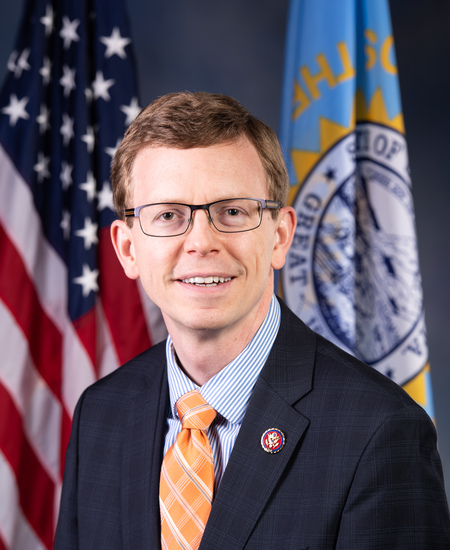
Rep. Dusty Johnson
Sponsored bills
Agricultural Security Risk Review Act This bill expands the membership of the Committee on Foreign Investment in the United States to include the Secretary of Agriculture. (The committee reviews the national security implications of certain foreign investments in U.S. businesses or real estate, including critical infrastructure or technologies.)
Surface Transportation Advanced through Reform, Technology, and Efficient Review Act 2.0 or the STARTER Act 2.0 This bill addresses provisions related to federal-aid highway, transit, highway safety, motor carrier, innovation, and resiliency programs of the Department of Transportation (DOT). It also sets forth requirements for the operation of railroad freight cars in the United States. For example, the bill extends FY2020 enacted levels through FY2026 for federal-aid highway, transit, and safety programs. DOT must provide competitive grants for projects to provide parking for commercial motor vehicles on the federal-aid highway system; establish a discretionary program to award competitive grants for eligible projects that encourage economic viability of the nation, a metropolitan area, or a region; create a public awareness campaign to reduce instances of driving while under the influence of prescription and over-the-counter medications; and promulgate regulations to implement an apprenticeship program for licensed commercial motor vehicle drivers under the age of 21. The bill also establishes new competitive grant programs to spur innovation of connected vehicle applications into operational deployments and to test the safe integration of automated driving system technologies into the on-road transportation system. Additionally, the bill addresses projects to improve the resiliency of federal-aid highways and bridges on and off the National Highway System. Further, the bill prohibits the operation of railroad freight cars in the United States that have been manufactured or assembled by certain foreign countries or that contain sensitive technology from such countries.
Native VetSuccess at Tribal Colleges and Universities Pilot Program Act This bill directs the Department of Veterans Affairs (VA) to take specified actions to assist veterans with education, employment, and housing. First, the bill requires the VA to carry out a five-year pilot program to provide on-campus benefits assistance and counseling to eligible students at tribal colleges and universities. An eligible student is a student who (1) is a veteran, a service member, or a dependent of a veteran or service member; and (2) is eligible for any service or benefit under the VetSuccess on Campus program. Next, the bill increases through FY2023 the annual funding limit for the Veteran Employment Through Technology Education Courses pilot program. In addition, the bill authorizes the VA to provide educational assistance, including a monthly housing stipend, to an eligible veteran who is pursuing an educational program on less than a half-time basis during the veteran's last semester, term, or academic period of enrollment. The bill extends to December 9, 2030, certain housing loan fees under the VA home loan program. Finally, the bill extends to September 30, 2025, the authority of the VA to enter into agreements with certain entities to provide housing assistance for homeless veterans. The bill also revises the program, including by allowing the VA to enter into agreements with tribal entities.
Recognizing the Protection of Motorsports Act of 2019 or the RPM Act of 2019 [ sic ] This bill authorizes the modification of a vehicle's air emission controls for vehicles that are not legal for operation on a street or highway and are used solely for competition.
Violence Against Women Extension Act of 2021 This bill reauthorizes for FY2022 various programs and activities authorized by the Violence Against Women Act of 1994 and subsequent legislation and administered by the Office on Violence Against Women within the Department of Justice.
Journalism Competition and Preservation Act of 2021 This bill creates a four-year safe harbor from antitrust laws for print, broadcast, or digital news companies to collectively negotiate with online content distributors (e.g., social media companies) regarding the terms on which the news companies' content may be distributed by online content distributors.
Regulations from the Executive in Need of Scrutiny Act of 20 21 This bill revises provisions relating to congressional review of agency rulemaking. Specifically, the bill establishes a congressional approval process for a major rule. A major rule may only take effect if Congress approves of the rule. A major rule is a rule that results in (1) an annual effect on the economy of $100 million or more; (2) a major increase in costs or prices for consumers, individual industries, government agencies, or geographic regions; or (3) significant adverse effects on competition, employment, investment, productivity, innovation, or the ability of U.S.-based enterprises to compete with foreign-based enterprises. In addition, the bill establishes a congressional disapproval process for a nonmajor rule. A nonmajor rule may only take effect if Congress does not disapprove of the rule.
Iran Sanctions Relief Review Act of 2021 This bill restricts the President's authority to unilaterally undertake certain actions with respect to Iran and increases congressional oversight of those actions. Specifically, the President must report to Congress before terminating or waiving sanctions related to Iran or taking a licensing action that significantly alters U.S. foreign policy with respect to Iran. Each report must (1) describe the proposed action and its rationale, and (2) indicate whether or not the action is intended to significantly alter foreign policy concerning Iran. If the intention is to alter that policy, the report must provide additional information about the policy objectives and anticipated effects of the action. After the President submits a report, the bill provides Congress with a 30-day period to review it; this period is extended to 60 days for reports submitted between July 10 and September 7. During this period, Congress may enact a joint resolution approving or disapproving the action. During the review period, the President may not take the action unless Congress passes a joint resolution of approval; if Congress enacts a joint resolution of disapproval, the bill prohibits the President from taking the action. The bill also outlines procedures for the introduction and consideration of these types of joint resolutions.
Combatting COVID Unemployment Fraud Act of 2021 This bill requires additional documentation for individuals seeking pandemic unemployment assistance, requires state unemployment agencies to use designated fraud prevention tools, and otherwise addresses pandemic-related unemployment benefits.