This bill provides supplemental FY2021 appropriations to the National Guard for its response to the events at the U.S. Capitol on January 6, 2021. The bill designates the funding as emergency spending, which is exempt from discretionary spending limits.
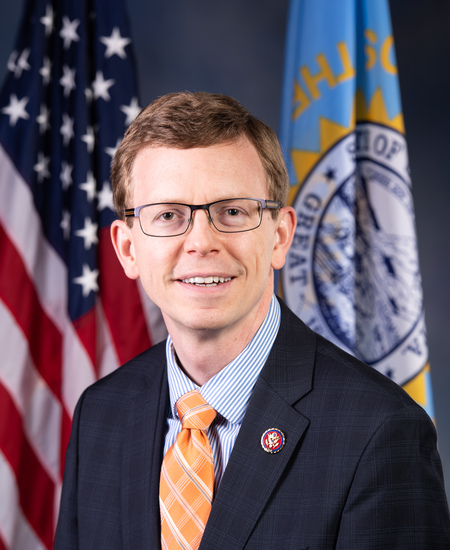
Rep. Dusty Johnson
Sponsored bills
Year-Round Fuel Choice Act of 2021 This bill amends the Clean Air Act to address the limitations on Reid vapor pressure (a measure of gasoline's volatility) that are placed on gasoline during the summer ozone season. The bill applies the Reid vapor pressure requirements that are applicable to gasoline blended with 10% ethanol (E10) to gasoline blended with more than 10% ethanol. Thus, the waiver given to E10 gasoline, which allows an increase in the Reid Vapor Pressure volatility, is extended to gasoline blended with more than 10% ethanol.
Preserving Rules Ordered for The Entities Covered Through 340B Act of 2021 or the PROTECT 340B Act of 2021 This bill prohibits pharmacy benefit managers (PBMs) and health insurance plans from discriminating against health providers participating in the 340B drug pricing program, including pharmacies contracted with such providers to dispense 340B drugs. The 340B program allows certain providers to receive covered outpatient drugs at reduced prices from manufacturers. Specifically, PBMs and insurance plans may not reimburse 340B participants at a lower rate than other entities not participating in the program; impose differing terms (such as fees, charge-backs, or audits) on 340B participants; interfere with an individual's choice to receive drugs from a 340B participant; require 340B participants to identify which drugs fall within the program; or refuse to contract with a 340B participant on the basis that they utilize the program. Violations of this bill are subject to a civil penalty of not more than $5,000 per violation per day. These prohibitions also apply to prescription drug (Part D) sponsors under Medicare. The bill also provides for a process to prevent duplicate 340B drug discounts to states under Medicaid.
Broadband for Rural America Act This bill modifies and consolidates Department of Agriculture (USDA) programs for expanding broadband internet in rural areas. Specifically, the bill modifies a program that provides grants, loans, and loan guarantees to support broadband expansion in rural areas. Modifications include revising the criteria used to prioritize applications and projects and changing the name of the program to the ReConnect Rural Broadband Program. Additionally, the bill terminates on June 30, 2022, a Department of Agriculture (USDA) COVID-19 response program that supports broadband expansion in rural areas for distance learning and telemedicine. Any remaining program funds available after the termination date shall be used for the ReConnect Rural Broadband Program. The bill also expands coordination requirements that apply to the Department of Commerce, USDA, the Federal Communications Commission (FCC), and the National Telecommunications and Information Administration. This includes requiring the use of specified FCC maps when assessing a community's access to broadband.
No Land Grab Act of 2021 This bill prohibits from having the force and effect of law a provision of Executive Order 14008 (86 Fed. Reg. 7619), titled Tackling the Climate Crisis at Home and Abroad , that requires the Department of the Interior to recommend steps to achieve the goal of conserving at least 30% of U.S. lands and waters by 2030.
The bill directs the Joint Committee on the Library to remove the bust of Roger Brooke Taney in the Old Supreme Court Chamber of the Capitol and to obtain a bust of Clarence Thomas with which to replace it.
Essential Caregivers Act of 2021 This bill requires skilled nursing facilities, nursing facilities, intermediate care facilities for the intellectually disabled, and nearby inpatient rehabilitation facilities to establish an essential caregivers program during a public health emergency. Under the program, facilities must allow each resident to select up to two essential caregivers to provide daily living assistance, emotional support, or companionship during the emergency. Facilities must afford such caregivers 12 hours of access to residents each day (or unlimited access for end-of-life care), and caregivers must agree to follow facility protocols for staff safety. Facilities may deny access to caregivers who violate protocols, subject to certain notification requirements; the Centers for Medicare & Medicaid Services must establish an appeals process relating to such decisions and may take specified enforcement actions against facilities that violate the bill's requirements.
Promotion and Expansion of Private Employee Ownership Act of 2021 This bill expands tax incentives and federal assistance for employee stock ownership plans (ESOPs) that are sponsored by S corporations. The bill provides additional tax incentives for ESOPs by (1) extending to all domestic corporations, including S corporations, provisions allowing deferral of tax on gain from the sale of employer securities to an ESOP; and (2) allowing a tax deduction for 50% of the interest received by a bank on loans to S corporation-sponsored ESOPs for the purchase of employer securities. The Department of the Treasury must establish the S Corporation Employee Ownership Assistance Office to foster increased employee ownership of S corporations. The bill defines an ESOP business concern for purposes of the Small Business Act as a business concern that was eligible for a loan, preference, or other program under such Act before more than 49% of the business concern was acquired by an ESOP.
Repealing Existing Substandard Provisions Encouraging Conciliation with Tribes Act This bill repeals certain provisions related to the treatment of Indians, including provisions on hostile tribes, alcohol, work requirements, penalties for truancy, and placement of youth in reform school without the consent of a parent or guardian.
Metropolitan Statistical Area Preservation Act This bill prohibits the Office of Management and Budget (OMB) from establishing, for purposes of designating areas as metropolitan statistical areas (MSAs), a minimum population for the urban area of such MSA that is more than 50,000. The OMB may, for statistical purposes only, establish other statistical area designations with higher minimum population requirements for such urban areas.