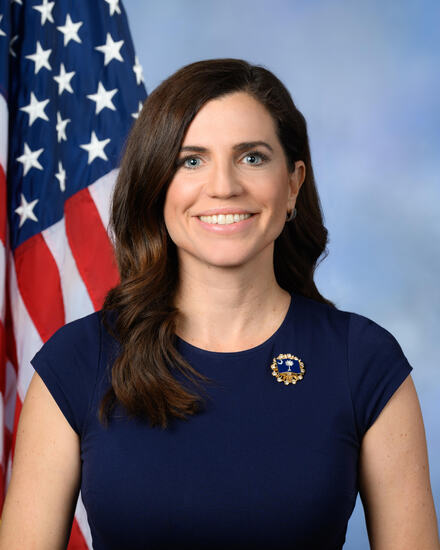
Photo of Nancy Mace
R United States House · District 1 · South Carolina

Rep. Nancy Mace

Compare
Total votes
2,837
all sessions
Attendance
94%
182 missed
Lower than 97% of chamber peers
With party
89%
of cast votes
Lower than 87% of chamber peers
Bipartisan score
6%
crosses aisle rarely
Higher than 86% of chamber peers
Sponsored
1,230
bills & resolutions
Near the chamber average
Committees
11
assignments
1,230 bills and resolutions

Sponsored bills

Total
1,230
Primary
200
Co-sponsor
1,030
This page
1,230
matching current filters
Co-sponsor HR 6520
In committee · Utah House · Co-sponsor
SNAP Data Transparency and Oversight Act of 2025

Maddy summaryThis bill requires state agencies administering the SNAP (food stamp) program to provide recipient-level data to the USDA Secretary upon request. It directly affects state SNAP agencies, which must submit this data within 30 days (or sooner for urgent cases) in secure electronic formats. Key provisions include mandatory data sharing for program oversight and integrity, strict privacy safeguards under the Privacy Act, and potential withholding of federal funds for non-compliance. The bill also clarifies that this does not limit the USDA's existing authority to access state data for program administration.

In committee Jan 13, 2026 1 co-sponsor
Primary HR 6457
In committee · Utah House · Lead sponsor
FAIR Act

Maddy summaryThe FAIR Act requires all SNAP (Supplemental Nutrition Assistance Program) benefit cards to display a photo of the cardholder - taken within the last 10 years for adults or 5 years for minors - and mandates retailers to verify that the photo matches the person using the card at checkout. This directly affects SNAP recipients (who must provide photos for card issuance) and retailers (who must inspect photos before accepting benefits). Exceptions allow caregivers to access benefits for minors, disabled individuals, or the elderly. The rule changes take effect 18 months after enactment, with federal regulations to be updated within 18 months of the law’s passage.

In committee Jan 13, 2026 0 co-sponsors
Primary HR 6209
In committee · Utah House · Lead sponsor
American Hemp Protection Act of 2025

American Hemp Protection Act of 2025 This bill repeals changes to the regulation of hemp products, which reimpose certain federal controls over some hemp products. Specifically, Congress enacted the FY2026 agriculture appropriations act (P.L. 119-37) on November 12, 2025. Effective November 12, 2026, the act modifies the statutory definition of hemp products that are considered to be lawful. This bill repeals the changes. As background, the 2018 farm bill excluded hemp from the Controlled Substances Act definition of marijuana and defined hemp . As a result, hemp and hemp-derived products at or below the 0.3% delta-9 tetrahydrocannabinol (THC, the psychoactive component of marijuana) concentration threshold were no longer regulated as Schedule I controlled substances. Registration with the Drug Enforcement Administration was no longer required to cultivate or handle hemp and hemp-derived products. However, hemp remained subject to Department of Agriculture and Food and Drug Administration regulation. The 2025 changes to the definition of hemp, include changing the limit to a total THC concentration of not more than 0.3% on a dry weight basis rather than only delta-9 THC, explicitly including industrial hemp, excluding seeds from a cannabis plant that exceed a certain THC concentration, and excluding various types of hemp-derived cannabinoid products. Cannabinoids refer to unique chemical compounds that are found in hemp and marijuana (e.g., THC) and are known to exhibit a range of psychological and physiological effects.

In committee Jan 13, 2026 0 co-sponsors
Co-sponsor HR 5017
In committee · Utah House · Co-sponsor
Greyhound Protection Act of 2025

Maddy summaryHR 5017, the Greyhound Protection Act of 2025, prohibits commercial greyhound racing, live lure training, open field coursing, and related betting across state lines. It bans activities like using live animals as bait, conducting interstate simulcast betting, and transporting greyhounds for racing purposes. The law amends the Animal Welfare Act to make these actions unlawful, with penalties including fines and up to 7 years in prison per violation. It applies to conduct occurring on or after October 1, 2027, and does not override existing state laws banning these activities. The bill directly affects greyhound racing industry participants and the animals involved in these practices.

In committee Jan 13, 2026 1 co-sponsor
Co-sponsor HR 909
Passed · Utah House · Co-sponsor
Crime Victims Fund Stabilization Act of 2025

Maddy summaryHR 909, the Crime Victims Fund Stabilization Act of 2025, modifies how funds from the False Claims Act are deposited into the Crime Victims Fund. It specifies that from 2025 through 2029, certain False Claims Act proceeds (specifically those for qui tam plaintiff payments and government damage reimbursements) cannot be deposited into the fund. This change directly affects the composition of the Crime Victims Fund by excluding these specific revenue streams during the specified period. The bill does not create new benefits or alter victim services; it only adjusts fund allocation rules for existing False Claims Act revenues.

Passed Jan 13, 2026 1 co-sponsor
Primary HR 6982
In committee · Utah House · Lead sponsor
Preventing Prosecutors from Protecting Predators Act of 2026

Maddy summaryThis bill requires prosecutors in jurisdictions with 100,000+ residents receiving federal funds to submit annual reports on how they handle specific serious crimes, including rape, domestic violence, child sexual abuse, and sex trafficking. The reports must detail case declines, bail decisions, plea agreements, sentencing outcomes, and whether defendants had prior offenses or were on sex offender registries. Prosecutors failing to report face withheld federal funds (25-50% of allocated money), while offices declining over half of eligible cases may need corrective plans. The data will be published publicly to increase transparency about prosecutorial practices for these offenses.

In committee Jan 8, 2026 0 co-sponsors
Co-sponsor HR 472
In committee · Utah House · Co-sponsor
Restore VA Accountability Act of 2025

Maddy summaryHR 472, the Restore VA Accountability Act of 2025, creates new disciplinary procedures for VA supervisors and management officials. It requires the VA Secretary to consider specific factors like the seriousness of misconduct and the employee's role when deciding on removal, demotion, or suspension, and limits the entire disciplinary process to 15 business days. The bill prevents courts from reviewing penalty amounts but allows review of whether procedures were followed correctly. It also strengthens whistleblower protections by requiring Special Counsel approval before disciplining employees who report misconduct, affecting VA supervisors and management officials but excluding senior executives and political appointees.

In committee Dec 19, 2025 1 co-sponsor
Primary HR 6871
In committee · Utah House · Lead sponsor
Preventing the Recognition of Terrorist States Act of 2025

Maddy summaryThis bill prohibits U.S. federal agencies from recognizing the Taliban-controlled government in Afghanistan as the official government of Afghanistan. It bans the use of federal funds for any policy or action that implies such recognition, affecting departments like State, USAID, and Defense. The bill requires the State Department to designate Afghanistan as a "state sponsor of terrorism" and the Taliban as a "foreign terrorist organization" under existing laws. These designations would trigger automatic sanctions and restrictions on U.S. assistance to Afghanistan.

In committee Dec 18, 2025 0 co-sponsors
Primary HR 6801
In committee · Utah House · Lead sponsor
American Citizenship Healthcare Integrity Act of 2025

Maddy summaryHR 6801, the American Citizenship Healthcare Integrity Act of 2025, requires hospitals participating in Medicare to ask patients about their U.S. citizenship or national status on intake forms 180 days after enactment. It mandates these facilities to submit annual reports detailing the number of noncitizen patients they treated and the dollar amount of uncompensated care provided to them. The bill also requires the Health Secretary to publish annual reports on the total cost of care for noncitizens and the federal spending that would have been avoided without that care. This legislation directly affects Medicare-participating hospitals, critical access hospitals, and rural emergency hospitals.

In committee Dec 17, 2025 0 co-sponsors
Co-sponsor HR 5457
Passed · Utah House · Co-sponsor
Strengthening Agency Management and Oversight of Software Assets Act

Strengthening Agency Management and Oversight of Software Assets Act This bill requires federal agencies and Intelligence Community (IC) elements to assess their software inventory and develop software management plans. The bill requires each agency and each IC element to complete a comprehensive assessment of the software paid for by, in use at, or deployed throughout the agency or element. The assessment must include information such as (1) the current inventory of software; (2) contracts and other arrangements used to acquire, build, deploy, or use the software; (3) costs and fees not included in the initial contract or agreement; and (4) the interoperability of the software and restrictions on its use. Each agency and IC element must use their assessment to develop a plan to consolidate software entitlements, develop procedures for cost-effective acquisition strategies, and restrict subordinate entities from using any software entitlement without approval. (A software entitlement is software that has been purchased, leased, or licensed by or billed to an agency and that is subject to use limitations.) Such plans must be submitted to the Office of Management and Budget (OMB) and Congress.  Within two years of enactment, OMB must submit recommendations to Congress regarding government software procurement policies and practices to     • increase the interoperability of software licenses;     • consolidate licenses when appropriate;     • reduce costs;     • improve performance; and     • modernize the management and oversight of agency software.      The GAO must report on certain related topics, including governmentwide trends in agency software asset management practices and comparisons of such practices among agencies.

Passed Dec 16, 2025 1 co-sponsor
Showing 111 to 120 of 1,230 bills
Previous 1 … 11 12 13 … 123 Next