Maddy summaryThis resolution expresses support for designating July 10th as Journeyman Lineworkers Recognition Day to honor the workers who maintain the nation's electrical grid. The bill specifically recognizes the dangerous conditions these employees face, such as working at heights near live power lines and responding to disasters like hurricanes and wildfires. It also commemorates Henry Miller, the first president of the International Brotherhood of Electrical Workers, who died on July 10, 1896, while performing his duties. Ultimately, the measure encourages the public to observe this day with reflection on the contributions of lineworkers.
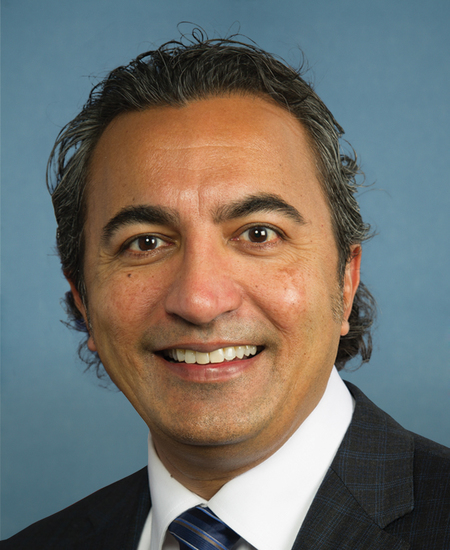
Rep. Ami Bera
Sponsored bills
Maddy summaryThis bill establishes a new coordinator within the President's Domestic Policy Council to lead federal efforts in using artificial intelligence to improve the diagnosis, treatment, and prevention of pediatric cancer. The coordinator will specifically work with the Childhood Cancer Data Initiative to enhance clinical trials, consolidate medical data for better analysis, and develop new tools that predict how patients respond to treatments. Additionally, the legislation directs the Health and Human Services Secretary to create interoperability standards that allow patient data to be safely shared for AI research while ensuring individuals maintain control over their health information. The bill authorizes funding for these initiatives through fiscal years 2027 to 2031 and requires a report to Congress on implementation within 180 days of enactment.
Maddy summaryThe American Space Leadership for the 21st Century Act directs the Secretary of State to lead diplomatic efforts aimed at securing the space domain against growing threats from adversaries like China and Russia. Key provisions authorize the State Department to establish international agreements with allies for information sharing and risk reduction, while also initiating regular dialogues to promote norms of behavior and prevent space debris. The bill mandates that the Secretary consult with congressional committees annually to report on emerging threats and the status of international cooperation, ensuring oversight of these new diplomatic initiatives.
Maddy summaryThe Let Doctors Provide Reproductive Health Care Act prohibits states and officials from restricting or penalizing health care providers and their staff for offering reproductive health services that are legal within the state where they are performed. It establishes a federal right for providers to assist patients regardless of where those patients live and allows attorneys general to sue states that enforce such restrictions, including stripping states of legal immunity in these cases. To support this framework, the bill appropriates $40 million each for legal defense grants to help providers navigate lawsuits and $40 million for security grants to improve physical and cyber safety at medical facilities. Additionally, the legislation requires insurance companies to offer professional liability coverage to providers without discrimination based on the reproductive services they provide.
Maddy summaryThe SAFE Training for OB-GYNs Act creates a new federal grant program to help medical residents who must leave their home states to receive training in reproductive health care due to local abortion restrictions. Funded with up to $10 million annually from 2027 to 2031, these grants support residency programs that offer specialized training in sexual and reproductive health, including abortion care. The funding can be used to expand existing programs or establish new ones specifically for out-of-state residents and to cover their travel expenses. This legislation directly affects health care professionals seeking specialized training and the medical residency programs that provide it.
Maddy summaryThe Reproductive Health Care Training Act of 2026 authorizes $25 million over five years to fund a program that provides grants to health schools and clinics for expanding abortion care training. These funds are specifically designated for institutions located in states where comprehensive abortion training is legal, with a priority on serving minority-serving schools and those training students from medically underserved areas. The program supports activities such as developing clinical curricula, utilizing telehealth, recruiting diverse healthcare workers, and offering scholarships to students pursuing this specialized training. Recipients must submit annual reports on program performance while ensuring federal funds supplement, rather than replace, existing state and private resources.
Maddy summaryThis bill redesignates the existing National Parks and Public Land Legacy Restoration Fund as the America's Legacy Restoration Fund to address deferred maintenance on federal lands. It directs revenue from recreation fees and a portion of energy development income into the fund, which must be used primarily for repairing critical infrastructure like roads, trails, and buildings managed by agencies such as the National Park Service and the Forest Service. The legislation establishes strict rules requiring that most funds go toward non-transportation projects, mandates transparency through public dashboards tracking project status, and sets aside a small percentage for matching private donations. Additionally, the bill increases entrance fees for foreign visitors to ensure they contribute to the fund, while prohibiting the use of these specific funds for land acquisition or employee bonuses.
Maddy summaryThis resolution commemorates the 30th anniversary of Taiwan's first direct presidential election in 1996 and expresses support for the preservation of its democratic institutions. It acknowledges Taiwan's history of free elections and peaceful transfers of power while reaffirming U.S. policy commitments under the Taiwan Relations Act and previous agreements. The text explicitly states that it does not authorize the use of military force, serving as a symbolic statement rather than a legislative action that changes laws or policy.
Maddy summaryThis bill requires the Secretary of State to develop a strategy encouraging foreign nations to jointly purchase defense equipment and services from the United States. The legislation mandates the government to identify lead buyers, address licensing challenges, and explore ways to speed up approval processes for these shared procurement efforts. Officials must submit regular reports to Congress every six months for three years, detailing the strategy's progress and any obstacles encountered. The policy aims to streamline how the U.S. sells defense articles to a lead nation who then distributes them to other allied partners under specific agreements.
Maddy summaryThe DOMINANCE Act aims to reduce U.S. reliance on strategic competitors like China for critical minerals by building international partnerships to secure diversified supply chains. It establishes a Minerals Security Partnership to coordinate diplomatic, development, and financial support for critical mineral projects with allies, creates a new Office of Energy Security Compacts to develop multi-year agreements with partner countries, and sets up a new Assistant Secretary position for Energy Security at the State Department. The bill also includes education programs like the Critical Mineral Mining Fellowship Program to build U.S. workforce capacity in mining. These measures are designed to enhance U.S. national security and economic competitiveness by ensuring reliable access to critical minerals needed for defense, technology, and energy systems.