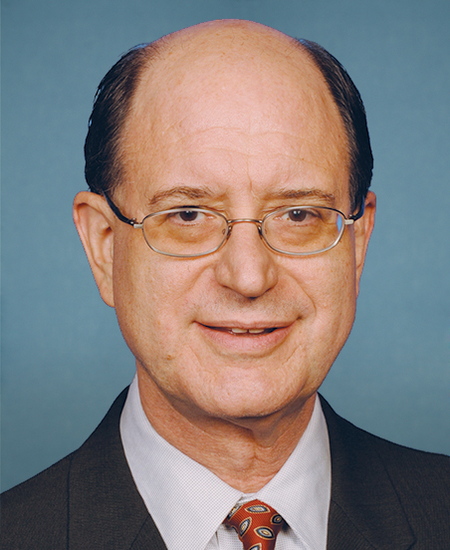
Governing Unaccredited Representatives Defrauding VA Benefits Act or the GUARD VA Benefits Act This bill imposes fines on individuals for soliciting, contracting for, charging, or receiving any unauthorized fee or compensation with respect to the preparation, presentation, or prosecution of any claim for Department of Veterans Affairs benefits. The attempted commission of such offenses is also punishable by fine.
Rep. Brad Sherman
Sponsored bills
Maddy summaryThis bill establishes a new excise tax on crude oil extracted or imported by large oil companies and uses the revenue to provide rebates to eligible consumers. The tax would be imposed on companies that extract or import over 300,000 barrels of crude oil per day, at a rate of 50% of the difference between the current Brent crude oil price and a 2025 baseline price, adjusted for inflation. All revenue from this tax would be deposited into a new "Protect Consumers from Gas Hikes Fund." This fund would then be used to provide refundable tax credits, or rebates, to eligible individuals, with the rebate amount determined by the Secretary based on fund revenues and the number of eligible individuals. These rebates would be phased out for individuals with adjusted gross incomes exceeding certain thresholds, such as $150,000 for joint filers.
Maddy summaryThis bill requires the Secretary of Health and Human Services to create a two-year demonstration program that would make certain wound care treatments mandatory for Medicaid coverage for people with epidermolysis bullosa. The program would include over-the-counter medications, antiseptics, antibiotic ointments, and specific wound care supplies such as dressings and bandages. It would operate nationwide and require states to include these items and services in their Medicaid plans or waivers. At the end of the program, the Secretary must submit a report to Congress evaluating the program's impact on treatment costs and health outcomes, along with recommendations on preventing hospitalizations.
Enhanced Iran Sanctions Act of 2025 This bill imposes sanctions on certain foreign persons (individuals and entities) that are involved in Iran's petroleum sector as well as certain associated persons. The bill also requires or authorizes actions to facilitate the enforcement of sanctions on Iran. Specifically, the bill requires the President to impose visa- and property-blocking sanctions on any foreign person that, after the bill's enactment, knowingly engages in any transaction related to the processing, export, or sale of oil, condensates, gas, liquefied natural gas, or other petrochemical products in whole or in part from Iran. The President must also impose sanctions on certain foreign persons associated with a sanctioned individual or entity. For example, the President must sanction the subsidiaries and corporate officers of a sanctioned business. The bill provides certain exceptions to these sanctions, including specifying that sanctions do not apply to the importation of goods or to conducting or facilitating transactions for humanitarian assistance. The Department of State must establish an interagency working group that shall seek to establish a multilateral contact group to coordinate international efforts to enforce sanctions on Iran. The bill expands the State Department rewards program to authorize a reward payment to any individual who furnishes information leading to the identification of a person (1) subject to sanctions under this bill, or (2) that has attempted or is attempting to evade sanctions under this bill.
Maddy summaryThis bill, known as the Diabetes Foot Health Access and Modernization Act of 2026, makes two main changes to federal healthcare programs. First, it allows Medicaid to cover foot and ankle care services provided by podiatric physicians, ensuring patients have access to this specialized care. Second, it updates Medicare rules to clarify documentation requirements for diabetic shoes, specifying conditions under which patients can receive extra-depth or custom-molded footwear. The changes take effect on January 1, 2026, for Medicaid services and January 1, 2028, for Medicare shoe coverage.
Maddy summaryHRES 1107 is a House resolution urging the President to issue a proclamation flying the U.S. flag at half-staff to honor Rev. Jesse Jackson. The resolution recognizes his civil rights leadership, including founding the Rainbow PUSH Coalition and his presidential campaigns in 1984 and 1988, which advanced racial equality and economic justice. This symbolic gesture directly affects the President (as the one who would issue the proclamation) and the public, who would observe the flag at half-staff.
Maddy summaryThis bill would allow individuals who receive wildfire relief payments to exclude those amounts from their taxable income. It directly affects people who suffer financial losses from federally declared forest or range fires after December 31, 2014. The key provision states that relief payments for expenses like additional living costs, lost wages, personal injury, or emotional distress are not taxable, but only to the extent those losses are not already covered by insurance or other compensation. The tax exclusion applies to payments received after December 31, 2025, and ends for payments received after December 31, 2032.
Maddy summaryThis bill, the PrEP Access and Coverage Act of 2026, requires most health insurance plans to cover HIV prevention medication without charging patients any out-of-pocket costs. It directly affects people with private insurance, government health programs like Medicare and Medicaid, military health care, and the Indian Health Service. The law mandates that insurance companies cannot require pre-approval for these medications, cannot charge deductibles or copayments for them, and cannot deny or charge higher premiums for life, disability, or long-term care insurance based on someone taking HIV prevention medication. The bill also creates a new public education campaign to increase awareness about HIV prevention options and provides federal funding to states and community organizations to expand access to these services.
Maddy summaryThis bill, known as the Direct File Act of 2026, would establish a government-run online system allowing taxpayers to prepare and file their individual income tax returns for free. The legislation prohibits the Treasury Department from entering into agreements that restrict its ability to provide tax preparation or filing services, and it voids any existing contracts with such restrictions. The program would use IRS data to simplify filing, include customer support, be available in multiple languages, and allow users to file even if they are not required to. It also enables taxpayers in participating states to file state and local returns alongside their federal returns, with funding provided to states that meet certain standards.
Maddy summaryThe DISCLOSE Act of 2026 aims to increase transparency in election spending and prevent foreign influence. It expands the ban on foreign money to cover federal, state, and local elections, including ballot initiatives and judicial nominations, and criminalizes using corporations to conceal these funds. The bill mandates that organizations spending over $10,000 on campaign-related activities, such as independent expenditures or judicial nomination advocacy, disclose their beneficial owners and top donors. Additionally, it establishes new "Stand By Every Ad" disclaimers for political communications, requiring the highest-ranking official to approve the message and, for certain ads, list their top funders. These provisions directly affect non-candidate organizations, individuals involved in political and judicial nomination spending, and foreign nationals.