

Maddy summaryHR 6119, the State Department Security Notification Act, requires the Secretary of State to notify Congress when certain high-level diplomatic officials lose their security clearances. Specifically, it applies to officials at or above Assistant Secretary level, chief of mission roles, or ambassadors/special envoys reporting directly to the Secretary. Within 15 days of a clearance suspension or revocation, the Secretary must submit a written notification to the House Foreign Affairs and Senate Foreign Relations committees, followed by a detailed briefing within 30 days covering the reasons for the action and the official's current employment status. The bill establishes a formal process for congressional oversight of security clearance actions affecting senior diplomatic personnel.
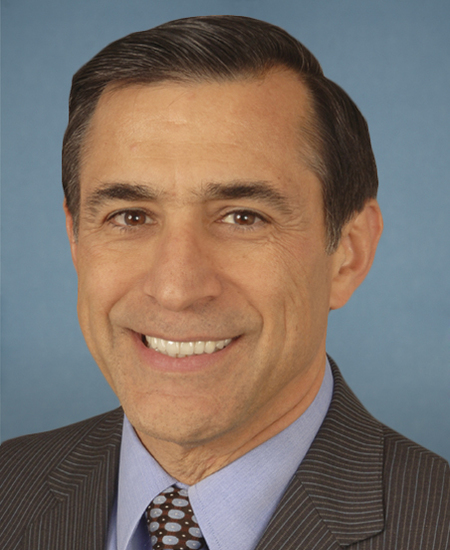
Rep. Darrell Issa
Sponsored bills
Maddy summaryThe SHIP Act imposes sanctions on foreign entities that knowingly handle Iranian petroleum, targeting those involved in port operations, transportation, refining, or ship-to-ship transfers of Iranian oil. Starting 90 days after enactment, the President must block assets, deny visas, and impose penalties on individuals or companies engaging in these activities, including family members or owners of sanctioned entities. It requires annual reports tracking Iran's oil exports, revenues, and key players like shipping companies and ports. The sanctions terminate if the President certifies Iran has stopped supporting terrorism and dismantled weapons programs.
Maddy summaryHR 6247 amends Section 1229(m)(1)(B) of the 2008 National Defense Authorization Act to change the description of the Office of the Special Inspector General for Afghanistan Reconstruction's (SIGAR) mandate. The bill replaces the phrase "reconstruction of Afghanistan" with "assistance for the benefit of the Afghan people" in the law. This technical adjustment broadens SIGAR's oversight scope to include all U.S. assistance to Afghanistan, not just physical reconstruction projects. The change directly affects SIGAR's reporting requirements under the law.
Maddy summaryThis resolution (HRES 843) reaffirms the U.S.-Philippines alliance and condemns China's "gray zone" tactics in the South China Sea, specifically targeting actions against Philippine vessels. It directly addresses the Philippines, which faces ongoing maritime disputes with China, and reaffirms that the 1951 Mutual Defense Treaty applies to attacks on Philippine forces in the South China Sea. Key provisions condemn China's use of lasers, water cannons, and ramming incidents against Philippine ships in 2023, as well as its broader unlawful territorial claims. The resolution calls on China to cease these actions and respect international law, referencing the 2016 UNCLOS tribunal ruling that invalidated China's nine-dash line claims. It has no binding legal effect but serves as a symbolic statement of U.S. support.
Maddy summaryHRES 798 is a House resolution condemning support for Hamas, Hezbollah, and other terrorist organizations at colleges and universities. It states such support may create a hostile environment for Jewish students, faculty, and staff, citing incidents like blaming Israel for the October 7 Hamas attack. The resolution urges the Secretary of Education to direct the Office for Civil Rights to investigate and take action where appropriate. This non-binding resolution expresses the House's position but does not create new law or policy changes.
Maddy summaryHR 6182 modifies an existing cyber cooperation pilot program under the 2021 National Defense Authorization Act. It expands the program to include Malaysia and the Philippines as "covered foreign military partners," replacing specific country names with this defined term throughout the law. The program, originally limited to Vietnam, Thailand, and Indonesia, now covers five Southeast Asian nations and is extended to run through December 2029. These changes update legal references in the program's framework without altering its core purpose of enhancing military cyber collaboration.
Maddy summaryHR 6181, the U.S.-ASEAN Center Act, establishes a public-private partnership to create a U.S.-ASEAN Center in the United States. The Center, managed by the Secretary of State, will support U.S. economic and cultural engagement with Southeast Asia through specific activities like funding research on U.S.-ASEAN partnerships, facilitating trade and investment, expanding technology cooperation, providing training programs, and developing educational initiatives. It will use existing State Department funding authorized under the Foreign Assistance Act and must avoid duplicating current U.S. government efforts. The bill directly affects U.S. government agencies, ASEAN nations, and U.S. businesses or citizens involved in Southeast Asian trade and cultural exchange.
Maddy summaryHR 2601, the National Human Trafficking Hotline Enhancement Act, requires organizations applying for federal grants under the Trafficking Victims Protection Act to certify they will share hotline information with state or local law enforcement upon request, while following disclosure laws. This directly affects grant applicants, such as anti-trafficking organizations operating the National Human Trafficking Hotline. The key mechanism adds a new certification requirement to grant eligibility, ensuring potential data sharing with law enforcement when appropriate. The bill also mandates a joint report from the Attorney General and DHS Secretary to Congress on how this requirement is implemented. The bill does not change the hotline's operations or victim services.
Maddy summaryHRES 771 is a non-binding resolution expressing the U.S. House of Representatives' support for Israel following Hamas' October 7, 2023, attack. It condemns Hamas' actions, affirms Israel's right to self-defense, and calls for the immediate release of hostages. The resolution also urges enforcement of existing laws restricting aid to terrorists and sanctions against Iran for supporting Hamas. It does not create new policies or allocate funds, as it is a symbolic statement of congressional support.
Maddy summaryHRES 768 is a symbolic House Resolution expressing congressional support for Israel following Hamas' October 7, 2023 attacks. It condemns Hamas' actions, reaffirms Israel's right to self-defense, and calls for the immediate release of hostages. The resolution references the U.S. commitment to Israel's security through existing military aid programs, including the 2016 U.S.-Israel Memorandum of Understanding, and emphasizes enforcement of laws like the Taylor Force Act to prevent U.S. aid from reaching terrorist groups. As a symbolic resolution, it does not create new policy but serves as a statement of congressional support for Israel.