Maddy summaryThis bill changes how firearm license violations are handled. It requires the federal government to give license holders (like dealers) 30 business days to correct self-reported violations before taking enforcement action, including license revocation. License holders can also choose to challenge license revocations in federal court within 10 days instead of requesting an administrative hearing. The law specifically defines "self-reported violation" and clarifies that minor or clerical errors cannot be considered "willful" violations. These provisions directly affect firearm license holders by altering the enforcement process for regulatory compliance.
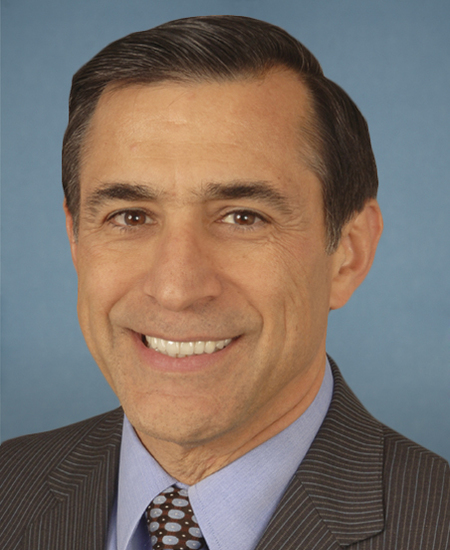
Rep. Darrell Issa
Sponsored bills
Maddy summaryThe Uyghur Policy Act of 2023 establishes a U.S. Special Coordinator for Uyghur Issues within the State Department to coordinate policy and advocate for the protection of Uyghur cultural, religious, and linguistic identity in Xinjiang. It authorizes $250,000 annually for Uyghur human rights advocates to speak at public diplomacy events in Muslim-majority countries and mandates Uyghur language training for U.S. diplomats. The bill also directs the U.S. government to support United Nations monitoring of Xinjiang human rights issues and oppose efforts to block discussions of Xinjiang at the UN. These provisions focus on diplomatic advocacy and information-sharing, not direct sanctions or enforcement actions against China.
Maddy summaryHR 7450, the Protecting Privacy in Purchases Act, prohibits payment card networks and covered entities (like payment processors) from requiring or assigning merchant category codes that specifically identify firearms retailers as different from general stores or sporting goods retailers. This directly affects firearms retailers and payment networks by preventing them from using business classification codes that could flag firearm sales. The bill establishes an enforcement process where the Attorney General investigates complaints, issues remediation notices, and can seek court injunctions for non-compliance, while preempting state or local laws on this issue. It does not create private lawsuits for individuals.
Maddy summaryThis bill restricts how credit reporting companies share homebuyers' credit reports during mortgage applications. It prevents companies from sending these reports to third parties (like marketers) just because a lender requested them for a mortgage. Only specific entities can receive the reports: the mortgage lender who originated the loan, the company servicing the loan, or the bank holding the homebuyer's account. This directly protects homebuyers' privacy by limiting unauthorized sharing of their financial data.
Maddy summaryThis bill appropriates over $15 billion in supplemental funding for U.S. security assistance to Israel following attacks in Israel. It includes specific allocations such as $5.2 billion for Israel's Iron Dome, David's Sling, and Iron Beam defense systems, as well as funds for military personnel, operations, and equipment across all branches of the military. The bill requires the Secretary of Defense and Secretary of State to submit regular reports to Congress detailing security assistance provided to Israel and designates all funding as "emergency requirements" under federal law. This funding directly supports U.S. security assistance programs with Israel to respond to regional security threats.
Maddy summaryThis resolution disapproves a Department of Energy rule that would have set new energy efficiency standards for consumer furnaces. The rule, published in the Federal Register (88 Fed. Reg. 87502), aimed to require furnace manufacturers to produce models meeting higher energy conservation levels. If enacted, this resolution would cancel the rule, preventing it from taking effect. As a result, current energy efficiency standards for furnaces would remain unchanged, and manufacturers would not face the new requirements.
Maddy summaryThis bill amends the McKinney-Vento Homeless Assistance Act to integrate behavioral health, mental health, and substance use disorder treatment into housing support for homeless individuals. It requires housing programs receiving federal funds to partner with nearby Certified Community Behavioral Health Clinics for eligible participants, defined as those in supportive housing, receiving Supplemental Security Income (SSI), Social Security Disability Insurance (SSDI), or classified as homeless with a disability. The bill sets aside 2% of annual funding for this integration and provides incentives of up to $500,000 per 1,000 homeless individuals in high-need areas, capped at $2 million per project. It also mandates annual reports on implementation progress to Congress.
Maddy summaryThe PRESS Act protects journalists' sources and unpublished materials from government subpoenas. It requires courts to approve any request for a journalist's protected information (like source identities or notes) only if the government proves it is necessary to prevent terrorism or imminent violence threatening life or safety. Service providers (like phone companies or social media platforms) must also obtain court approval before handing over journalists' personal accounts or devices. The law explicitly excludes civil defamation cases and does not shield journalists who are suspects in criminal investigations or terrorism-related cases.
Maddy summaryHRES 974 is a non-binding House resolution supporting the designation of January 21-27, 2024, as "National School Choice Week." It encourages parents to learn about K-12 education options - including public schools, charter schools, private schools, and homeschooling - and promotes public awareness of educational choice. The resolution does not create new laws or policies but formally expresses the House's backing for this annual observance. It directly affects parents and students by highlighting available education pathways and urging communities to host events celebrating school choice. The resolution was introduced by multiple House members and referred to the Education Committee.
Maddy summaryThe Death Tax Repeal Act would eliminate the federal estate tax and generation-skipping transfer tax for estates of people who die on or after the bill's enactment date, and for generation-skipping transfers made after that date. It would also establish a new $10 million lifetime gift tax exemption (adjusted annually for inflation) and replace the existing gift tax rate schedule with a revised structure. These changes would primarily affect high-net-worth individuals and their heirs, as the estate tax and gift tax typically apply to large estates or gifts exceeding the new exemption threshold. The bill's provisions would take effect on the date of enactment, with transitional rules for the year the bill is signed into law.