Child Tax Credit Integrity Act This bill requires an individual taxpayer to provide social security account numbers to claim the child tax credit. The social security number must be that of the taxpayer and the taxpayer's spouse (for joint returns) and the child named on the tax return.
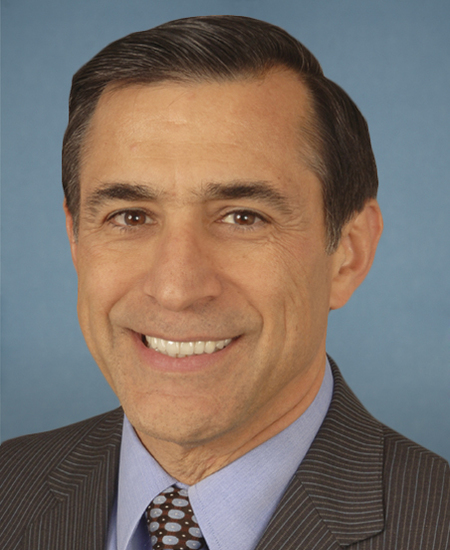
Rep. Darrell Issa
Sponsored bills
Maddy summaryHRES 987 is a symbolic resolution introduced in the U.S. House of Representatives on January 31, 2024, by multiple Republican members. It formally denounces the Biden administration’s energy policies as "harmful" and "anti-American," citing specific actions like canceling the Keystone XL pipeline, restricting federal land leasing for oil and gas, blocking LNG exports, and implementing mineral extraction rules. The resolution does not create new laws or affect any group directly; it serves only as a formal expression of disapproval by the House. It has no legal effect and is intended to convey political opposition to the administration’s approach to energy development.
Maddy summaryHR 7770, the Rosie the Riveter Commemorative Coin Act, authorizes the U.S. Mint to produce and sell three commemorative coins honoring women who worked on the U.S. home front during World War II. It specifies $5 gold coins (max 50,000), $1 silver coins (max 400,000), and half-dollar coins (max 750,000), all to be issued between January 1, 2025, and December 31, 2025. Each coin sale includes a surcharge ($35 for gold, $10 for silver, $5 for half-dollar), with all surcharge funds directed to the Rosie the Riveter Trust for maintaining the Rosie the Riveter WWII Home Front National Historical Park and educational programs. The coins will feature designs reflecting the legacy of diverse women workers and must meet specific weight, diameter, and composition standards.
Maddy summaryHR 6727 establishes the United States Foundation for International Conservation, a nonprofit organization that will provide grants to support long-term management of protected and conserved areas in eligible countries. The Foundation requires a 2:1 cost match from other sources, demands host country and community consent through binding agreements, and prioritizes areas with high biodiversity or species of significant importance. It will be governed by a Board of Directors including government officials and private sector experts, operate for 10 years with $1 million authorized for 2024 and $100 million annually from 2025-2035, and must follow international conservation standards while prohibiting funding for countries supporting terrorism or violating human rights.
Maddy summaryHR 6610, the Passport System Reform and Backlog Prevention Act, aims to reduce delays in U.S. passport processing for citizens applying for routine new or renewal passports. It mandates a 30-day processing standard from document submission to mailing, requires technology upgrades like digital tracking dashboards and mobile apps for applicant updates, and authorizes hiring up to 100 temporary staff annually for passport offices. The bill also sets cybersecurity standards, maintains affordable fees, and requires regular progress reports to Congress on implementation. These changes directly affect U.S. citizens seeking passports, particularly those in remote areas with limited access to processing centers.
Maddy summaryHR 4278, the Restore VA Accountability Act of 2023, establishes new disciplinary procedures for VA supervisors and management officials (excluding senior executives and political appointees). It requires the VA Secretary to use "substantial evidence" for removal, demotion, or suspension, sets strict timelines (15 business days total for decisions), and creates a new internal grievance process. The bill limits judicial review to procedural errors, not penalty severity, and strengthens whistleblower protections by requiring Office of Special Counsel approval for disciplinary actions involving disclosures. This directly affects VA supervisors and managers whose performance or misconduct leads to disciplinary action.
Maddy summaryThis bill amends U.S. immigration law to automatically bar immigrants from entering the country and require their removal if they have been convicted of, admitted to committing, or are charged with sexual assault. It directly affects non-citizens (aliens) who have been involved in sexual assault offenses, as defined under existing law. Key provisions add new grounds for inadmissibility (preventing entry) and deportability (requiring removal) specifically for such offenses under sections 212(a)(2) and 237(a)(2) of the Immigration and Nationality Act. The bill does not change criminal penalties for sexual assault but modifies immigration consequences for those with such convictions or admissions.
Maddy summaryThe Federal Judgeship Act of 2024 adds new federal district judgeships across multiple courts, primarily in California, Florida, Texas, and other states with growing caseloads. It authorizes specific numbers of additional judges for districts including the Central and Northern Districts of California, the Middle District of Florida, and the Western District of Texas, with appointments to take effect in 2025, 2027, 2029, and 2031. The bill also permanently converts certain temporary judgeships to permanent positions and adds circuit judges to the Ninth Circuit Court of Appeals in 2027 and 2031. These changes directly affect federal court operations by increasing judicial capacity in specific geographic regions. The legislation focuses on adjusting court staffing levels to address case volume without altering substantive legal procedures or policies.
Maddy summaryThis bill would require U.S. immigration authorities to detain undocumented immigrants who are charged with, arrested for, convicted of, or admit to committing robbery offenses, rather than releasing them on bond. It amends immigration law to add robbery (defined by local jurisdiction) to the list of offenses triggering mandatory detention under specific inadmissibility categories. The Secretary of Homeland Security must issue a detainer to local authorities to hold these individuals if not already detained. This applies to undocumented immigrants already in immigration proceedings under certain inadmissibility grounds.
Maddy summaryHR 7494, the Protect America’s Lands Act, prohibits national securities exchanges from processing transactions involving stocks issued by companies primarily managing land for conservation. It defines "natural asset companies" as those holding rights to ecological performance of specific land areas, with their core purpose being to conserve, restore, or sustainably manage natural assets without causing material harm. The bill directly affects securities exchanges and these specific companies by banning exchange-based trading of their securities. This is a regulatory change to the Securities Exchange Act of 1934, focusing on financial market rules rather than direct land management policies.