

Maddy summaryHR 3598, the Deescalation Drone Pilot Program Act of 2025, establishes a federal pilot program to test nonlethal drones for law enforcement during active shooter events. The program, managed by the FAA, will review nonlethal devices (like sound emitters or cameras) for drones, develop training and safety protocols, and assess effectiveness in indoor scenarios to increase officer safety. It requires drones to be manufactured in the U.S. and mandates a report to Congress within 3 months of the pilot's conclusion, followed by rulemaking to create a formal approval process for law enforcement use. The bill directly affects Federal, State, local, and Tribal law enforcement agencies responding to active shooter events as defined by the legislation.
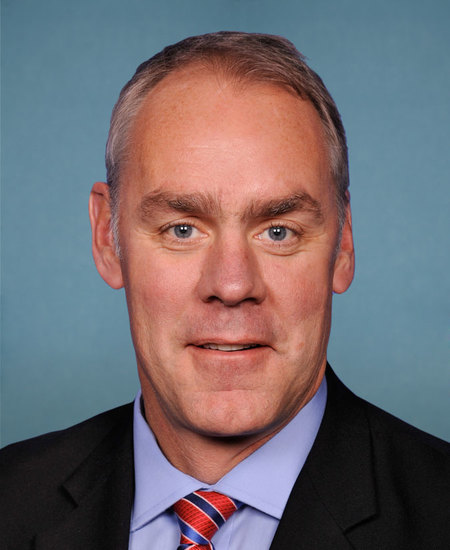
Rep. Ryan K. Zinke
Sponsored bills
This bill authorizes coal to be mined on approximately 800 acres of federal land in Musselshell County, Montana. Specifically, it allows all federal coal reserves in such federal land and leased under Federal Coal Lease MTM 97988 to be mined in accordance with the 2020 Bull Mountains Mining Plan Modification. The Bull Mountains Mine is operated by Signal Peak Energy. This bill directs the Department of the Interior, without modification or delay, to approve the Bull Mountains Mining Plan Modification to the extent necessary to mine such land.
Maddy summaryThis bill amends the Fair Labor Standards Act to exempt certain employees in the outdoor recreation industry from overtime pay requirements. It specifically applies to employees primarily engaged in outdoor recreational outfitting (like equipment rentals) or guiding services, but only if their business meets one of two seasonal criteria: operating for fewer than seven months annually, or having average receipts for six months that don't exceed 33 1/3% of receipts during the other six months. The exemption applies to wages and overtime compensation for workweeks starting after the bill's enactment date. This change directly affects small seasonal outdoor recreation businesses and their employees who meet the specified operational thresholds.
Maddy summaryHRES 412 is a non-binding House resolution congratulating Pope Leo XIV on his historic election as the 267th pope and the first American-born pope in the Catholic Church's 2,000-year history. The resolution recognizes his Chicago upbringing, missionary work in Peru, and commitment to humility and pastoral care, highlighting his significance for American Catholics. As a symbolic gesture with no legal effect, it expresses the House's support for his leadership without altering any policies or affecting any stakeholders.
Maddy summaryHR 3361 reauthorizes the Collaborative Forest Landscape Restoration Program through 2034, doubling its annual funding cap from $4 million to $8 million. It directly affects collaborative groups working on forest restoration across federal, state, tribal, and private lands. Key changes include expanding eligible projects to address wildfire risk reduction across multiple land ownerships, enhance watershed health, and improve monitoring standards. The bill also requires federal staffing plans for supporting these collaboratives and adds new mechanisms like conservation finance agreements for implementation.
Maddy summaryHR 3231, the American Energy Act, streamlines oil and gas drilling permit processing by requiring the government to approve applications even during pending lawsuits (unless a court has already canceled the lease), and limits court challenges to lease sales. It sets a four-year expiration for drilling permits and bars courts from halting development or lease awards based on environmental lawsuits (like those under NEPA) after bids are opened, unless imminent environmental harm is proven with no other remedy. This directly affects oil and gas companies seeking permits, federal agencies managing leases, and courts handling related litigation. The bill changes procedural rules for permits and lease sales without altering environmental standards.
Maddy summaryHR 3228, the Constitutional Hearing Protection Act, reclassifies firearm silencers as firearms under federal tax law and eliminates their separate registration under the National Firearms Act. It requires the Attorney General to destroy all existing federal silencer registration records within one year and preempts state laws that impose taxes, registration, or recordkeeping requirements on silencers. The bill defines "firearm silencer" and specifies that manufacturers must mark silencers on a "keystone part" with a serial number. This directly affects silencer owners, manufacturers, and state governments by standardizing federal regulation and removing state-level restrictions.
Maddy summary# Summary of the SHIPS for America Act This comprehensive legislation focuses on strengthening the U.S. maritime industry, shipbuilding capacity, and maritime workforce to enhance national security and economic competitiveness. ## Key Areas of Focus 1. **Shipbuilding & Maritime Infrastructure** - Establishes a United States Center for Maritime Innovation to accelerate adoption of commercial technologies - Creates a National Shipbuilding Research Program - Requires an annual survey of anticipated commercial vessel construction - Includes provisions for streamlined environmental reviews of maritime infrastructure 2. **Workforce Development** - Establishes the United States Merchant Marine Career Retention Program to maintain mariner qualifications - Creates Centers of Excellence for Domestic Maritime Workforce Training and Education - Implements military-to-maritime transition programs - Establishes a Maritime Career and Technical Education Advisory Committee 3. **Education & Training** - Expands educational assistance for merchant mariners - Creates eligibility for Naval Postgraduate School for merchant mariners - Establishes maritime education programs from K-12 through higher education - Provides for international exchanges for mariners and naval architects 4. **National Security & Strategic Readiness** - Requires reports on National Defense Reserve Fleet utilization - Includes measures to de-risk the maritime sector from Chinese influence - Enhances shipbuilding capacity for national security needs - Establishes programs to ensure sufficient mariner workforce for national defense 5. **Funding Mechanisms** - Authorizes appropriations from the Maritime Security Trust Fund - Includes funding for workforce programs, education, and shipbuilding initiatives - Establishes specific funding levels for various programs over multiple fiscal years The legislation aims to create a sustainable domestic maritime industrial base that supports both commercial shipping and national defense requirements, with a particular emphasis on developing and retaining a skilled U.S. maritime workforce.
Maddy summaryHR 2238, the Ranching Without Red Tape Act of 2025, streamlines minor maintenance projects for ranchers holding grazing permits on U.S. Forest Service (USFS) and Bureau of Land Management (BLM) public lands. It requires the USFS and BLM to respond to rancher requests for minor improvements - such as repairing fences, wells, water pipelines, or stock tanks - within 30 days, or the request is automatically approved. The bill also mandates agencies to expedite such projects using existing administrative tools if approved. This directly affects ranchers with grazing permits on federal lands managed by the USFS or BLM, reducing bureaucratic delays for routine land maintenance.
Maddy summaryHR 2235, the Habitat Connectivity on Working Lands Act of 2025, amends key USDA conservation programs to prioritize wildlife habitat connectivity, particularly for big game species like deer and elk. It adds habitat connectivity and migration corridors as conservation goals in the Environmental Quality Incentives Program (EQIP) and Conservation Stewardship Program (CSP), allowing payments for activities like planning and maintenance on grasslands enrolled in the Conservation Reserve Program (CRP) that are ecologically significant. The bill increases the maximum rental payment limit for CRP grasslands from $50,000 to $125,000 per year and requires the USDA to incorporate nonstructural methods (like virtual fencing) into conservation standards. It also directs research grants to study virtual fencing technology and its impacts on sensitive habitats used by big game species.