

Maddy summaryThe Neighborhood Homes Investment Act creates a new tax credit for developers who build or rehabilitate affordable homes in distressed communities. The credit is calculated as the lesser of (1) the difference between development costs and sale price, (2) 40% of development costs, or (3) 32% of the national median home price. It applies only to homes sold to qualified homeowners with income up to 140% of area median income in designated "qualified census tracts" (areas with high poverty rates, low median home values, and low median family income). Developers must meet quality standards and repay the credit if the home is sold within 5 years of the affordable sale. This credit aims to address the "value gap" that prevents housing development in distressed communities by incentivizing affordable home construction and rehabilitation.
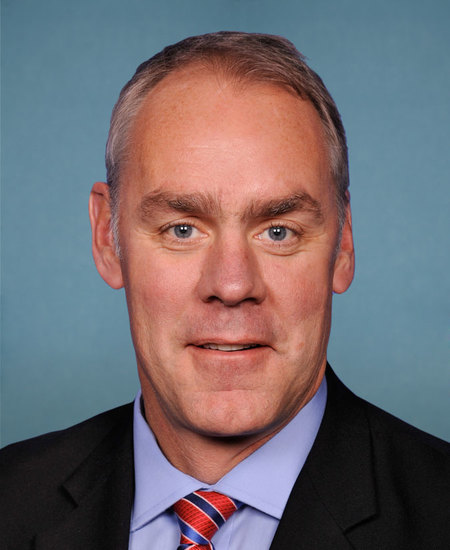
Rep. Ryan K. Zinke
Sponsored bills
Maddy summaryHR 2819, the DRIVE Act, prohibits the Federal Motor Carrier Safety Administration from requiring speed limiting devices on trucks weighing over 26,000 pounds operating in interstate commerce. This directly affects commercial truck drivers and carriers that operate large vehicles across state lines. The bill blocks the agency from implementing any rule mandating speed limiters that would cap these trucks' maximum speed. It prevents a potential new federal requirement for trucking companies without altering existing safety standards.
Maddy summaryHR 2806 prohibits the Secretary of Energy from selling petroleum products from the Strategic Petroleum Reserve to entities under Chinese Communist Party control or if the products could be exported to China. It directly affects U.S. energy sales to Chinese-linked companies and the Department of Energy’s management of the reserve. Key provisions require the Secretary to block such sales and mandate that any sale not result in exports to China. This policy change restricts access to U.S. strategic oil reserves for China-related entities.
Maddy summaryThe Affordable Housing Credit Improvement Act of 2025 would reform the Low-Income Housing Credit program, which provides tax credits to developers of affordable housing. It would increase state allocations based on population with annual cost-of-living adjustments, modify tenant eligibility rules to allow higher income limits for some residents, and add protections for domestic violence victims in housing. The bill would simplify rules for rural and Native American housing projects, clarify credit eligibility requirements, and require greater transparency in program administration. These changes would directly affect developers, property owners, and low-income tenants in housing projects that receive LIHC tax credits.
Maddy summaryThis bill amends immigration law to expand mandatory detention for non-citizen immigrants convicted of specific property crimes. It adds trespassing, vandalism, and arson to the list of offenses that trigger detention under Section 236(c) of the Immigration and Nationality Act, alongside burglary and serious bodily injury. Non-citizen immigrants convicted of these crimes would now face automatic detention without bond, rather than potentially being released pending removal proceedings. The key change modifies existing detention criteria to include these three property crimes as grounds for mandatory immigration detention.
Maddy summaryThis bill, HR 2102 (Major Richard Star Act), allows veterans with combat-related disabilities to receive both full military retired pay and veterans' disability compensation simultaneously, without the previous offset that reduced retired pay. It directly affects veterans already eligible for both benefits due to combat-related injuries, removing the requirement that their retired pay be reduced by the disability compensation amount. The key provision amends Title 10 and Title 38 to eliminate the offset rule (sections 5304 and 5305 of Title 38) for these veterans. The change applies to payments starting after the bill’s enactment date, effective for all qualifying veterans. This is a policy change to increase financial support for affected veterans, not a new benefit.
Maddy summaryThis bill codifies a "maximum pressure" policy toward Iran, requiring the U.S. to maintain all sanctions until Iran meets specific conditions related to its nuclear program, missile development, support for terrorism, and human rights violations. It expands sanctions on Iran's Revolutionary Guard Corps (IRGC) and entities supporting Iran's ballistic missile program, while prohibiting waivers of sanctions on these entities. The bill mandates regular reports to Congress on Iran's nuclear activities, support for terrorist groups like Hamas and Hezbollah, and human rights abuses within Iran. It also directs the use of frozen Iranian assets to support victims of state-sponsored terrorism and prevents the release of funds that could benefit Iran's terrorist proxies. The bill aims to maintain economic and diplomatic pressure on Iran until it changes its behavior across multiple fronts.
Sanctioning Russia Act of 2025 This bill imposes penalties on certain persons (individuals and entities) if the President determines that the Russian government or a person acting at Russia's direction is involved with (1) refusing to negotiate a peace agreement with Ukraine; (2) violating a negotiated peace agreement; (3) initiating another invasion of Ukraine; or (4) overthrowing, dismantling, or seeking to subvert the Ukrainian government. If the President makes such a determination, the bill requires certain actions including the President must impose visa- and property-blocking sanctions on specified persons such as the Russian president, certain Russian military commanders, and any foreign person that knowingly provides defense items to the Russian armed forces; the President must increase the rate of duty on all goods and services imported from Russia into the United States to at least 500% relative to the value of such goods and services; the President must increase the rate of duty on all goods and services imported into the United States from countries that knowingly engage in the exchange of Russian-origin uranium and petroleum products to at least 500% relative to the value of such goods and services; the Department of the Treasury must impose property-blocking sanctions on any financial institution organized under Russian law and owned wholly or partly by Russia, and any financial institution that engages in transactions with those entities; and the Department of Commerce must prohibit the export, reexport, or in-country transfer to or in Russia of any U.S.-produced energy or energy product.
Maddy summaryHR 1762, the Forest Service Accountability Act, is a procedural bill changing how the Forest Service Chief is appointed. It requires the President to nominate a candidate with substantial forest management experience for Senate confirmation, with nominations referred jointly to the Senate Agriculture and Energy Committees. The bill also mandates that the President submit a new nomination within 30 days of enactment, applying to the current Chief. This affects the President, Senate committees, and the current Forest Service leadership.
Maddy summaryHR 1417 establishes a new program within the U.S. Department of Agriculture to provide tailored technical assistance to rural health care facilities. The program directly supports facilities like hospitals, clinics, and health centers in rural areas by helping them identify operational needs, improve financial management, and access USDA loan and grant programs. Key provisions include prioritizing facilities in medically underserved areas or facing financial vulnerability, with a $2 million annual funding limit for fiscal years 2026-2030. The program requires annual reports on outcomes and effectiveness to Congress, focusing on preventing facility closures and strengthening rural health care delivery.