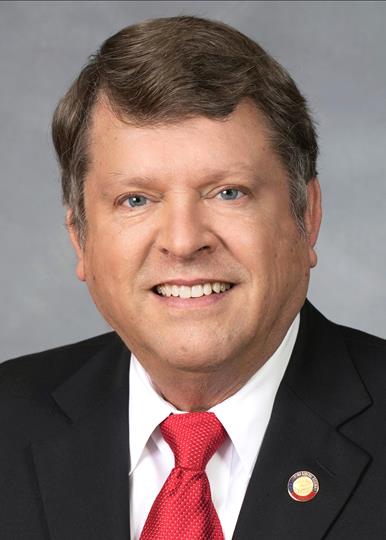
Photo of Larry Strickland
R North Carolina House · District 28 On the 2026 ballot

Rep. Larry Strickland

Compare
Total votes
2,369
all sessions
Attendance
99%
16 missed
Near the chamber average
With party
98%
of cast votes
Higher than 86% of chamber peers
Bipartisan score
1%
crosses aisle rarely
Lower than 89% of chamber peers
Sponsored
469
bills & resolutions
Near the chamber average
Committees
8
assignments
469 bills and resolutions

Sponsored bills

Total
469
Primary
35
Co-sponsor
434
This page
469
matching current filters
Co-sponsor HB 1191
In committee · North Carolina House · Co-sponsor
Fostering Care in NC Act 2026.

Maddy summaryHB 1191, titled the Fostering Care in NC Act 2026, introduces several changes to how North Carolina handles cases involving juveniles and child welfare. The bill increases privacy protections by sealing court records in abuse and neglect cases and clarifying who can access them. It also updates procedures for expunging names from the responsible individuals list and requires courts to schedule permanency planning hearings within 30 days. Additionally, the act mandates that siblings be placed together whenever possible and ensures counties communicate before transferring cases to improve coordination on care and financial support.

In committee May 5, 2026 1 co-sponsor
Co-sponsor HB 1186
In committee · North Carolina House · Co-sponsor
Equipping Law Enforcement for Better Drug Detection.

Maddy summaryHB 1186 directs the North Carolina Collaboratory to create a pilot program that provides participating law enforcement agencies with new, more accurate drug-detecting technology to replace traditional color-based field tests. The bill requires these new devices to be portable, avoid relying on visual color changes for identification, and generate digital records for auditing and tracking emerging substances. Additionally, the program must conduct a comprehensive study to measure the technology's impact on case outcomes, officer safety, and the accuracy of drug testing across different communities.

In committee May 5, 2026 1 co-sponsor
Primary HB 1176
In committee · North Carolina House · Lead sponsor
North Carolina-Ireland Trade Commission.

Maddy summaryThis bill establishes a new North Carolina-Ireland Trade Commission to strengthen economic and cultural connections between the state and Ireland. The commission will be composed of seven members appointed by state legislative leaders and the governor, including representatives from business, education, and Irish-American civic organizations. Its primary responsibilities include encouraging trade and investment, facilitating exchanges, and submitting annual reports to the state legislature. The state will allocate $10,000 for administrative support, and the commission is set to begin operations in October 2026.

In committee May 4, 2026 0 co-sponsors
Co-sponsor HB 1163
In committee · North Carolina House · Co-sponsor
Workforce Act of 2026.

Maddy summaryThis bill, titled the Workforce Act of 2026, provides funding and policy changes to expand workforce development programs in North Carolina. It allocates $3.1 million to the Community Colleges System Office to support the ApprenticeshipNC program, which helps connect employers with learners through work-based training. The legislation also directs the Department of Commerce to maintain a list of industry-valued credentials and collect data on wages and job outcomes to better align education with labor market needs. Additionally, it increases financial aid for short-term workforce development grants to help students pursue credentials that are not eligible for federal funding.

In committee May 4, 2026 1 co-sponsor
Primary HB 1146
In committee · North Carolina House · Lead sponsor
2026 Governor's Budget.

Maddy summaryHB 1146 establishes the 2026 Governor's Budget for North Carolina by allocating specific funding amounts to state departments, institutions, and agencies for the 2025-2027 fiscal biennium. The bill directly affects public education, health and human services, agriculture, justice, and general government entities by setting their operational budgets for the upcoming fiscal year. Key provisions include detailed dollar amounts for various programs, such as funding for public instruction, university operations, and health services, while also allowing for savings to revert to the state fund if not fully utilized. This legislation provides the financial framework necessary for state agencies to carry out their mandated duties and services during the specified period.

In committee May 4, 2026 0 co-sponsors
Co-sponsor HB 1149
In committee · North Carolina House · Co-sponsor
Keep NC Working Act.

Maddy summaryThis bill, titled the Keep NC Working Act, creates a new Short-Time Compensation Program in North Carolina to help employers avoid layoffs by reducing employee work hours instead. Starting in October 2026, eligible employers can submit a plan to the state Division of Unemployment Insurance to reduce employee hours by between 10% and 60% for up to one year. In exchange for these reduced hours, employees will receive additional unemployment benefits, while employers must ensure that health and retirement benefits continue as if the workers were still working full time. The program requires employers to maintain a clean record with the state regarding unemployment taxes and must have the agreement of any collective bargaining units involved.

In committee May 4, 2026 1 co-sponsor
Co-sponsor HB 1167
In committee · North Carolina House · Co-sponsor
2026 Governor's Budget.

Maddy summaryHB 1167 establishes the 2026 Governor's Budget for North Carolina by providing specific funding amounts to state departments, institutions, and agencies for their current operations. The bill directly affects a wide range of public services, including education, health and human services, agriculture, justice, and general government functions. Key provisions include allocating funds for public schools, universities, healthcare programs, and law enforcement, with detailed dollar amounts specified for each fiscal year of the 2025-2027 biennium. Any unused funds from these appropriations will revert to the appropriate state funds at the end of the fiscal year.

In committee May 4, 2026 1 co-sponsor
Co-sponsor HB 434
Failed · North Carolina House · Co-sponsor
Lower Healthcare Costs.

Maddy summaryHB 434, titled "Lower Healthcare Costs," is a procedural bill focused on updating definitions related to health insurance utilization review in North Carolina. It rewrites statutory definitions (e.g., "medical necessity," "clinical peer," "closely related service") within existing insurance regulations but does not introduce new cost-saving mechanisms or policy changes. The bill directly affects insurers, healthcare providers, and covered individuals by standardizing terminology used in prior authorization processes. As a definition-only update, it has no concrete policy impact on healthcare costs or patient access, and the title does not align with its actual scope.

Failed Apr 6, 2026 1 co-sponsor
Co-sponsor HB 491
Failed · North Carolina House · Co-sponsor
Medicaid Rebase Funding.

Maddy summaryHB 491 prepares North Carolina's Medicaid program to implement work requirements if authorized by the federal Centers for Medicare and Medicaid Services (CMS). It requires the state's Division of Health Benefits to negotiate with CMS, notify oversight committees within 30 days of starting talks, and submit detailed reports after CMS approves any work requirements plan. The bill does not enact work requirements itself but establishes procedures for future implementation, including timelines for reporting funding needs. This would directly affect current Medicaid recipients if CMS approves work requirements, though the bill is procedural and conditional on federal approval. The legislation is currently in committee review and has not yet become law.

Failed Oct 23, 2025 1 co-sponsor
Co-sponsor HB 389
Passed · North Carolina House · Co-sponsor
Continuing Budget Operations Part III.

Maddy summaryHB 389 establishes a two-year pilot program to create free child care workforce academies across North Carolina, directly affecting individuals seeking careers in child care with no prior experience. The program provides free training, credentialing support (including health screenings and background checks), and stipends ($150 upon completion, $500 after one year of employment) to help participants become lead teachers in licensed child care centers. It allocates $738,000 annually from the General Fund for 2025-2027 to cover tuition and stipends, requiring local partnerships to contribute 25% match. The pilot will launch in Johnston and Wayne counties plus 10 additional regions, with progress reports due by 2026 to evaluate expansion potential. (Note: The bill title "Continuing Budget Operations Part III" appears inconsistent with the actual content; the text focuses on child care workforce training.)

Passed Sep 22, 2025 1 co-sponsor
Showing 11 to 20 of 469 bills