Maddy summaryHF 16 prohibits Minnesota cities, counties, or local governments from passing laws that block law enforcement from sharing immigration status information with federal authorities. It requires county attorneys to notify federal immigration agencies when someone without legal status is arrested for a violent crime. The bill overrides any local "noncooperation" policies that would restrict this information sharing or federal immigration enforcement. It applies to all local law enforcement and government entities in Minnesota, ensuring consistent cooperation with federal immigration enforcement on specific matters.
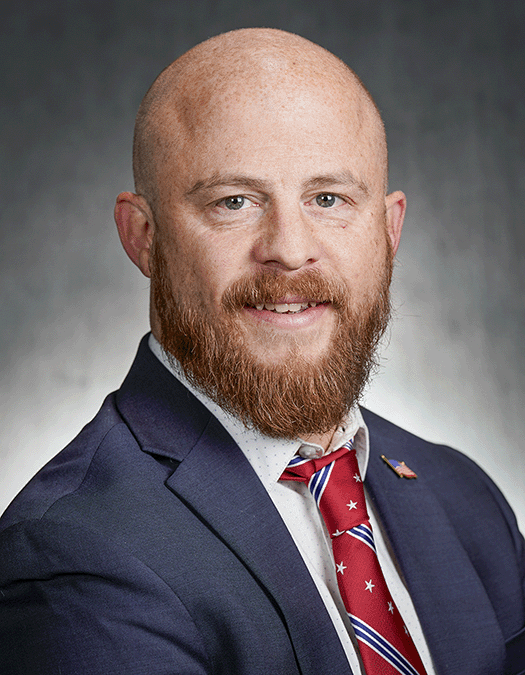
Rep. Drew Roach
Sponsored bills
Maddy summaryHF 13 would amend Minnesota Statutes section 609.06 to eliminate the requirement that individuals must attempt to retreat before using reasonable force in self-defense or defense of others. The bill specifically removes the "duty to retreat" provision, allowing people to use force without first trying to avoid confrontation if they reasonably believe it is necessary. This change would directly affect Minnesotans using force to defend themselves or others in situations where they perceive an immediate threat. The bill was introduced but not passed, as it was laid on the table during the 2025 legislative session.
Maddy summaryThis bill restricts how parents and guardians in Minnesota can delegate their legal authority over a child's care, custody, or property to another person. It requires that anyone receiving delegated powers must be a U.S. citizen and have no criminal convictions for crimes against minors. The law also mandates that parents notify other parents about power delegations unless specific exceptions apply, such as limited parenting time or existing protection orders. Professional guardians face stricter rules, including a 30-day limit on delegation and a requirement to submit the delegation to the court.
Maddy summaryHF 100 would amend Minnesota tax law to allow taxpayers to subtract the full amount of their Social Security benefits from their state taxable income, removing previous limits. Currently, Minnesota caps this subtraction at $5,840 for joint filers, $4,560 for singles, and lower amounts for separate filers. The bill eliminates these maximums, meaning eligible taxpayers could deduct all their Social Security benefits without reduction. It directly affects Minnesota residents receiving Social Security income who file state tax returns. The change takes effect for taxable years beginning after December 31, 2024.
Maddy summaryThis bill creates a new crime called disruption of worship services in Minnesota, targeting individuals who enter religious buildings with the intent to disrupt scheduled services by committing a crime. The law defines a religious establishment as a building used for worship that is clearly marked with a sign or other identifier. First-time offenders face gross misdemeanor charges, while repeat offenders could be charged with a felony punishable by up to five years in prison or a fine of $10,000 or both. The provisions take effect on August 1, 2026, and apply only to crimes committed on or after that date.
Maddy summaryThis bill requires publicly funded state and local correctional facilities in Minnesota to check the immigration status of certain noncitizens and notify U.S. Immigration and Customs Enforcement when they are housed there. The law applies to individuals in pretrial confinement, those convicted of felonies, and people committed to mental health institutions, mandating that facility officers immediately report nationality, conviction details, commitment duration, citizenship country, and last entry information to federal immigration authorities. Additionally, the bill requires a one-time review of all felony inmates in public facilities by July 1, 2026, to identify any noncitizens and report their status to federal officials. This policy change directly affects correctional facilities, sheriffs, and county officials who manage public institutions, while requiring them to share specific inmate information with U.S. immigration officers.
Maddy summaryThis bill would allow Minnesota residents to subtract certain capital gains from the sale of their main home from their state income tax. It creates a new provision that mirrors the federal tax exclusion limits, letting homeowners exclude up to $250,000 or $500,000 in gains depending on their filing status. The change would apply to taxable years starting after December 31, 2025, and only affects properties that qualify for the federal principal residence exclusion.
Maddy summaryThis bill prohibits individuals convicted of a crime of violence from receiving Minnesota's major public assistance programs, including MFIP, medical assistance, food support, and MinnesotaCare. It achieves this by adding new disqualification clauses to existing state statutes that specifically target those with violent crime convictions, while maintaining eligibility rules for other offenses. The law applies to convictions under Minnesota law or equivalent statutes from other states or the federal government, and it removes a previous provision that allowed certain drug-related benefits to continue under specific conditions.
Maddy summaryThis bill modifies MinnesotaCare eligibility rules to exclude undocumented noncitizens from receiving coverage. It directly affects individuals residing in Minnesota without legal immigration status, removing their access to the state's health insurance program. The legislation defines undocumented noncitizens as those living in the United States without approval from U.S. Citizenship and Immigration Services and requires families with citizen children to provide documentation proving their citizenship status. The change takes effect immediately upon final enactment, with no grandfathering provisions for adults who were previously enrolled in MinnesotaCare.
Maddy summaryThis bill allows the city of Farmington to issue social district licenses, enabling designated areas where people can consume alcoholic beverages purchased from nearby licensed establishments. The legislation requires cities to clearly define district boundaries with posted signs, establish management plans for public safety, and mandate that drinks be in non-glass containers with specific labeling requirements. Only beverages bought from participating on-sale licensees can be consumed in the district, and all drinks must be disposed of before leaving the area unless the person returns to the place of purchase. The city must also submit a report within 24 months detailing the district's operation, community response, and any public safety concerns.