

Maddy summaryThis bill makes it a crime in Minnesota to intentionally create or share images that digitally alter a person to appear nude or engaging in a sexual act without their consent. It specifically targets realistic images generated from original photos or videos where the individual was not originally depicted in that state. The law applies to anyone who knows or should know the person did not agree to the image being made or shared, and it covers cases where the person can be identified from the image or accompanying information. Violations are classified as felonies punishable by up to five years in prison or a $10,000 fine, with harsher penalties of up to ten years or a $20,000 fine for aggravating factors like intent to profit, harassment, or operating a website dedicated to this activity.
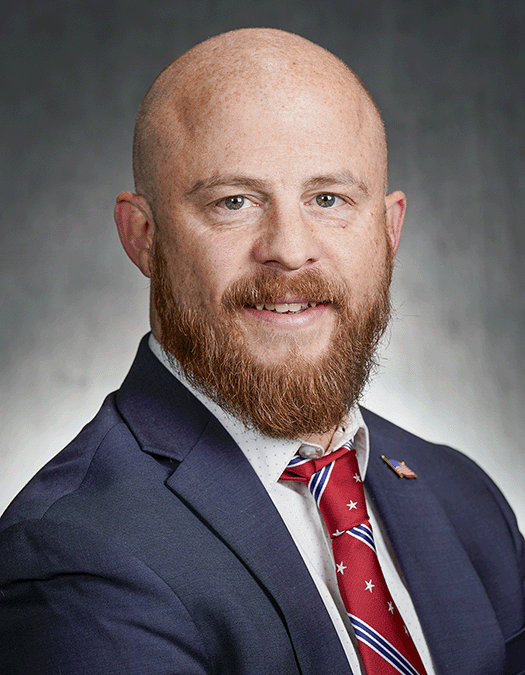
Rep. Drew Roach
Sponsored bills
Maddy summaryThis bill proposes adding a new section to the Minnesota Constitution that explicitly states a preborn child has a right to life. It defines a preborn child as a living human fetus from fertilization until live birth and requires voter approval at the 2026 general election for the amendment to take effect in 2027. The text includes specific language ensuring that medical treatment to save a pregnant person's life or the removal of a nonviable or deceased fetus remains allowed.
Maddy summaryThis bill prohibits Minnesota municipalities from signing nondisclosure agreements that prevent them from sharing information about projects funded with public money. It directly affects local governments, including cities, counties, school districts, and other political subdivisions that manage public funds. The law makes any such restrictive contracts automatically unenforceable and requires municipalities to publicly disclose any agreements that violate this rule. The provision specifically covers projects involving land development, economic initiatives, tax revenues, bonds, and other debt obligations.
Maddy summaryThis bill establishes a "Parent's Bill of Rights" in Minnesota to protect the authority of parents over their minor children's upbringing, education, and healthcare. It mandates that government entities and schools cannot interfere with parental decisions regarding education methods, moral training, medical consent, and the privacy of school and medical records. The law also requires written parental consent before biometric scans, DNA collection, or recording a child, with specific exceptions for emergencies or legitimate security needs. Additionally, it prohibits employees from pressuring children to hide information from parents or from discriminating against parents who exercise these rights.
Maddy summaryThis bill makes it a crime to digitally alter or generate images of identifiable people to show intimate parts they did not originally have, provided the result looks realistic enough that a reasonable person would believe it is real. It directly affects anyone who intentionally creates such non-consensual "nudified" photos or videos, classifying the act as a felony punishable by up to two years in prison or a fine of $4,000, or both. The law defines "nudify" specifically as changing an image to depict an intimate area not present in the original while maintaining a realistic appearance that deceives viewers. This provision will only take effect on August 1, 2026, and applies to offenses committed on or after that date.
Maddy summaryThis bill expands the legal definition of a "disorderly house" in Minnesota to include commercial establishments where high-risk sexual activities occur habitually, provided the owner or manager knows about them. The legislation specifically defines "high-risk sexual conduct" as activities likely to spread diseases through bodily fluid exchange, such as anonymous sex or sex with multiple partners. While the law already covers places involved in prostitution, gambling, or drug sales, this change adds a new category targeting venues facilitating unsafe sexual behavior. The new provisions will take effect on August 1, 2026, and apply to crimes committed on or after that date.
Maddy summaryHF 482 establishes "Choose Life" special license plates for Minnesota motor vehicle owners. To obtain these plates, applicants must pay a $25 initial fee and $25 annual contribution to a dedicated "Choose Life account," in addition to standard registration fees. Funds collected are deposited into this account and distributed by Choose Life Minnesota, Inc., to non-profit agencies within each county that assist pregnant women making adoption plans - excluding any agencies involved in abortion services or charging fees for services. The bill also specifies plate design requirements (featuring the "Choose Life" logo and inscription) and limits administrative costs for the program to 15% of funds. The program becomes effective January 1, 2026.
Maddy summaryThis bill creates a new tax subtraction for Minnesota individual income tax that reduces taxable income for taxpayers aged 65 and older. It applies to both single filers and married couples filing jointly, where the subtraction covers income received by any spouse who has reached age 65 during the tax year. The provision defines "income" broadly to include amounts included in adjusted gross income or required to be added back under existing tax rules. The bill would take effect for taxable years beginning after December 31, 2025, meaning it would apply to tax returns filed in 2026 and later.
Maddy summaryThis bill establishes the SAVE Minnesota Act, which requires voters to present a specific photo identification card to register to vote and to cast their ballots. To obtain this new voter identification card, applicants must provide proof of their U.S. citizenship and may receive certain vital records, such as birth certificates, without a fee. The legislation also creates a new voter identification card program, modifies existing driver's license requirements, and sets up a process for handling provisional ballots. Additionally, the bill includes funding provisions to support the administration of these new election procedures and establishes a children's trust fund.
Maddy summaryThis bill is a House resolution that formally impeaches Minnesota Governor Timothy J. Walz for alleged corrupt conduct in office. It directly affects the Governor by charging him with four specific articles of misconduct, including concealing fraud in state programs, obstructing oversight investigations, prioritizing political narratives over transparency, and failing to enforce laws protecting public funds. If adopted by the House, the resolution would immediately suspend the Governor's duties while the Senate conducts a trial to determine whether he should be removed from office. The bill also requires the Speaker of the House to serve formal notice of the charges to the Governor and directs the Chief Clerk to send copies of the resolution to relevant state officials.