Maddy summaryHF 412 requires members of Minnesota's education policy and finance legislative committees to observe a teacher or administrator for at least 12 hours over a two-year period. Committee members must submit detailed reports - including date, school, and grade levels observed - to legislative leadership, with all reports published online by the Legislative Reference Library. The House and Senate are also required to adopt rules to implement these requirements. The bill takes effect on July 1, 2025.
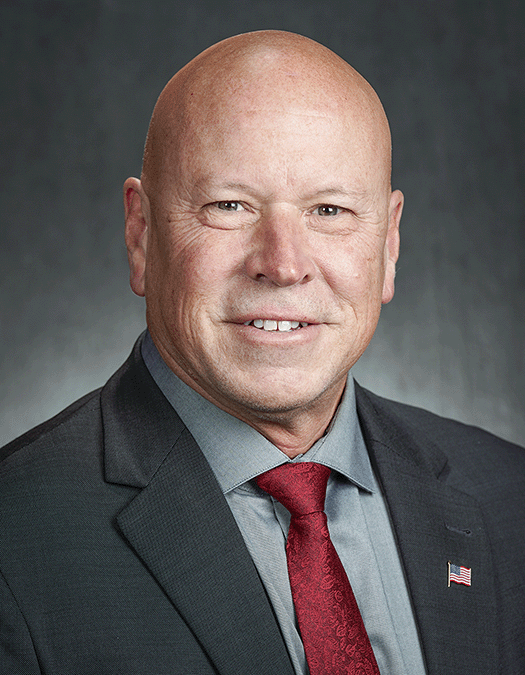
Rep. Wayne Johnson
Sponsored bills
Maddy summaryThis bill modifies how the state of Minnesota calculates registration taxes for passenger automobiles and hearses, directly affecting vehicle owners and dealers. It lowers the tax rate applied to the manufacturer's suggested retail price from 1.54% to 1.25% for cars registered before November 2020, and from 1.575% to 1.285% for newer vehicles, while also removing destination charges from the calculation for most cars. The legislation adjusts the percentage of the vehicle price used for tax purposes as the car ages, reducing the rate each year until it reaches a flat fee in the eleventh year. These tax changes are scheduled to take effect for registration periods beginning on or after January 1, 2027.
Maddy summaryThis bill increases the time limit for prosecuting certain financial crimes in Minnesota, specifically targeting medical assistance fraud and theft of government funds. It directly affects prosecutors and law enforcement by extending the window in which they can file charges for these offenses. The key provision adds a 15-year statute of limitations for theft involving public money belonging to the state or local agencies, while also updating time limits for other financial crimes ranging from five to ten years depending on the specific offense. These changes apply to crimes committed on or after August 1, 2026, and to older crimes if the prosecution deadline has not yet passed.
Maddy summaryHF 3602 requires all Minnesota public schools (K-12) to develop and adopt evidence-based school safety plans by May 2028, with the Minnesota School Safety Center reviewing and approving these plans. The bill establishes a School Safety Advisory Council, appropriates funding for the Center to create a model safety plan, and mandates that schools include mental health support and positive climate efforts in their plans. Schools failing to adopt approved plans must notify parents and staff by August 2028, and the Center must publicly report on compliance by December 2028. The law defines "evidence-based" using research standards like experimental studies or strong research rationale, and requires the Center to employ at least two mental health professionals.
Maddy summaryThis bill requires drivers to stop at least 20 feet away from a school bus displaying flashing red lights while children are boarding or exiting. It directly affects all drivers approaching school buses on Minnesota roads, mandating they remain stopped until the red lights cease flashing. The bill also adds a new provision warning drivers that amber lights indicate red lights will soon activate, requiring them to prepare to stop. These changes aim to improve safety for children near school bus stops. The bill is currently pending passage after committee approval.
Maddy summaryThis bill updates Minnesota's state tax code to align with recent federal changes regarding dependent care assistance programs. It directly affects Minnesota taxpayers who receive employer-provided dependent care benefits by ensuring their state tax treatment matches federal rules. The key provision amends the state's definition of the Internal Revenue Code to include new federal exclusions for dependent care assistance, with changes applying retroactively to when the federal law took effect. This adjustment ensures Minnesota residents do not pay state tax on dependent care assistance that is already excluded from federal taxable income.
Maddy summaryHF 3198 appropriates $2 million for fiscal year 2026 and $1 million for fiscal year 2027 from the state general fund to the city of Brooklyn Park. This funds the Northwest Metro Regional Real Time Crime Center (RTCC), which serves six participating cities (Brooklyn Center, Brooklyn Park, Crystal, Golden Valley, New Hope, and Robbinsdale) to enhance public safety through real-time data analysis, coordination between law enforcement agencies, and community intervention staff. The RTCC must operate as a centralized facility with technology and staff to monitor and respond to criminal activity across jurisdictional lines. An advisory board, composed of police department representatives and mayors from each city, oversees the center and must submit biennial reports to the governor and legislative committees starting in 2027.
Maddy summaryHF 641 expands Minnesota's fourth-degree assault law to specifically protect healthcare workers. It makes it a felony to physically assault a nurse, physician, or other healthcare provider in a hospital emergency department, causing physical injury. The penalty includes up to two years in prison, a $4,000 fine, or both. This law applies to crimes committed on or after August 1, 2025, and directly affects healthcare workers providing emergency care. The bill adds this protection alongside existing safeguards for firefighters and emergency medical personnel.
Maddy summaryHF 495 creates a new tax subtraction for Minnesota individual income taxpayers who pay for licensed child care. It allows taxpayers to subtract day care costs paid to licensed programs (like centers or family child care) from their taxable income, but only for amounts exceeding any dependent care benefits they already excluded from federal income tax. This change applies to taxable years beginning after December 31, 2024, and directly affects Minnesota taxpayers with qualifying child care expenses. The bill does not change existing federal tax rules but adds a state-level benefit for eligible costs.
Maddy summaryThis bill expands the investigative authority of Minnesota's Office of the Foster Youth Ombudsperson to better protect children in foster care. It grants the ombudsperson the power to enter and inspect any facility where a foster youth lives, including detention centers and treatment facilities, without prior notice. The office will also gain direct access to social services and medical records, the ability to subpoena witnesses and documents, and the authority to receive complaints from any source regarding a child's safety or welfare. Additionally, the law requires placement managers and caregivers to immediately forward any communications from foster youth to the ombudsperson without opening them first.