Maddy summaryHF 532 appropriates $150,000 for fiscal year 2026 and $150,000 for fiscal year 2027 from the general fund to the commissioner of veterans affairs for veteran retreats at Camp Bliss in Walker. The funds reimburse Independent Lifestyles, Inc. $850 per eligible veteran or family member per visit (up to two visits yearly) for services like therapy, transportation, and camp maintenance. Eligible veterans include former service members with a DD-214 or current military members, and their spouses, domestic partners, or children. This bill directly provides funding for retreat programs supporting veterans and their families through a specific reimbursement mechanism.
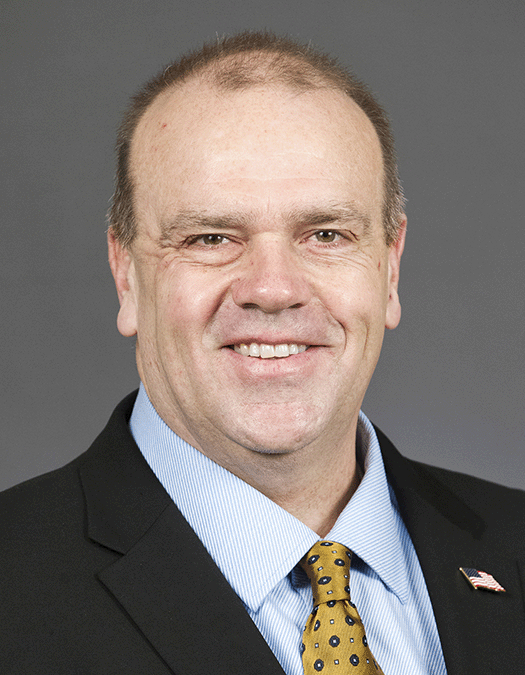
Rep. Matt Bliss
Sponsored bills
Maddy summaryHF 1350 modifies Minnesota's county veterans service office grant program by increasing funding based on each county's veteran population. Counties receive a base $7,500 grant plus supplemental amounts up to $20,000 depending on veteran population size (e.g., $10,000 for counties with 10,000-20,000 veterans). The bill appropriates $60,000 annually for fiscal years 2026-2027 to the Minnesota Association of County Veterans Service Officers, allocating $20,000 each for specialized coordinators focused on women veterans, suicide prevention, and justice-involved veterans. These funds support training, administrative costs, and technical assistance to enhance veteran services statewide. The bill directly affects counties with veterans service offices and the statewide association.
Maddy summaryHF 1444 amends Minnesota Statutes 2024, section 609.06, to clarify that individuals legally permitted to use force in self-defense under specific circumstances (as defined in existing law) are not required to retreat before making a reasonable threat to use force. The bill directly affects Minnesotans claiming self-defense in situations where they could potentially retreat but choose to issue a threat. It adds a new provision stating that no duty to retreat exists in these cases, even if retreat is possible. This change modifies the legal standard for self-defense threats but does not alter when force may be used. The law takes effect the day after final enactment.
Maddy summaryHF 1118 requires Minnesota law enforcement agencies to provide specific benefits to peace officers diagnosed with posttraumatic stress syndrome (PTSD) resulting from work-related traumatic events. The bill mandates agencies pay for unreimbursed lost wages (up to one year) and unreimbursed medical expenses, including psychiatric care (up to one year), if an officer meets all three conditions: 1) suffers a debilitating psychological reaction to a traumatic event, 2) is diagnosed with PTSD by a mental health professional, and 3) cannot perform job duties without reassignment. It clarifies benefits apply regardless of physical injury and defines "traumatic event" to include lawful use of force causing death or serious injury, direct exposure to violence, or witnessing such events. The law affects all Minnesota peace officers covered under the statute and sets clear, time-limited benefit provisions.
Maddy summaryHF 1200 exempts cooperative electric associations in Minnesota from four specific clean energy standards under Minnesota Statutes § 216B.1691. The bill adds a new exemption (subdivision 11) that removes these member-owned utilities from requirements for eligible energy technology, solar energy, carbon-free energy, and distributed solar energy standards. This directly affects cooperative electric associations, which serve many rural and community-based areas across Minnesota. The change modifies the existing law to exclude these cooperatives from the renewable energy targets applied to other electric utilities. The bill does not alter the standards themselves but removes a category of utilities from compliance obligations.
Maddy summaryThis bill prohibits local government officials (mayors, city councils, county boards, or chief law enforcement officers) from disarming peace officers who are in good standing and not under investigation or disciplinary action, unless another law specifically authorizes it. It directly affects peace officers and the local officials who manage their employment. The key provision amends Minnesota Statutes section 626.8452 to add this restriction, ensuring qualified officers cannot be disarmed without legal justification. The law takes effect the day after it is enacted.
Maddy summaryHF 1116 creates a formal process for prosecutors to maintain a "Brady-Giglio list" of Minnesota peace officers with documented credibility issues, such as untruthfulness, criminal convictions, or disciplinary problems. It requires prosecutors to adopt clear policies for adding officers to this list, including providing written notice to the officer before designation and allowing them to review relevant records and request reconsideration. The bill also prohibits law enforcement agencies from firing or disciplining an officer solely because prosecutors identified exculpatory evidence related to the officer. This directly affects peace officers whose credibility is under review and sets new procedural standards for prosecutors handling such cases.
Maddy summaryHF 1119 amends Minnesota law to establish a felony charge for drivers who flee or attempt to flee a peace officer while knowingly evading them and simultaneously violating specific traffic laws. It directly affects drivers who flee police and either fail to obey traffic signs/signals/markings (under MN Statutes 169.06, subdivisions 4, 4a, 4b, 5, 6, 7, or 8) or fail to stay on the proper side of the road (under 169.18). The key provision elevates this behavior to a felony punishable by up to five years in prison, a $10,000 fine, or both. The law takes effect August 1, 2025, applying to offenses committed on or after that date.
Maddy summaryHF 1202 requires certain interagency group meetings to be open to the public. Specifically, it amends Minnesota's open meeting law to include "interagency groups of state employees making recommendations regarding permitting decisions of a public body" under the requirement that all such meetings must be accessible to the public. This directly affects state interagency groups involved in permitting decisions, ensuring their discussions about these decisions are transparent. The bill extends existing public meeting requirements to these specific groups without creating new procedures. (HF 1202, "Interagency group meetings required to be open to the public")
Maddy summaryHF 1201 exempts the Minnesota Department of Transportation (MnDOT) from paying sales and use taxes on materials, supplies, and equipment used for road construction, improvement, and maintenance projects. This policy change directly affects MnDOT by reducing costs for purchasing necessary items for public highway projects. The bill amends Minnesota Statutes to add a specific tax exemption under section 297A.71 for these purchases, effective after June 30, 2025. The change simplifies tax compliance for MnDOT on road-related procurement without altering broader tax policy.