Maddy summaryThis bill establishes a new mandatory health insurance pool specifically for school employees in Minnesota, requiring certain school districts and charter schools to participate. It creates a Labor Management Committee composed of representatives from various teacher and administrator unions to oversee the program, approve changes to cost-sharing plans, and study issues like benefits and cost efficiency. The legislation also defines key terms such as "school employer" and "retired school employee" to clarify who is covered under the new system. Additionally, the bill provides funding and grants the state commissioner authority to manage the program's administration and offer specific coverage options.
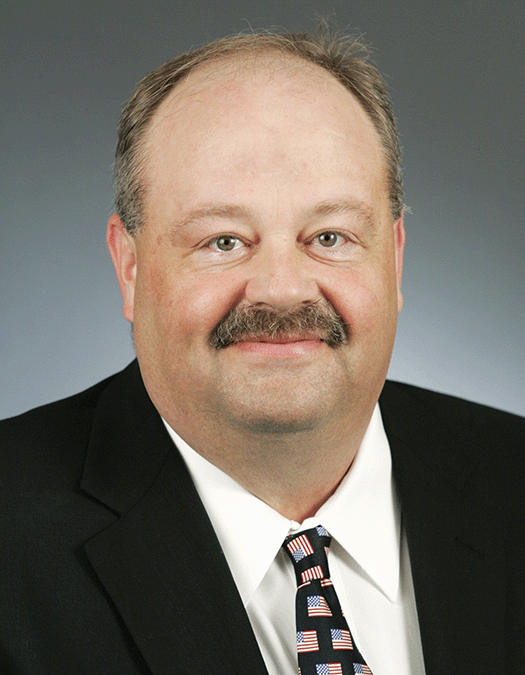
Rep. Greg Davids
Sponsored bills
Maddy summaryThis bill authorizes the state of Minnesota to issue up to $290,000 in bonds to fund the replacement of the Chokio Bridge in Stevens County. The appropriated funds will be given to the commissioner of transportation to design, build, and equip the new bridge on State-Aid Highway 13. The legislation takes effect immediately upon final enactment.
Maddy summaryThis bill requires Minnesota school districts and charter schools to complete an annual health insurance survey and submit detailed reports to the Legislative Budget Office. The surveys must include information on employee counts, insurance premiums paid, plan details, prescription costs, and any compensation paid to insurance brokers or agents. The Legislative Budget Office will compile this data into a public report by December each year, making the information available online in a standardized format. The bill also includes provisions for legal action against schools that fail to submit the required information.
Maddy summaryThis bill makes it a felony to force or coerce a pregnant minor under 18 into seeking or obtaining an abortion, defining coercion broadly to include threats, isolation, financial pressure, and exploiting vulnerabilities. It requires hospitals and other facilities to screen and report suspected cases of human trafficking involving minors. Additionally, the law adds wrongful death as a cause of action for deaths resulting from abortions and mandates the creation of specific rules by the state health commissioner.
Maddy summaryHF 482 establishes "Choose Life" special license plates for Minnesota motor vehicle owners. To obtain these plates, applicants must pay a $25 initial fee and $25 annual contribution to a dedicated "Choose Life account," in addition to standard registration fees. Funds collected are deposited into this account and distributed by Choose Life Minnesota, Inc., to non-profit agencies within each county that assist pregnant women making adoption plans - excluding any agencies involved in abortion services or charging fees for services. The bill also specifies plate design requirements (featuring the "Choose Life" logo and inscription) and limits administrative costs for the program to 15% of funds. The program becomes effective January 1, 2026.
Maddy summaryThis bill proposes significant changes to Minnesota's tax system, including a new gross receipts tax on firearms and a new tax on social media companies, while simultaneously lowering the statewide sales tax rate and expanding the range of items subject to it. The legislation also introduces a commission on artificial intelligence, modifies existing credits for sustainable aviation fuel and historic structure rehabilitation, and updates tax laws to align with federal reporting requirements for various income payments. Additionally, the bill adjusts the dependent care credit, alters the cannabis gross receipts tax, and appropriates funds for state operations.
Maddy summaryThis bill modifies Minnesota's individual and corporate franchise taxes by updating how nonresident partners, shareholders, and beneficiaries of estates or trusts can file composite tax returns. It allows these entities to elect a simplified filing method where the partnership or corporation calculates and pays the tax on their behalf, provided they have no other Minnesota-source income. The legislation also clarifies definitions of net income for trusts, estates, and corporations and removes outdated provisions related to the JOBZ program. These changes will take effect for taxable years beginning after December 31, 2025.
Maddy summaryThis bill creates a new type of supplemental health insurance product in Minnesota specifically designed to cover short-term home health and nursing care services. It directly affects insurance companies, consumers seeking coverage for temporary care needs, and state regulators overseeing insurance markets. The legislation establishes clear definitions for the new insurance category, distinguishing it from long-term care policies and other health products, while setting requirements for policy terms like free-look periods and coverage scope. Additionally, the bill outlines civil penalties for violations and amends existing state statutes to incorporate these new insurance definitions and regulatory standards.
Maddy summaryThis bill amends existing Minnesota law to update the local sales tax authorization for the City of Virginia. It allows the city to collect up to one percent in sales tax revenue specifically to fund the renovation of the Miner's Memorial recreation complex and the conversion of the city's steam system. The legislation also permits the city to issue up to $30 million in bonds to help pay for these projects without needing a separate voter approval. The tax is set to expire on December 31, 2055, or earlier once the city has collected enough funds to cover all project costs and bond interest.
Maddy summaryThis bill establishes a one-time special property tax refund for Minnesota property owners who paid taxes in 2026. It directly affects owners of specific property types, including residential homes, apartments, farms, and forests, by allowing them to apply for a share of a $4 billion fund. To receive money, owners must submit an application to the Department of Revenue between July 15 and September 15, 2026, and the refunds will be distributed by December 31, 2026. The legislation appropriates $4 billion from the state's general fund to finance these payments, with each eligible owner receiving a portion based on their individual tax contribution relative to the total taxes paid by all applicants.