Maddy summaryThis bill establishes a trusted contact program for financial services customers in Minnesota to help prevent and address financial exploitation and fraud. It allows customers to designate a trusted adult contact who can be reached by financial institutions in emergencies, when contact is lost, or when fraud is suspected. The bill also permits financial institutions to report suspected fraud or exploitation to law enforcement without liability and limits legal responsibility for both institutions and trusted contacts who act in good faith. Additionally, it allows banks to offer optional account features that let trusted contacts view account activity and set transaction limits for enhanced security.

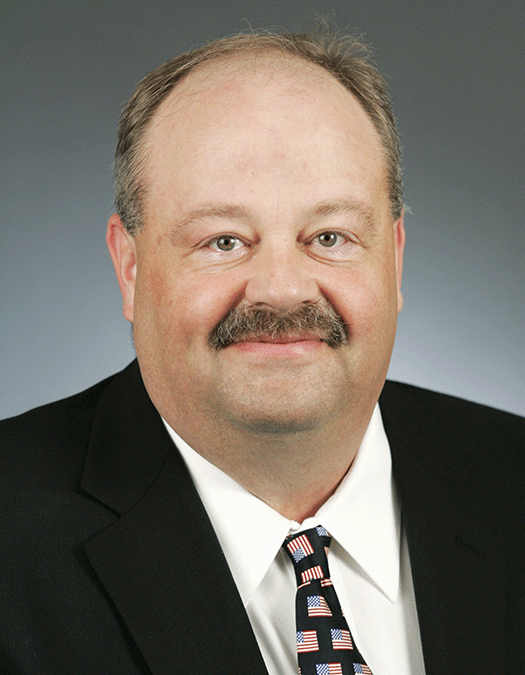
Rep. Greg Davids
Sponsored bills
Maddy summaryHF 1606 prohibits websites, apps, software, or programs from allowing users to access, download, or use technology that alters images or videos to reveal private body parts (defined as "nudification"). It directly affects platform operators who host such tools and individuals whose images are altered without consent. The bill creates civil lawsuits for victims, allowing them to seek triple damages, punitive penalties, and attorney fees, while imposing $500,000 civil penalties per violation on violators. It becomes effective August 1, 2025, targeting the unauthorized use of image-altering technology that could harm individuals' privacy.
Maddy summaryThis Minnesota bill requires large social media platforms to implement specific protections for children under 18, including restrictions on addictive design features like infinite scrolling, autoplay videos, and personalized feeds. The law applies to platforms that earn at least $1 billion in annual advertising revenue and defines "addictive interface features" in detail, such as push notifications and metrics showing likes or follower counts. Parents of children under 15 must receive clear notifications about their child's online activity, and platforms must provide tools for parents to manage their child's account settings. The bill also establishes enforcement mechanisms and sets up a new chapter in Minnesota statutes to govern these requirements.
Maddy summaryHF 2438 is a funding bill that allocates $4.88 billion for Minnesota's Department of Transportation (DOT) in fiscal year 2026 and $3.96 billion in 2027. It specifies funding sources including the trunk highway fund ($3.43 billion for 2026), airports fund ($28 million annually), and county/municipal state-aid highway funds. The bill directs funds toward existing programs like airport development, aviation support services, and Civil Air Patrol, with no new policy changes. It affects state agencies managing transportation infrastructure, airports, and highway systems, not individual citizens or businesses. This is a routine budget appropriation, not a policy bill.
Maddy summaryThis bill proposes a constitutional amendment to modify how Minnesota's permanent school fund is invested, managed, and distributed to school districts. The key change would require the fund to be managed as a perpetual resource that preserves its purchasing power over time while providing annual distributions to support schools without raising individual taxes. The amendment establishes a board of investment led by the governor, state auditor, secretary of state, and attorney general, and prohibits the use of state funds to underwrite municipal securities. If approved by voters in 2026, the new policy would take effect on July 1, 2027, with specific rules for calculating distributable amounts and handling investment gains and losses.
Maddy summaryHF 5092 modifies how Minnesota distributes revenue from mineral production taxes to school districts. The bill updates the specific dollar amounts and formulas used to allocate funds, ensuring that districts near taconite mines and those in designated tax relief areas receive their designated shares. It also clarifies how money from specific mining facilities is directed to particular school districts and establishes rules for funding early childhood programs in qualifying areas.
Maddy summaryHF 2133 makes a technical correction to Minnesota's tax law regarding credits for pass-through entity taxes paid to other states. The bill clarifies that businesses structured as pass-through entities (such as partnerships, LLCs, and S corporations) and their owners can claim a credit for taxes paid to another state, specifying how this credit must be claimed per tax commissioner rules. It also aligns the credit's expiration with a federal tax provision without affecting the state's authority to audit or assess claims. This amendment corrects a technical error in existing law to ensure the credit is applied as intended, without changing tax rates or eligibility.
Maddy summaryThis bill clarifies how Minnesota school districts and charter schools receive state library aid based on student enrollment. It specifies that regular school districts get aid equal to the greater of $16.11 per student or $40,000, while charter schools receive the greater of $16.11 per student or $20,000. The change retroactively applies to fiscal year 2024 and future years, ensuring consistent funding calculations. This directly affects all public school districts and charter schools eligible for state library aid under Minnesota Statutes.
Maddy summaryThis bill amends Minnesota statutes to update pension contribution rates and annuity calculation formulas for teachers in the state's retirement systems. It establishes specific employer contribution percentages for certain districts like Minneapolis and Duluth while adjusting the rates for other districts. Additionally, the legislation modifies how retirement annuities are computed based on years of service, distinguishing between different periods of employment and membership types. These changes directly affect teachers and school districts in Minnesota by altering the financial terms of their retirement benefits.
Maddy summaryHF 3727 increases property tax relief for Minnesota veterans with service-connected disabilities by raising the market value exclusion amounts. Veterans with a 70% or higher disability rating now qualify for a $200,000 exclusion (up from $150,000), while those with a total and permanent 100% disability qualify for $400,000 (up from $300,000). The bill applies to veterans owning their primary residence ("homestead") in Minnesota, requiring certification of disability by the U.S. Department of Veterans Affairs and honorable military discharge. Surviving spouses of qualifying veterans may also inherit this tax benefit under specific conditions. This change directly reduces taxable value for eligible veterans’ primary homes, lowering their property tax burden.