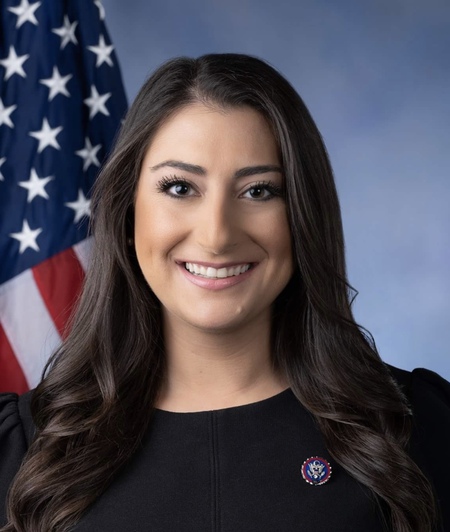
Photo of Sara Jacobs
D United States House · District 51 · California On the 2026 ballot

Rep. Sara Jacobs

Compare
Total votes
2,837
all sessions
Attendance
98%
46 missed
Higher than 92% of chamber peers
With party
98%
of cast votes
Near the chamber average
Bipartisan score
1%
crosses aisle rarely
Near the chamber average
Sponsored
1,472
bills & resolutions
Near the chamber average
Committees
6
assignments
1,472 bills and resolutions

Sponsored bills

Total
1,472
Primary
79
Co-sponsor
1,393
This page
1,472
matching current filters
Co-sponsor HR 842
Passed · Michigan House · Co-sponsor
Protecting the Right to Organize Act of 2021

Protecting the Right to Organize Act of 20 21 This bill expands various labor protections related to employees' rights to organize and collectively bargain in the workplace. Among other things, it (1) revises the definitions of employee , supervisor , and employer to broaden the scope of individuals covered by the fair labor standards; (2) permits labor organizations to encourage participation of union members in strikes initiated by employees represented by a different labor organization (i.e., secondary strikes); and (3) prohibits employers from bringing claims against unions that conduct such secondary strikes. The bill also allows collective bargaining agreements to require all employees represented by the bargaining unit to contribute fees to the labor organization for the cost of such representation, notwithstanding a state law to the contrary; and expands unfair labor practices to include prohibitions against replacement of, or discrimination against, workers who participate in strikes. The bill makes it an unfair labor practice to require or coerce employees to attend employer meetings designed to discourage union membership and prohibits employers from entering into agreements with employees under which employees waive the right to pursue or a join collective or class-action litigation. The bill further prohibits employers from taking adverse actions against an employee, including employees with management responsibilities, in response to that employee participating in protected activities related to the enforcement of the prohibitions against unfair labor practices (i.e., whistleblower protections). Such protected activities include providing information about a potential violation to an enforcement agency, participating in an enforcement proceeding, initiating a proceeding concerning an alleged violation or assisting in such a proceeding, or refusing to participate in an activity the employee reasonably believes is a violation of labor laws. Finally, the bill addresses the procedures for union representation elections, provides employees with the ability to vote in such elections remotely by telephone or the internet, modifies the protections against unfair labor practices that result in serious economic harm, and establishes penalties and permits injunctive relief against entities that fail to comply with National Labor Relations Board orders.

Passed Mar 11, 2021 1 co-sponsor
Co-sponsor HR 1
Passed · Michigan House · Co-sponsor
For the People Act of 2021

For the People Act of 2021 This bill addresses voter access, election integrity and security, campaign finance, and ethics for the three branches of government. Specifically, the bill expands voter registration (e.g., automatic and same-day registration) and voting access (e.g., vote-by-mail and early voting). It also limits removing voters from voter rolls. The bill requires states to establish independent redistricting commissions to carry out congressional redistricting. Additionally, the bill sets forth provisions related to election security, including sharing intelligence information with state election officials, supporting states in securing their election systems, developing a national strategy to protect U.S. democratic institutions, establishing in the legislative branch the National Commission to Protect United States Democratic Institutions, and other provisions to improve the cybersecurity of election systems. Further, the bill addresses campaign finance, including by expanding the prohibition on campaign spending by foreign nationals, requiring additional disclosure of campaign-related fundraising and spending, requiring additional disclaimers regarding certain political advertising, and establishing an alternative campaign funding system for certain federal offices. The bill addresses ethics in all three branches of government, including by requiring a code of conduct for Supreme Court Justices, prohibiting Members of the House from serving on the board of a for-profit entity, and establishing additional conflict-of-interest and ethics provisions for federal employees and the White House. The bill requires the President, the Vice President, and certain candidates for those offices to disclose 10 years of tax returns.

Passed Mar 11, 2021 1 co-sponsor
Co-sponsor HR 1670
In committee · Michigan House · Co-sponsor
Abortion is Health Care Everywhere Act of 2021

Abortion is Health Care Everywhere Act of 2021 This bill authorizes the use of certain foreign assistance funds to provide comprehensive reproductive health care services in developing countries, including abortion services, training, and equipment.

In committee Mar 9, 2021 1 co-sponsor
Co-sponsor HR 1280
Passed · Michigan House · Co-sponsor
George Floyd Justice in Policing Act of 2021

George Floyd Justice in Policing Act of 2021 This bill addresses a wide range of policies and issues regarding policing practices and law enforcement accountability. It increases accountability for law enforcement misconduct, restricts the use of certain policing practices, enhances transparency and data collection, and establishes best practices and training requirements. The bill enhances existing enforcement mechanisms to remedy violations by law enforcement. Among other things, it does the following: lowers the criminal intent standard—from willful to knowing or reckless—to convict a law enforcement officer for misconduct in a federal prosecution, limits qualified immunity as a defense to liability in a private civil action against a law enforcement officer, and grants administrative subpoena power to the Department of Justice (DOJ) in pattern-or-practice investigations. It establishes a framework to prevent and remedy racial profiling by law enforcement at the federal, state, and local levels. It also limits the unnecessary use of force and restricts the use of no-knock warrants, chokeholds, and carotid holds. The bill creates a national registry—the National Police Misconduct Registry—to compile data on complaints and records of police misconduct. It also establishes new reporting requirements, including on the use of force, officer misconduct, and routine policing practices (e.g., stops and searches). Finally, it directs DOJ to create uniform accreditation standards for law enforcement agencies and requires law enforcement officers to complete training on racial profiling, implicit bias, and the duty to intervene when another officer uses excessive force.

Passed Mar 9, 2021 1 co-sponsor
Co-sponsor HR 1627
In committee · Michigan House · Co-sponsor
Capitol Remembrance Act

Capitol Remembrance Act This bill requires the Architect of the Capitol (AOC) to design and install in a prominent location in the U.S. Capitol a permanent exhibit that depicts the January 6, 2021, attack on the Capitol. To the extent possible, the AOC must preserve property that was damaged during the attack and include it in the exhibit. The AOC must also include (1) existing photographic records relating to the attack; and (2) a plaque to honor the U.S. Capitol Police and other law enforcement agencies that protected the Capitol, the individuals who died or sustained injuries to protect the Capitol, and the staff who helped restore the Capitol complex after the attack.

In committee Mar 8, 2021 1 co-sponsor
Co-sponsor HRES 25
In committee · Michigan House · Co-sponsor
Directing the Committee on Ethics to investigate, and issue a report on, whether any and all actions taken by Members of the 117th Congress who sought to overturn the 2020 Presidential election violated their oath of office to uphold the Constitution or the Rules of the House of Representatives, and should face sanction, including removal from the House of Representatives.

This resolution requires the House Committee on Ethics to investigate and report on whether (1) actions taken by Members of the 117th Congress seeking to overturn the 2020 Presidential election violated their oath of office; and (2) these Members should face sanction, including removal from the House of Representatives. It also condemns all targeted and malicious efforts to disenfranchise Black, Brown, and Indigenous voters.

In committee Mar 4, 2021 1 co-sponsor
Co-sponsor HRES 32
In committee · Michigan House · Co-sponsor
Impeaching Donald John Trump, President of the United States, for high crimes and misdemeanors.

This resolution impeaches President Donald John Trump for high crimes and misdemeanors. Specifically, the resolution sets forth two articles of impeachment. The first article states that President Trump abused the powers of the presidency by attempting to unlawfully overturn the results of Georgia's presidential election. The article specifies that President Trump, on a recorded call, repeatedly asked the Secretary of State of Georgia to overturn the verified results of the election and threatened consequences for a failure to do so. The second article states that President Trump abused the powers of the presidency by inciting violence and orchestrating an attempted coup. The article specifies that, on January 6, 2021, President Trump incited a crowd of supporters to attack the Capitol while Congress was in session to certify the results of the election. The article further specifies that, after those supporters had violently breached the Capitol, President Trump made a statement repeating his false claims of election fraud and expressing affection for the supporters. Both articles state that, by such conduct, President Trump warrants impeachment and trial, removal from office, and disqualification from holding U.S. office.

In committee Mar 4, 2021 1 co-sponsor
Co-sponsor HR 276
In committee · Michigan House · Co-sponsor
Congressional Oversight of Unjust Policing Act

Congressional Oversight of Unjust Policing Act This bill establishes the U.S. Commission on Unjust Policing to investigate law enforcement activities and decisions related to the security breach at the U.S. Capitol on January 6, 2021. Specifically, the commission must investigate decisions made by leadership of the U.S. Capitol Police (USCP), the Federal Bureau of Investigation, the U.S. Secret Service, and the Department of Homeland Security leading up to and during the siege at the Capitol, including an assessment of whether conscious and unconscious bias was a factor in the miscalculation of the risk posed by protesters to Members of Congress and their staff. The commission must also investigate whether current USCP officers have ties to white supremacist and other extremist groups, movements, and organizing efforts, and whether any USCP officers neglected their duty and colluded with protestors or other law enforcement entities. Further, the commission must recommend specific measures and reforms related to realigning (1) USCP priorities and practice to address disparate use of force and surveillance targets in and around the Capitol; and (2) USCP recruitment, hiring, and retention policies and practices to address conscious and unconscious biases.

In committee Mar 4, 2021 1 co-sponsor
Showing 1,411 to 1,420 of 1,472 bills