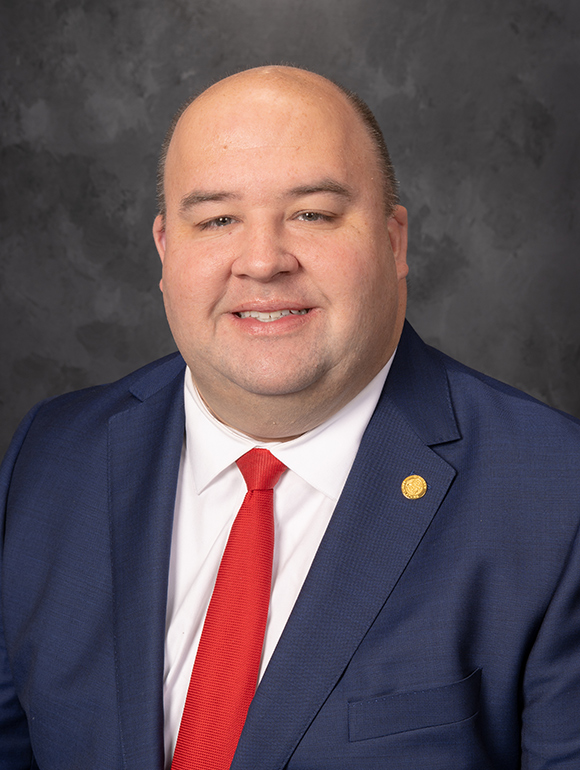
Photo of Michael Webber
R Michigan Senate · District 9 On the 2026 ballot

Sen. Michael Webber

Compare
Total votes
1,323
all sessions
Attendance
100%
1 missed
Higher than 92% of chamber peers
With party
84%
of cast votes
Lower than 85% of chamber peers
Bipartisan score
9%
crosses aisle rarely
Higher than 81% of chamber peers
Sponsored
271
bills & resolutions
Near the chamber average
Committees
3
assignments
271 bills and resolutions

Sponsored bills

Total
271
Primary
77
Co-sponsor
194
This page
271
matching current filters
Co-sponsor SB 1061
In committee · Michigan Senate · Co-sponsor
Occupations: mortuary science; crematory facility and operator licenses; provide for. Amends sec. 1851 of 1980 PA 299 (MCL 339.1851) & adds art. 18B. TIE BAR WITH: SB 1063'26

Maddy summaryThis bill establishes new licensing requirements for crematory facilities and operators in Michigan to regulate the practice of cremation. It creates a specific license for the facility itself, which requires a $100,000 surety bond, proof of environmental and fire safety approvals, and full disclosure of ownership details. Additionally, the bill mandates that individuals operating or managing a crematory must hold an operator license obtained through approved training and a character review. The legislation also grants the state department authority to inspect these facilities and revoke licenses if standards are not met or ownership changes occur.

In committee Jun 23, 2026 1 co-sponsor
Co-sponsor SB 1068
In committee · Michigan Senate · Co-sponsor
Occupations: mortuary science; crematory ownership and regulation; modify. Amends sec. 2 of 1968 PA 251 (MCL 456.522). TIE BAR WITH: SB 1061'26, SB 1063'26

Maddy summarySB 1068 updates the definitions within Michigan's Cemetery Regulation Act to clarify terms related to mortuary science and crematory ownership. The bill specifically redefines "cemetery" to explicitly include crematories and columbariums, while also refining descriptions for related concepts like "interment," "mausoleum," and "operator." These changes aim to ensure the law accurately covers various methods of handling human remains and the entities responsible for them. The legislation does not take effect until two other related bills, SB 1061 and SB 1063, are also passed by the legislature.

In committee Jun 23, 2026 1 co-sponsor
Co-sponsor SB 1065
In committee · Michigan Senate · Co-sponsor
Occupations: mortuary science; references to article 18 of the occupational code in 1953 PA 181; revise. Amends sec. 5 of 1953 PA 181 (MCL 52.205). TIE BAR WITH: SB 1060'26

Maddy summaryThis bill amends Michigan's medical examiner laws to clarify procedures for handling deceased individuals, particularly those who died violently or without medical care. It requires county medical examiners to take charge of bodies found in their counties and allows them to use designated investigators who must be independent of funeral homes to conduct inquiries and transport remains. The legislation also updates rules for identifying decedents when visual identification is impossible, mandates written records of autopsy details and notification efforts, and establishes a liability shield for examiners acting in good faith during these duties.

In committee Jun 23, 2026 1 co-sponsor
Primary SB 1064
In committee · Michigan Senate · Lead sponsor
Cemeteries and funerals: other; funeral establishments to have refrigeration units in certain circumstances; require. Amends sec. 1809 of 1980 PA 299 (MCL 339.1809). TIE BAR WITH: SB 1060'26, SB 1061'26

Maddy summarySenate Bill 1064 amends Michigan's occupational code to update requirements for funeral establishments, primarily affecting business owners and managers in the funeral industry. The bill mandates that managers must reside within 75 miles of their establishment and limits an individual to managing only one funeral home, though a state director may grant a waiver for managing two if the locations are in the same or neighboring counties with low population density. Additionally, the legislation requires all funeral homes to have on-site refrigeration units capable of storing bodies at temperatures not exceeding 40 degrees Fahrenheit, unless they have a contract with a nearby facility that provides such storage. The bill also clarifies rules regarding branch establishments, sets specific timelines for notifying the state of managerial changes, and outlines inspection rights for state officials. This measure is part of a package of related bills that must all be enacted together for the changes to take effect.

In committee Jun 23, 2026 0 co-sponsors
Co-sponsor SB 1062
In committee · Michigan Senate · Co-sponsor
Occupations: licensing fees; application fees for crematory facility and operator licenses; establish. Amends sec. 43 of 1979 PA 152 (MCL 338.2243). TIE BAR WITH: SB 1060'26, SB 1061'26

Maddy summaryThis bill proposes changes to the fees required for obtaining licenses to operate crematory facilities and to become a crematory operator in Michigan. It amends an existing state law to establish specific application and licensing fees for these roles. The legislation directly affects individuals and businesses seeking to work in or manage cremation services. By setting these fees, the bill aims to create a standardized cost structure for entering the crematory industry.

In committee Jun 23, 2026 1 co-sponsor
Co-sponsor SB 1071
In committee · Michigan Senate · Co-sponsor
Occupations: mortuary science; references to article 18 of the occupational code in the estates and protected individuals code; revise. Amends sec. 3206 of 1998 PA 386 (MCL 700.3206). TIE BAR WITH: SB 1060'26

Maddy summarySB 1071 updates Michigan's Estates and Protected Individuals Code to clarify who has the authority to make funeral arrangements and decide on the disposition of a deceased person's body. The bill establishes a priority list for decision-makers, starting with a pre-designated funeral representative, followed by the surviving spouse, and then children, parents, and other relatives in a specific order. It also sets a 72-hour window for locating these individuals after a death; if they cannot be found or do not act within that time, the authority passes to the next person on the list. Additionally, the legislation restricts who can serve as a funeral representative, barring employees of funeral homes, cemeteries, crematories, or healthcare providers who treated the deceased from holding this role unless they are a surviving spouse or relative.

In committee Jun 23, 2026 1 co-sponsor
Primary SB 1063
In committee · Michigan Senate · Lead sponsor
Cemeteries and funerals: other; refrigeration units inside crematories; require. Amends 1968 PA 251 (MCL 456.521 - 456.543) by adding sec. 12b. TIE BAR WITH: SB 1060'26, SB 1061'26, SB 1068'26

Maddy summaryThis bill requires cemetery owners who operate crematories to install refrigeration units capable of storing deceased bodies at temperatures no higher than 40 degrees Fahrenheit. The rule applies to any body that has not been cremated or embalmed within 24 hours of arriving at the facility. However, the requirement is waived if the owner has a contract with a nearby facility within 50 miles that can store the remains, or if the owner operates a funeral home within that same distance. Additionally, the bill mandates that these crematories continue to comply with existing state regulations regarding occupational safety and public health.

In committee Jun 23, 2026 0 co-sponsors
Co-sponsor SB 1067
In committee · Michigan Senate · Co-sponsor
Occupations: mortuary science; references to article 18 of the occupational code in the public health code; revise. Amends secs. 2843 & 10205 of 1978 PA 368 (MCL 333.2843 & 333.10205). TIE BAR WITH: SB 1060'26

Maddy summaryThis bill updates Michigan's public health code to clarify how funeral directors must report deaths and obtain medical certifications, including specific provisions for infants born alive after attempted abortions. It requires medical certification within 48 hours of death and mandates that death records be filed within 72 hours, while also protecting the privacy of such infants by prohibiting the reporting of identifying information like parental names. Additionally, the legislation defines which facilities are authorized for surgically removing human organs and tissues for transplantation, specifying that these procedures must occur in hospitals, approved facilities, or mortuaries linked to licensed funeral establishments. The bill includes penalties for physicians who fail to certify death records and for individuals who perform organ removals outside of designated locations.

In committee Jun 23, 2026 1 co-sponsor
Co-sponsor SB 1044
In committee · Michigan Senate · Co-sponsor
Individual income tax: property tax credit; definition of homestead; modify. Amends sec. 508 of 1967 PA 281 (MCL 206.508).

Maddy summaryThis bill modifies the definition of a homestead and adjusts how property tax credits are calculated for Michigan residents. It clarifies that unoccupied property leased to others is excluded from homestead status and sets specific acreage limits for agricultural land based on how long a claimant has lived there. Additionally, the legislation updates the rules for determining household resources by excluding certain business, rental, and operating losses from income calculations. These changes directly affect homeowners and renters who rely on property tax credits and aim to refine the criteria used to determine eligibility.

In committee Jun 18, 2026 1 co-sponsor
Co-sponsor SB 1045
In committee · Michigan Senate · Co-sponsor
Individual income tax: property tax credit; owner and eligibility of a homestead placed in certain trusts; clarify. Amends sec. 510 of 1967 PA 281 (MCL 206.510).

Maddy summarySB 1045 clarifies the definition of "owner" for Michigan's homestead property tax credit by explicitly including individuals who place their primary residence into a revocable trust or a qualified personal residence trust. This change ensures that people using these specific types of trusts to hold their homes can still qualify for the tax credit, which is designed to help offset property taxes for homeowners. The bill amends the state's income tax act to update this eligibility rule without altering other parts of the tax code or the credit amount itself.

In committee Jun 18, 2026 1 co-sponsor
Showing 21 to 30 of 271 bills
Previous 1 2 3 4 28 Next