Maddy summarySRES 467 is a Senate resolution designating October 30, 2025, as a national day of remembrance for workers in the U.S. nuclear weapons program, including uranium miners, millers, haulers, plutonium processors, and those who participated in atmospheric nuclear tests. It formally recognizes these workers' contributions and sacrifices, building on previous Senate resolutions from 2009 to 2024 that honored similar service. The resolution encourages public participation in commemorative activities on that date but does not create new benefits or policies. As a symbolic gesture, it focuses solely on recognition, not legislative action.
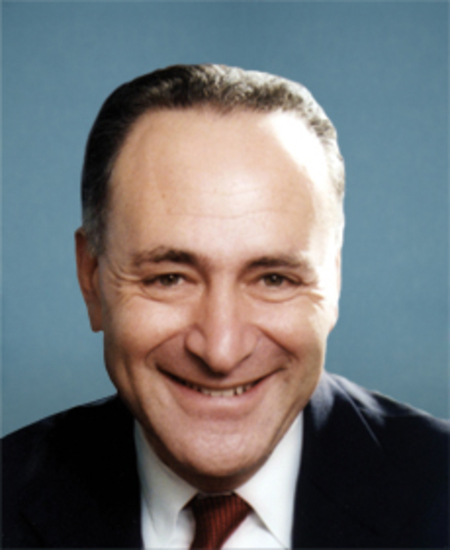
Sen. Charles E. Schumer
Sponsored bills
Maddy summaryThis bill ensures uninterrupted food assistance benefits for SNAP recipients during a government funding gap. If Congress fails to pass full funding for the Department of Agriculture by September 30, 2025, the bill directs the Treasury to provide necessary funds to keep SNAP benefits flowing without interruption. It also covers missed benefits retroactively from September 30, 2025, through the bill’s enactment date. The funding stops once Congress enacts actual fiscal year 2026 appropriations for the Department of Agriculture. This directly affects approximately 40 million low-income individuals and families who rely on SNAP benefits.
Maddy summaryThis Senate resolution (SRES 442) formally condemns recent Russian military incursions into NATO member countries' airspace, citing specific incidents in Poland, Romania, and Estonia during September 2025. It also condemns Russia's ongoing invasion of Ukraine and its refusal to negotiate an end to the war. The resolution reaffirms NATO's Article 5 commitment to collective defense, emphasizing that attacks on any member are considered attacks on all. As a symbolic resolution, it does not create new laws or policies but expresses the Senate's support for NATO allies facing these threats.
Maddy summaryThis bill provides temporary relief to federal workers during government shutdowns by pausing specific civil obligations. It directly affects federal employees (including contractor employees) who are furloughed or working without pay, suspending actions like evictions, mortgage foreclosures, student loan collections, tax payments, and insurance lapses during the shutdown and for 30 days afterward. Key mechanisms include court-ordered stays for rent, mortgages, and loans; automatic student loan deferment; tax payment deferrals; and protection against insurance policy termination due to unpaid premiums. The relief applies only to civil matters (not criminal cases or child support) and requires court involvement for certain actions.
Maddy summaryThis bill prohibits the U.S. Treasury's Exchange Stabilization Fund from providing financial support to Argentina's government or financial markets. It specifically blocks the use of the fund for currency swaps, purchasing Argentine debt, or any credit instruments intended to bail out Argentina. The restriction applies until December 10, 2027, and requires any existing contracts violating this rule to be terminated within seven days of the bill's enactment. The law directly affects the Treasury Department's use of its financial tools, not Argentina itself.
Maddy summarySRES 428 is a Senate resolution recognizing Hispanic Heritage Month from September 15 to October 15, 2025. It formally acknowledges the cultural heritage, historical contributions, and economic impact of Latino communities across the United States. The resolution urges all Americans to observe the month through programs and activities celebrating Latino achievements. It does not create new laws, funding, or obligations but serves as a symbolic recognition of Latino contributions to U.S. society.
Maddy summaryThe Pray Safe Act of 2025 establishes a Federal Clearinghouse within the Department of Homeland Security to provide research-backed safety and security resources for houses of worship (like churches, mosques, and synagogues), faith-based organizations, and nonprofit groups deemed at risk of threats. The clearinghouse will compile evidence-based safety guidelines, list federal and state grant programs for security improvements, and offer training materials on measures like facility hardening and incident response. It requires annual updates to Congress and expires four years after enactment. The bill directly supports these organizations by centralizing accessible safety resources and grant information without creating new funding.
Maddy summaryThis bill establishes the New York-New Jersey Watershed Restoration Program to coordinate federal, state, and local efforts for ecosystem restoration across the New York-New Jersey Harbor watershed. It directly affects state/local governments, nonprofits, tribal entities, and communities experiencing environmental injustice by creating a voluntary grant program that provides up to 90% federal funding for projects improving water quality, habitat, and climate resilience - particularly for small, rural, or disadvantaged communities. Key mechanisms include requiring coordination with existing plans (like the Hudson River Estuary Program), prioritizing projects that advance environmental justice, and mandating annual reports to Congress on funded activities. The program emphasizes measurable outcomes through science-based strategies and requires matching funds for most projects (50% federal share). It authorizes $20 million annually for fiscal years 2026-2031, with 75% dedicated to grants.
Maddy summaryThis bill requires the Federal Trade Commission (FTC) to conduct a one-year study on neural data privacy and governance, including risks of behavioral manipulation and gaps in current laws. The study will analyze how neural data (from brain-monitoring devices) and related biometric data are collected, used, and transferred, with recommendations for future privacy protections. It directly affects the FTC (which must complete the study) and federal agencies (which will later receive guidance on using neural technology). The bill does not create new regulations but sets the stage for potential future policy changes based on the FTC's findings.
Maddy summarySRES 402 is a Senate resolution recognizing Lloyd Ashburn Williams for his decades of work advancing Harlem's economic, cultural, and social development. It honors his leadership as CEO of the Greater Harlem Chamber of Commerce, co-founding Harlem Week, and advocacy for minority businesses, affordable housing, and community initiatives. The resolution has no binding effect or policy changes - it solely commemorates Williams' legacy following his passing in August 2025. It directly affects no individuals or communities through legislative action, as it is a ceremonial tribute.