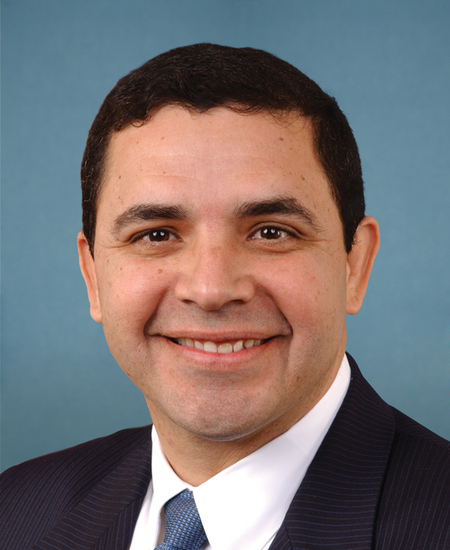
Photo of Henry Cuellar
D United States House · District 28 · Texas On the 2026 ballot

Rep. Henry Cuellar

Compare
Total votes
2,837
all sessions
Attendance
98%
43 missed
Near the chamber average
With party
86%
of cast votes
Among the lowest in the chamber
Bipartisan score
7%
crosses aisle rarely
Higher than 99% of chamber peers
Sponsored
768
bills & resolutions
Lower than 78% of chamber peers
Committees
4
assignments
768 bills and resolutions

Sponsored bills

Total
768
Primary
26
Co-sponsor
742
This page
768
matching current filters
Co-sponsor HR 1004
In committee · Florida House · Co-sponsor
Love Lives On Act of 2025

Love Lives On Act of 2025 This bill extends entitlement for various benefit programs and services for surviving spouses of deceased members of the Armed Forces or veterans. The bill provides that the remarriage of a surviving spouse must not bar the furnishing of dependency and indemnity compensation or special pension benefits to such spouse. Additionally, the Department of Defense may not terminate the payment of an annuity for a surviving spouse under the Survivor Benefit Plan solely because the surviving spouse remarries. The bill also expands the definition of a dependent under TRICARE to include a remarried widow or widower whose subsequent marriage has ended due to death, divorce, or annulment.

In committee Mar 26, 2026 1 co-sponsor
Co-sponsor HR 4642
In committee · Florida House · Co-sponsor
Fiscal Contingency Preparedness Act

Maddy summaryThe Fiscal Contingency Preparedness Act (HR 4642) requires the Treasury Secretary and OMB Director to annually examine how the federal government would respond to major crises like recessions, pandemics, natural disasters, or cyberattacks, including their short- and long-term fiscal impacts. It mandates these assessments be included in an existing annual report and specifies key crisis types to evaluate. The Government Accountability Office (GAO) must then review the methodology and results of these assessments within one year of the first report. The bill directly affects federal agencies responsible for fiscal planning (Treasury and OMB) but does not create new spending or alter existing programs. It focuses solely on improving preparedness through structured risk analysis.

In committee Mar 18, 2026 1 co-sponsor
Co-sponsor HR 1422
Passed · Florida House · Co-sponsor
Enhanced Iran Sanctions Act of 2025

Enhanced Iran Sanctions Act of 2025 This bill imposes sanctions on certain foreign persons (individuals and entities) that are involved in Iran's petroleum sector as well as certain associated persons. The bill also requires or authorizes actions to facilitate the enforcement of sanctions on Iran. Specifically, the bill requires the President to impose visa- and property-blocking sanctions on any foreign person that, after the bill's enactment, knowingly engages in any transaction related to the processing, export, or sale of oil, condensates, gas, liquefied natural gas, or other petrochemical products in whole or in part from Iran. The President must also impose sanctions on certain foreign persons associated with a sanctioned individual or entity. For example, the President must sanction the subsidiaries and corporate officers of a sanctioned business. The bill provides certain exceptions to these sanctions, including specifying that sanctions do not apply to the importation of goods or to conducting or facilitating transactions for humanitarian assistance. The Department of State must establish an interagency working group that shall seek to establish a multilateral contact group to coordinate international efforts to enforce sanctions on Iran. The bill expands the State Department rewards program to authorize a reward payment to any individual who furnishes information leading to the identification of a person (1) subject to sanctions under this bill, or (2) that has attempted or is attempting to evade sanctions under this bill.

Passed Mar 17, 2026 1 co-sponsor
Primary HR 7865
In committee · Florida House · Lead sponsor
American Consumer Tariff Rebate Act of 2026

Maddy summaryThis bill would provide one-time refunds to eligible U.S. taxpayers for tariffs imposed without congressional approval, totaling up to $231 billion. Eligible taxpayers (those who filed income tax returns for the most recent year with adjusted gross income under $400,000) would receive payments based on filing status - ranging from 100% to 200% of a calculated base amount. Families with children would also receive an additional $125 per qualified child, funded by excluding high-income earners from the refund pool. All payments are capped at the $231 billion total, with automatic distribution via direct deposit or check.

In committee Mar 9, 2026 0 co-sponsors
Co-sponsor HRES 1107
In committee · Florida House · Co-sponsor
Memorializing Rev. Jesse Jackson by flying the flag of the United States at halfstaff.

Maddy summaryHRES 1107 is a House resolution urging the President to issue a proclamation flying the U.S. flag at half-staff to honor Rev. Jesse Jackson. The resolution recognizes his civil rights leadership, including founding the Rainbow PUSH Coalition and his presidential campaigns in 1984 and 1988, which advanced racial equality and economic justice. This symbolic gesture directly affects the President (as the one who would issue the proclamation) and the public, who would observe the flag at half-staff.

In committee Mar 5, 2026 1 co-sponsor
Co-sponsor HR 7776
In committee · Florida House · Co-sponsor
Highway Formula Fairness Act

Maddy summaryThis bill, known as the Highway Formula Fairness Act, changes how federal highway funds are distributed to states starting in fiscal year 2026. It requires that each state receive at least 95 percent of the funds it would normally get based on its share of highway user taxes paid into the Highway Trust Fund. The law uses historical data from 2012 to calculate each state's initial funding share, then adjusts those amounts to ensure states meet the minimum threshold. This change directly affects state transportation budgets and the allocation of federal highway program money.

In committee Mar 4, 2026 1 co-sponsor
Co-sponsor HR 7736
In committee · Florida House · Co-sponsor
RELIEF Act

Maddy summaryHR 7736, the RELIEF Act, requires U.S. Customs and Border Protection to refund tariffs collected under the International Emergency Economic Powers Act (IEEPA) on imports entered on or after January 1, 2025. It directly affects importers of record by mandating automatic refunds within 90 days of the bill's enactment, without requiring them to submit applications or protests. The bill directs Customs to use existing data to calculate and disburse refunds for all affected tariff collections, including entries involving goods withdrawn from warehouse for consumption. This policy change eliminates the need for importers to seek refunds through separate processes, streamlining the recovery of overpaid duties.

In committee Feb 26, 2026 1 co-sponsor
Co-sponsor HR 7727
In committee · Florida House · Co-sponsor
Sustaining Rural Healthcare Act

Maddy summaryHR 7727, the Sustaining Rural Healthcare Act, creates a new "Critical Access in Character" designation to help rural hospitals facing closure risk maintain Medicare reimbursement rates. It allows the Secretary of Health and Human Services to designate qualifying hospitals (located in rural areas, serving underserved communities, with high Medicare use, and at risk of reduced services) as eligible for payment rates equivalent to Critical Access Hospitals (CAHs). Hospitals receive this designation for up to three years to stabilize financially and operationally, with renewal possible only for good cause. The bill directly affects rural hospitals at risk of closing, ensuring continued access to essential health services for patients in those communities. This policy change modifies Medicare reimbursement rules without altering existing CAH status.

In committee Feb 26, 2026 1 co-sponsor
Co-sponsor HR 2189
Passed · Florida House · Co-sponsor
To modernize Federal firearms laws to account for advancements in technology and less-than-lethal weapons, and for other purposes.

Law-Enforcement Innovate to De-Escalate Act This bill removes less-than-lethal projectile devices (e.g., certain TASERs) from regulation under the Gun Control Act. The term less-than-lethal projectile device means a device that (1) is not designed or intended to expel (and may not be readily converted to discharge) commonly used ammunition or projectiles exceeding a velocity of 500 feet per second; (2) is designed and intended to be used in a manner not likely to cause death or serious bodily injury; and (3) does not accept (and cannot be readily modified to accept) an ammunition feeding device. The bill also requires the Bureau of Alcohol, Tobacco, Firearms and Explosives to determine whether a device satisfies the definition of a less-than-lethal projectile device within 90 days of a request.

Passed Feb 24, 2026 1 co-sponsor
Co-sponsor HR 7615
In committee · Florida House · Co-sponsor
RELIEF Act

Maddy summaryHR 7615, the RELIEF Act, requires the U.S. Customs and Border Protection Commissioner to refund all tariffs collected under emergency economic powers laws (specifically the International Emergency Economic Powers Act) for imports entered on or after January 1, 2025. It mandates these refunds be processed automatically within 90 days of the bill's enactment, without importers needing to file applications or protests. The refund applies to all importers of record for goods subject to these tariffs, covering entries including withdrawals from warehouses for consumption. This directly affects businesses importing goods subject to those specific tariffs by returning funds collected under the emergency authority.

In committee Feb 20, 2026 1 co-sponsor
Showing 41 to 50 of 768 bills
Previous 1 … 4 5 6 … 77 Next