Grand Canyon Protection Act This bill withdraws 1,006,545 acres of federal lands in Arizona, including any land or interest in land acquired by the United States after enactment of this bill, from entry, appropriation, and disposal under the public land laws; location, entry, and patent under the mining laws; and operation of the mineral leasing and geothermal leasing laws and mineral materials laws.
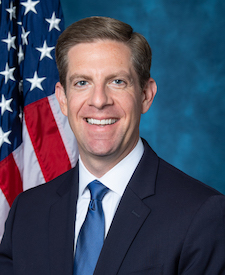
Rep. Mike Levin
Sponsored bills
Water Recycling Investment and Improvement Act This bill makes permanent, and otherwise revises, the Bureau of Reclamation's grant program for the funding of water recycling and reuse projects. Specifically, the bill removes priority under the program for projects in areas that, in the preceding four-year period, have been (1) identified as experiencing severe, extreme, or exceptional drought; or (2) designated as a disaster area by a state. Additionally, the bill increases through FY2025 the authorization of appropriations for the program and otherwise revises provisions related to program funding.
Funding for Aviation Screeners and Threat Elimination Restoration Act or the FASTER Act This bill repeals the requirement that a portion of aviation security service fees collected from passengers be credited as offsetting receipts and deposited in the general fund of the Treasury. It requires such fees to be deposited into a separate account in the Treasury for expenditure to pay only the costs of activities and services for which the fee is imposed (i.e., aviation security screening).
This bill designates the portion of U.S. Route 80 from Selma, Alabama, to Montgomery, Alabama, as the John R. Lewis Voting Rights Highway.
Civics Secures Democracy Act of 2021 This bill provides resources to expand educational programs in American civics and history, including by establishing grant and fellowship programs and reauthorizing various programs. First, the bill authorizes the Department of Education (ED) to award grants to states, qualified nonprofit organizations, institutions of higher education (IHEs), and qualified researchers to support and expand access to civics and history education. Next, the bill establishes a fellowship program to diversify the civics and history education workforce. In addition, the bill reauthorizes through FY2027 and revises the American History for Freedom grant program. The bill renames the program as the American Civics Education Program. The bill revises the grant program to authorize ED to award grants to IHEs once every three years to establish or strengthen academic programs to promote American political thought and history; the history, achievements, and impact of American representative democracy and constitutional democracies globally; and the means of participation in political and civic life. IHEs may use grants to support additional activities, such as collaborating with federal or state humanities programs and using open educational resources. Further, the bill reauthorizes through FY2022 and revises the Harry S. Truman Memorial Scholarship Trust Fund and the James Madison Memorial Fellowship Trust Fund. Finally, the bill requires the National Assessment of Educational Progress in civics and history to be administered every two years to certain grade levels.
Protecting the Right to Organize Act of 20 21 This bill expands various labor protections related to employees' rights to organize and collectively bargain in the workplace. Among other things, it (1) revises the definitions of employee , supervisor , and employer to broaden the scope of individuals covered by the fair labor standards; (2) permits labor organizations to encourage participation of union members in strikes initiated by employees represented by a different labor organization (i.e., secondary strikes); and (3) prohibits employers from bringing claims against unions that conduct such secondary strikes. The bill also allows collective bargaining agreements to require all employees represented by the bargaining unit to contribute fees to the labor organization for the cost of such representation, notwithstanding a state law to the contrary; and expands unfair labor practices to include prohibitions against replacement of, or discrimination against, workers who participate in strikes. The bill makes it an unfair labor practice to require or coerce employees to attend employer meetings designed to discourage union membership and prohibits employers from entering into agreements with employees under which employees waive the right to pursue or a join collective or class-action litigation. The bill further prohibits employers from taking adverse actions against an employee, including employees with management responsibilities, in response to that employee participating in protected activities related to the enforcement of the prohibitions against unfair labor practices (i.e., whistleblower protections). Such protected activities include providing information about a potential violation to an enforcement agency, participating in an enforcement proceeding, initiating a proceeding concerning an alleged violation or assisting in such a proceeding, or refusing to participate in an activity the employee reasonably believes is a violation of labor laws. Finally, the bill addresses the procedures for union representation elections, provides employees with the ability to vote in such elections remotely by telephone or the internet, modifies the protections against unfair labor practices that result in serious economic harm, and establishes penalties and permits injunctive relief against entities that fail to comply with National Labor Relations Board orders.
For the People Act of 2021 This bill addresses voter access, election integrity and security, campaign finance, and ethics for the three branches of government. Specifically, the bill expands voter registration (e.g., automatic and same-day registration) and voting access (e.g., vote-by-mail and early voting). It also limits removing voters from voter rolls. The bill requires states to establish independent redistricting commissions to carry out congressional redistricting. Additionally, the bill sets forth provisions related to election security, including sharing intelligence information with state election officials, supporting states in securing their election systems, developing a national strategy to protect U.S. democratic institutions, establishing in the legislative branch the National Commission to Protect United States Democratic Institutions, and other provisions to improve the cybersecurity of election systems. Further, the bill addresses campaign finance, including by expanding the prohibition on campaign spending by foreign nationals, requiring additional disclosure of campaign-related fundraising and spending, requiring additional disclaimers regarding certain political advertising, and establishing an alternative campaign funding system for certain federal offices. The bill addresses ethics in all three branches of government, including by requiring a code of conduct for Supreme Court Justices, prohibiting Members of the House from serving on the board of a for-profit entity, and establishing additional conflict-of-interest and ethics provisions for federal employees and the White House. The bill requires the President, the Vice President, and certain candidates for those offices to disclose 10 years of tax returns.
Speeding Therapy Access Today Act of 2021 This bill requires and authorizes various actions to accelerate the development of therapies for rare diseases. The Food and Drug Administration (FDA) shall establish the Intercenter Institute on Rare Diseases and Conditions. The institute shall (1) coordinate engagement with relevant stakeholders, (2) build the FDA's expertise in the review of medical products to treat rare diseases, (3) coordinate regulatory science initiatives related to rare diseases, (4) establish and implement a program to make recommendations to address challenges associated with developing medical products to treat rare diseases in an individual or in very small populations, (5) convene a stakeholder meeting to consider potential amendments to labels for medical products to treat rare diseases, and (6) establish and carry out a program to facilitate voluntary communication between the sponsors of such medical products and third-party payers (e.g., insurance companies). The bill also authorizes the FDA to make grants to assist in developing practices related to the development and production of individualized therapies or therapies to treat very small populations. The bill also establishes an advisory committee to advise the FDA on issues related to the development of therapies to treat rare diseases.
Passports for Purple Hearts Act This bill exempts Purple Heart recipients from fees associated with obtaining a passport.
COVID-19 Mental Health Research Act This bill requires the National Institute of Mental Health to support mental health research activities related to COVID-19 (i.e., coronavirus disease 2019). The institute must coordinate these activities with other components of the National Institutes of Health.