Maddy summaryHR 964, the Democracy in Design Act, requires the General Services Administration (GSA) to follow the 1962 "Guiding Principles for Federal Architecture" when designing all new U.S. public buildings. It mandates the GSA Administrator to create new regulations within 180 days of the bill's enactment, establishing minimum design standards for federal buildings. These regulations must be developed after public notice and comment, as required by standard federal rulemaking procedures. The bill directly affects all federal building projects and the GSA's design process, ensuring adherence to established architectural principles.
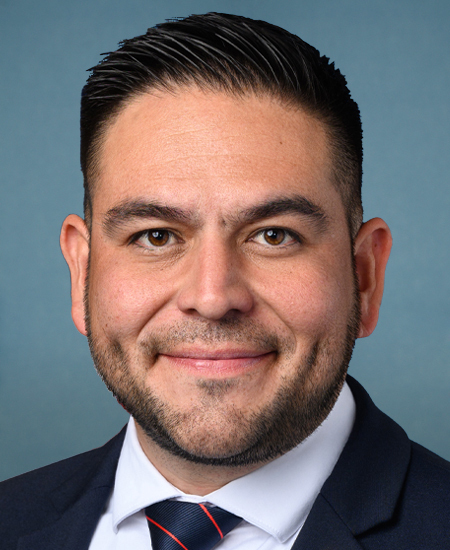
Rep. Gabe Vasquez
Sponsored bills
Maddy summaryHR 621, the PART Act, requires catalytic converters on vehicles to be stamped with a visible vehicle identification number (VIN) using special high-visibility paint to deter theft. It creates a federal grant program to help auto dealers, repair shops, and law enforcement implement this stamping at no cost to vehicle owners. The bill also mandates that sellers of catalytic converters retain buyer identification and vehicle details for two years, and adds new federal criminal penalties for stealing or trafficking in catalytic converters.
Maddy summaryHR 889, the Broadband Grant Tax Treatment Act, excludes certain federal broadband grants from recipients' taxable income. It specifically applies to grants received under programs like the Infrastructure Investment and Jobs Act's Broadband Equity, Access, and Deployment Program and state digital equity grants. The bill prevents double tax benefits by disallowing deductions or credits for expenses covered by these excluded grants and reduces the adjusted basis of related property. This policy change directly affects broadband providers, local governments, and tribal entities receiving qualifying grants from federal or state sources for broadband infrastructure deployment.
Maddy summaryHR 866, the Equal COLA Act, changes how cost-of-living adjustments (COLAs) are calculated for federal retirees under the Federal Employees Retirement System (FERS). It requires that each year's COLA be based on the exact percent change in the price index from the previous year's base quarter, rounded to the nearest 0.1%, effective December 1. This applies to all FERS annuities starting before, on, or after the bill's enactment date, ensuring a standardized calculation method for retirees' annual adjustments.
Maddy summaryThe BRAVE Act requires the Department of Veterans Affairs to create a new system that proactively offers mental health resources to eligible veterans. It specifically targets veterans enrolled in VA care who have experienced traumatic or highly stressful events, allowing them to opt-in to receive information about available mental health services. The system must coordinate with the Department of Defense's Transition Assistance Program and be fully implemented within two years of the bill's enactment. This changes VA's outreach approach by making mental health support more accessible after critical life events. The bill directly affects veterans who qualify under these criteria, not broader populations.
Maddy summaryThis bill prevents the Department of Veterans Affairs (VA) from denying veterans any benefits due to participation in state-approved marijuana programs. It requires VA healthcare providers to discuss cannabis use with enrolled veterans, adjust treatment plans accordingly, and document such use in medical records. VA doctors are also authorized to provide recommendations about state cannabis programs to veterans living in states that have legalized them. The policy directly affects veterans enrolled in VA care who use state-legal cannabis, removing federal barriers to their participation in state programs without benefit penalties.
Maddy summaryHCONRES 13 is a concurrent resolution expressing Congress's support for maintaining the current policy that prohibits imposing new fees on local radio stations for playing music. It states that Congress should not impose any performance fee, tax, royalty, or charge on local radio stations for broadcasting sound recordings over the air, or on businesses like bars and restaurants that play music publicly. The resolution argues that such fees would harm local radio stations - critical sources for emergency information and community programming - and jeopardize the economic model that has supported both radio and the music industry for decades. This resolution does not create new law but formally opposes potential legislative changes to the existing fee structure.
Maddy summaryThe Auto Theft Prevention Act establishes a federal grant program to fund state and local law enforcement efforts combating auto theft and stolen vehicle trafficking, authorizing $30 million annually from 2024 to 2028. States receive funds based on prior-year auto theft rates, requiring at least 50% to be distributed to local agencies in high-theft areas and 25% to state agencies. Grants cover specific anti-theft measures like purchasing equipment (e.g., license plate readers), hiring staff, training officers, and funding data collection related to auto theft. The program also expands existing grant uses to include these anti-theft activities, with no more than 5% of funds allowed for administrative costs.
Maddy summaryHR 770, the ESP Family Leave Act, amends the Family and Medical Leave Act (FMLA) to create specific eligibility rules for education support professionals and school support staff in public schools and public higher education institutions. It changes the standard FMLA work-hour requirement (1,250 hours) to a new threshold: these workers qualify if they've worked at least 60% of their expected monthly hours for the previous school year. Employers must maintain records of each employee's expected monthly hours, and the bill defines "education support professionals" to include roles like paraeducators, secretaries, custodians, food service workers, security staff, and health support staff. The bill directly affects these support staff members, making it easier for them to qualify for FMLA leave under the revised hours calculation.
Maddy summaryHR 827, the Home Internet Accessibility Act, requires a study of broadband access in federally assisted housing (like public housing and HUD-subsidized units) and a plan to improve it. The Comptroller General must report within one year on where broadband access exists or is lacking, including demographic breakdowns by location, and analyze retrofitting costs and challenges. The Department of Housing and Urban Development (HUD) must then develop and submit a specific plan to retrofit housing for broadband service within 18 months of the bill's enactment. This bill directly affects residents of federally assisted housing nationwide by focusing on infrastructure gaps, not by providing immediate internet service.