Maddy summaryThis resolution expresses support for National Public Lands Day and encourages Americans to visit public lands on a designated fee-free day. It highlights the significant role these areas play in supporting rural economies, preserving biodiversity, and providing cultural and spiritual value. The text notes that public lands generate substantial economic output and employment while serving as hubs for outdoor recreation.
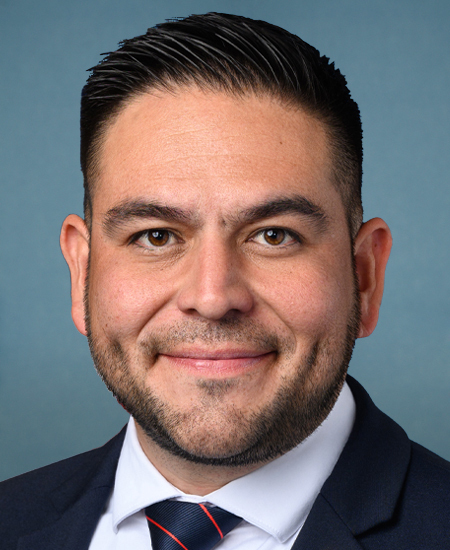
Rep. Gabe Vasquez
Sponsored bills
Maddy summaryThis House resolution expresses support for designating the week beginning September 14, 2026, as National Hispanic-Serving Institutions Week. It recognizes these colleges and universities, which enroll at least 25 percent Hispanic students, for their role in providing higher education access to low-income and underserved populations. The bill highlights that these institutions serve a significant portion of the nation's undergraduate students and contribute to economic mobility. It calls on the public and interested groups to observe the week with ceremonies and activities during Hispanic Heritage Month.
Maddy summaryThe BEEF Act nullifies a recent presidential proclamation that expanded beef import quotas and requires Congress to pass specific legislation within 30 days to approve any future executive actions that increase beef imports. The bill directly affects American ranchers, domestic beef processors, and consumers by aiming to restrict foreign beef entry into the U.S. market. To support these goals, it establishes a temporary Beef Import and Domestic Supply Advisory Board within the Department of Agriculture, chaired by the Secretary of Agriculture and composed of 11 appointed industry and academic experts. This board is tasked with developing strategies to rebuild the national cattle herd, reduce regulatory burdens for ranchers, and advise on policies that improve domestic beef supply and market competition.
Maddy summaryThis House resolution formally recognizes the role of Latino communities in outdoor recreation and conservation efforts that protect U.S. natural resources. It highlights how these groups lead activities such as hiking, community cleanups, and environmental justice initiatives on public lands. The bill specifically supports the designation of September 12 through September 20, 2026, as Latino Conservation Week to celebrate this engagement. As a commemorative measure, it does not create new laws or funding but serves to affirm the importance of inclusive access to nature and the cultural contributions of Latino populations to environmental stewardship.
Maddy summaryThe Reverse Big Ugly Tax Breaks for Data Centers Act removes specific tax incentives for large-scale data centers and artificial intelligence facilities. It excludes these facilities from bonus depreciation, a provision that currently allows businesses to deduct the full cost of certain equipment in the year it is purchased. Additionally, the bill prevents these properties from qualifying as opportunity zone business property, which would otherwise offer significant tax benefits for investments in designated areas. The legislation targets structures with a power capacity exceeding 50 megawatts that are dedicated to data storage, processing, or AI operations.
Maddy summaryThis bill would require Medicare to cover early detection screening tests for Alzheimer's disease and related dementias starting January 1, 2028. It defines eligible tests as FDA-cleared genomic blood tests, blood product analyses, or equivalent medical imaging methods (like protein expression or whole genome sequencing) that detect pre-symptomatic or early-stage conditions. Medicare beneficiaries would receive this coverage without cost-sharing for these specific screenings. The bill amends Medicare coverage rules to explicitly include these tests under Section 1861(nnn) of the Social Security Act.
Maddy summaryHR 2978, the GUARD Act, allows state, local, and tribal law enforcement agencies to use existing federal grant funds for investigating elder financial fraud, "pig butchering" investment scams, and general financial fraud. The bill directs these funds toward hiring specialized staff, training on blockchain tools and transnational fraud, purchasing investigative software, improving data collection, and creating financial sector liaisons to coordinate with banks. It requires annual reports from law enforcement on fund usage and outcomes, and mandates federal agencies to submit comprehensive reports to Congress on scam statistics, enforcement actions, and funding allocation. The legislation directly affects law enforcement agencies and aims to strengthen efforts against fraud targeting vulnerable populations, particularly elderly individuals.
Maddy summaryHR 2004, titled "Tyler’s Law," requires the Secretary of Health and Human Services to study how often hospital emergency departments test for fentanyl during overdose cases (beyond standard drug tests), including associated costs, patient benefits/risks, and impacts on privacy and patient-physician relationships. The study must be completed within one year of the bill's enactment. Based on the study results, the Secretary must issue guidance within six months on whether emergency departments should routinely test for fentanyl, how to inform clinicians about test contents, and how such testing may affect future overdose risks and health outcomes. This bill directly affects hospital emergency departments and patients experiencing overdoses by shaping future testing protocols.
Maddy summaryHR 1266, the Combating Illicit Xylazine Act, adds xylazine - a veterinary sedative increasingly found in illicit drug mixtures - to Schedule III of the Controlled Substances Act, regulating its use and trafficking. It directly affects veterinarians, animal owners, and manufacturers by allowing xylazine to be legally dispensed for animal use under specific veterinary prescriptions, while prohibiting non-veterinary human use. The bill includes transition periods (60 days for practitioners, 1 year for labeling) to ease compliance for manufacturers and practitioners, and requires the DEA and FDA to expedite necessary applications. It also mandates two congressional reports on xylazine's illicit use and trafficking patterns, and directs the Sentencing Commission to review penalties for offenses involving xylazine.
Maddy summaryThis bill requires all new passenger vehicles manufactured for sale in the U.S. to include AM radio as standard equipment (not an optional add-on) by 2027-2028, depending on manufacturer size. It mandates that AM radio receivers must be easily accessible to drivers and allows compliance through digital AM broadcast technology. During a transition period, manufacturers must clearly label vehicles without AM radio but cannot charge extra for this feature. The bill also mandates a GAO study on AM radio's role in emergency alerts and includes a 10-year sunset provision for the rule. It preempts state laws regarding AM radio access in vehicles.