

Existing law prohibits Members of the Legislature from entering into, or requesting that another party enter into, a nondisclosure agreement relating to the drafting, negotiation, or discussion of proposed legislation, and makes any nondisclosure agreement relating to the drafting, negotiation, or discussion of proposed legislation void and unenforceable. Existing law provides an exception for nondisclosure agreements, or portions thereof, that prevent only the disclosure of trade secrets, financial information, or proprietary information, as specified. This bill would prohibit an elective or appointive officer of a state agency acting in their official capacity from entering into, or requesting that another party enter into, a nondisclosure agreement relating to the drafting, negotiation, or discussion of a proposed regulation or legislation. The bill would also make any nondisclosure agreement relating to the drafting, negotiation, or discussion of a proposed regulation or legislation entered into by an elective or appointive officer of a state agency acting in their official capacity after the effective date of this bill void and unenforceable. The bill would provide an exception for nondisclosure agreements, or portions thereof, that prevent only the disclosure of trade secrets, private financial information, or proprietary information, as specified.
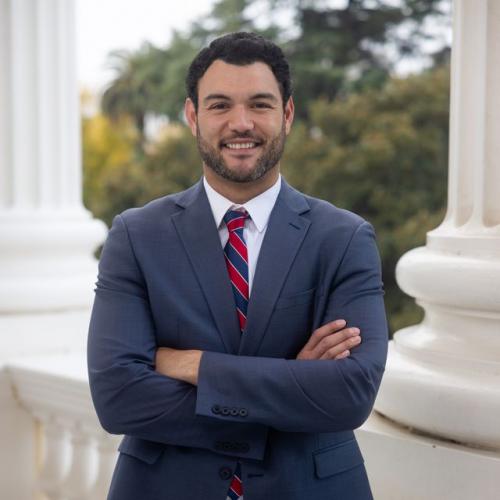
Rep. David Tangipa
Sponsored bills
Maddy summaryCalifornia Assembly Resolution 141 expresses concern that the state's new energy efficiency standards for replacement tires may impose significant financial burdens on consumers and businesses. The resolution cites industry data suggesting tire costs could rise by up to $365 per set, contradicting official estimates of a smaller increase, and argues that the program's environmental benefits have not fully accounted for the impacts of manufacturing, transporting, and disposing of additional tires. It urges the State Energy Resources Conservation and Development Commission to reassess the program by conducting a comprehensive evaluation of affordability, tire safety, and full life-cycle environmental effects.
Existing law establishes a specialized license plate program and requires the Department of Motor Vehicles to issue specialized license plates, also referred to as environmental license plates, on behalf of a sponsoring state agency if the agency receives 7,500 applications for that plate within a 12-month period, among other requirements. Existing law authorizes a person who is the registered owner or lessee of a vehicle to apply to the department for specialized license plates. Existing law imposes a fee, in addition to the regular registration fee, for the issuance, renewal, retention, transfer, and duplication of specialized license plates. Existing law requires that all revenue derived from these fees be deposited in the California Environmental License Plate Fund. This bill would require the Arts Council to apply to the department to sponsor "The Lowrider" specialized license plate program, as specified. The bill would require the design of the plate to reflect lowrider culture and heritage. The bill would require the council to consult with a nonprofit entity for plate design consultation, stakeholder engagement, publicity, and community outreach. The bill would authorize the council to accept and use donated or licensed artwork from a nonprofit entity for these purposes, and to use funds from nonprofit or private sources to augment implementation. The bill would require the department, after deducting its administrative costs, to deposit additional revenue derived from the issuance, renewal, transfer, and substitution of the plate into the Specialized License Plate Fund in the State Treasury. The bill would require the council to use those funds, upon appropriation by the Legislature, to fund projects that include, among others, supporting lowrider arts and cultural preservation efforts. The bill would authorize the council to use 4 to 6% of those funds to consult with or enter into an agreement with a nonprofit entity to support implementation of the program.
Existing law establishes the Medi-Cal program, which is administered by the State Department of Health Care Services and under which qualified low-income individuals receive health care services through various delivery systems, including fee-for-service and managed care. The Medi-Cal program is, in part, governed by, and funded pursuant to, federal Medicaid program provisions. Existing law establishes the California Program of All-Inclusive Care for the Elderly (PACE program) to provide community-based, risk-based, and capitated long-term care services as optional services for older individuals under the state's Medi-Cal State Plan and under contracts entered into between the federal Centers for Medicare and Medicaid Services, the department, and PACE organizations. Existing law requires the department to pay capitation rates to health plans participating in the Medi-Cal managed care program using actuarial methods. Existing law requires the department to develop and pay capitation rates to entities contracted pursuant to the PACE program, using actuarial methods consistent with those provisions, with specified exceptions. Existing law requires the department to consult with those contracted entities in developing a rate methodology. This bill would require the department to notify the contracting PACE organization of the proposed rates at least 60 days prior to submission to the federal Centers for Medicare and Medicaid Services (CMS) for approval. The bill would authorize the department to define a reasonable date by which the PACE organization must submit written questions or feedback concerning the proposed rates. The bill would require the department to respond in writing to those questions or feedback by no later than 30 days prior to submitting the rates to CMS.
Existing law, the Alcoholic Beverage Control Act, which is administered by the Department of Alcoholic Beverage Control, regulates the application, issuance, and suspension of alcoholic beverage licenses. Existing law, until December 31, 2026, authorizes the holder of an on-sale license for a bona fide public eating place that has off-sale privileges, or a licensed beer manufacturer, licensed wine manufacturer, or licensed craft distiller that operates a bona fide public eating place at its premises of production, to sell distilled spirits in manufacturer-prepackaged containers and alcoholic beverages other than beer that are not in manufacturer-prepackaged containers for off-sale consumption if specified conditions are met. This bill would extend those provisions until December 31, 2029. This bill would declare that it is to take effect immediately as an urgency statute.
This measure would urge the President of the United States and Congress of the United States to immediately restore full and consistent funding and staffing for the National Park Service.
Maddy summaryCalifornia Assembly Resolution 140 designates August 2026 as Children's Get Offline and Get Outdoors Month to promote awareness of the benefits of screen-free play for child development. The resolution cites research linking excessive social media use and reduced free play time to increased rates of anxiety, depression, and other behavioral issues among teenagers. It encourages families and communities to support unstructured outdoor activities and highlights ongoing federal efforts to protect children's mental health through technology guardrails.
Under the Z'berg-Nejedly Forest Practice Act of 1973, the Legislature finds and declares that it is the policy of the state to encourage prudent and responsible forest management of nonindustrial timberlands by approving working forest management plans in advance. Existing law regulates nonindustrial tree farmers and working forest landowners for timberland management purposes, including by setting a maximum acreage each may own, and authorizes a person who intends to become a nonindustrial tree farmer or a working forest landowner to submit to the Department of Forestry and Fire Protection a nonindustrial timber management plan or a working forest harvest plan, respectively, regarding that acreage. Existing law provides a maximum of 2,500 acres owned for nonindustrial tree farmers and nonindustrial timber management plans and a maximum of 10,000 acres owned for working forest landowners and working forest management plans. This bill would increase the maximum acreage for nonindustrial tree farmers and nonindustrial management plans to 4,000 acres and for working forest landowners and working forest management plans to 15,000 acres. Existing law requires the harvest area of a working forest management plan to be contained within a single hydrological area, as defined. This bill would eliminate the requirement that the harvest area of a working forest management plan be contained within a single hydrological area. Existing law requires the working forest landowner who owns, leases, or otherwise controls or operates on all or any portion of any timberland within the boundaries of an approved working forest management plan, and who plans to harvest any of the timber during a given year, to file a working forest harvest notice, as defined, with the department in writing. Existing law exempts the Southern Subdistrict of the Coast Forest District, as described in regulations, from these provisions regarding working forest management plans. This bill would eliminate this exemption.
Existing law, the California Retail Food Code, establishes uniform health and sanitation standards for retail food facilities, which are primarily enforced by local public health agencies. Violation of the California Retail Food Code is a misdemeanor, except as otherwise provided. Existing law limits the size of a passthrough window service opening to 216 square inches, and requires the opening to be provided with a solid or screened window, equipped with a self-closing device. Existing law authorizes a passthrough window of up to 432 square inches if equipped with an air curtain device. This bill would remove the requirement that the 216 square inch solid or screened window has to be equipped with a self-closing device. The bill would require a passthrough window service opening of up to 432 square inches to be equipped with an air curtain device or a self-closing device. The bill would require a passthrough window service opening that is larger than 432 square inches to be equipped with both a self-closing device and an air curtain device. The bill would require a passthrough window or other service opening to be used specifically for food delivery operations and not as a general entrance or exit for employees or customers. By expanding the scope of an existing crime, this bill would impose a state-mandated local program. The California Constitution requires the state to reimburse local agencies and school districts for certain costs mandated by the state. Statutory provisions establish procedures for making that reimbursement. This bill would provide that no reimbursement is required by this act for a specified reason.
Maddy summaryCalifornia Assembly Resolution 137 formally recognizes the Diwali festival scheduled for November 8, 2026, and encourages state residents to participate in the celebration. The resolution highlights the cultural significance of the holiday for Indian Americans and South Asian communities, noting its themes of unity, joy, and the triumph of light over darkness. It also acknowledges that California previously designated Diwali as an official state holiday in 2025. This measure serves as a commemorative statement rather than a law with new regulatory or financial provisions.