

Existing law designates specific days as holidays in this state, including, among others, Dr. Martin Luther King, Jr. Day and Cesar Chavez Day. Existing law designates certain days as judicial holidays and exempts others including, Lunar New Year, Diwali, and Genocide Remembrance Day. This bill would designate Sylvia Mendez Day as a state holiday, but would exempt the holiday from being a judicial holiday. The bill would include related legislative findings and declarations. This bill would incorporate additional changes to Section 135 of the Code of Civil Procedure proposed by AB 2017 to be operative only if this bill and AB 2017 are enacted and this bill is enacted last. The bill would also incorporate additional changes to Section 6700 of the Government Code proposed by AB 2017 and SB 1394 to be operative only if this bill and either or both of those bills are enacted and this bill is enacted last.
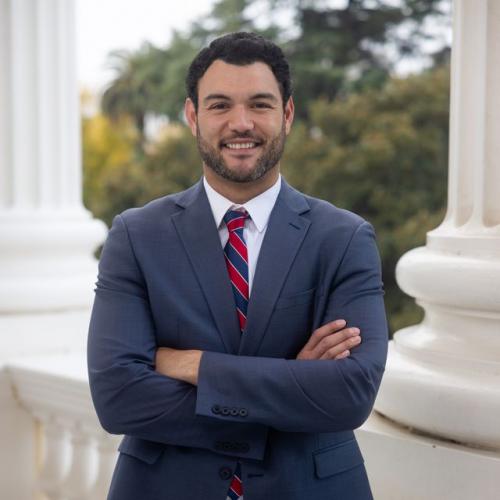
Rep. David Tangipa
Sponsored bills
Existing law, the California Emergency Services Act, authorizes the Governor to proclaim a state of emergency when specified conditions of disaster or extreme peril to the safety of persons and property exist, and authorizes the Governor to exercise certain powers in response to that emergency, including, but not limited to, suspending specified statutes, ordinances, orders, regulations, or rules. This bill would impose specific duties on the Department of Housing and Community Development if the Office of Emergency Services makes a written determination, within 10 days after the date that the Governor declared a state of emergency relating to a wildfire, that the wildfire caused substantial structural damage requiring significant rebuilding efforts, as defined. The bill would require the department, under this condition, to consult with other specified state entities and local governments to identify state permitting requirements and local procedures that could be suspended or revised to support recovery and rebuilding efforts as a result of the wildfire, as specified. The bill would require the department to prepare and submit initial and periodic reports to the Governor and Legislature with the information and recommendations. This bill, on or before July 1, 2028, would require the Department of Housing and Community Development, in consultation with other specified state entities, to convene a workgroup to review and provide a report to the Governor and the Legislature with recommendations regarding any provision of the California Building Standards Code that should be suspended for specified types of projects to facilitate rapid, safe, disaster-resilient, and cost-effective rebuilding and recovery guidance for any future state of emergency. The bill would require the workgroup to review and update the report to the Governor and Legislature after the release of every update to the California Building Standards Code. This bill, starting January 1, 2028, would require, upon the Governor's declaration of a state of emergency relating to a wildfire, every state agency or political subdivision, as defined, involved in postdisaster response, debris removal, reconstruction, housing, or land-use permitting to accept electronic submission of any application, form, plan set, appeal, or request for state agency or political subdivision action related to recovery efforts for that state of emergency, as provided. By imposing new duties on local agencies, the bill would impose a state-mandated local program. The California Constitution requires the state to reimburse local agencies and school districts for certain costs mandated by the state. Statutory provisions establish procedures for making that reimbursement. This bill would provide that, if the Commission on State Mandates determines that the bill contains costs mandated by the state, reimbursement for those costs shall be made pursuant to the statutory provisions noted above.
Existing law, the State Housing Law, establishes statewide construction and occupancy standards for buildings used for human habitation. Existing law requires the building department of every city or county to enforce the provisions of the State Housing Law, the State Building Standards Code, and other specified rules and regulations promulgated pursuant to the State Housing Law pertaining to standards for buildings used for human habitation. Existing law authorizes an officer, employee, or agent of an enforcement agency to enter and inspect any building or premises whenever necessary to secure compliance with, or prevent a violation of, any provision of the State Housing Law, the building standards published in the State Building Standards Code, and other rules and regulations promulgated pursuant to the provisions of the State Housing Law. Existing law provides certain immunities to a public entity or employee immunity relative to an inspection or license, as provided. This bill would require a city, including a charter city, county, or city and county, except as specified, to offer a homeowner or contractor, as described, the option of requesting remote inspections for all or a subset of an inspection required by a building permit for specified works in one- or 2-family dwelling units, by either January 1, 2028, or July 1, 2028, as provided. The bill would authorize these local agencies to adopt reasonable protocols governing the technical conduct of a remote inspection, as specified. The bill would apply the above-described immunities to remote inspections. The bill would authorize these local agencies to temporarily ban the homeowner or contractor from using the remote inspection if a homeowner is found to have willfully misrepresented the work, as provided. By imposing new duties on local agencies, the bill would impose a state-mandated local program. The bill would include findings that changes proposed by this bill address a matter of statewide concern rather than a municipal affair and, therefore, apply to all cities, including charter cities. The California Constitution requires the state to reimburse local agencies and school districts for certain costs mandated by the state. Statutory provisions establish procedures for making that reimbursement. This bill would provide that no reimbursement is required by this act for a specified reason.
Existing law authorizes the Public Utilities Commission to supervise and regulate every public utility in the state, including telephone corporations, and to fix just and reasonable rates and charges for public utilities. Existing law establishes the state's 6 universal service funds in the State Treasury, including the California High-Cost Fund-A Administrative Committee Fund (CHCF-A) and the California High-Cost Fund-B Administrative Committee Fund (CHCF-B) , and provides that moneys in each of the state's universal service funds are the proceeds of rates and are held in trust for the benefit of ratepayers and to compensate telephone corporations for their costs of providing universal service. Moneys in the funds may only be expended to accomplish specified telecommunications universal service programs, upon appropriation in the annual Budget Act or upon supplemental appropriation. Existing law, the CHCF-A program, until January 1, 2028, requires the commission to develop, implement, and maintain a suitable program to establish a fair and equitable local rate structure aided by universal service rate support to small independent telephone corporations that serve rural areas and are subject to rate-of-return regulation by the commission. Existing law, the CHCF-B program, until January 1, 2028, requires the commission to develop, implement, and maintain a suitable, competitively neutral, and broad-based program to establish a fair and equitable local rate support structure aided by universal service rate support to telephone corporations serving areas where the cost of providing services exceeds rates charged by providers, as determined by the commission. This bill would extend the CHCF-A program and CHCF-B program requirements to January 1, 2033. Under existing law, a violation of the Public Utilities Act or an order, decision, rule, direction, demand, or requirement of the commission is a crime. Because the CHCF-A program and CHCF-B program, which would be extended under the provisions of this bill, are part of the act, and a violation of a commission action implementing the programs' requirements would be a crime, the bill would impose a state-mandated local program. The California Constitution requires the state to reimburse local agencies and school districts for certain costs mandated by the state. Statutory provisions establish procedures for making that reimbursement. This bill would provide that no reimbursement is required by this act for a specified reason. This bill would declare that it is to take effect immediately as an urgency statute.
Maddy summaryThis bill designates September 2026 as Childhood Cancer Awareness Month. It directly affects state agencies and organizations by encouraging them to recognize this specific month for awareness activities. The measure does not change laws or allocate funding but serves as a formal commemorative resolution.
Existing law establishes the University of California, administered by the Regents of the University of California, the California State University, administered by the Trustees of the California State University, and the California Community Colleges, administered by the Board of Governors of the California Community Colleges, as the 3 segments of public postsecondary education in the state. The Donahoe Higher Education Act prohibits the campuses of those segments from charging mandatory systemwide tuition or fees to specified students who apply for a waiver, including a child of any veteran of the United States military who has a service-connected disability, has been killed in service, or has died of a service-connected disability, an undergraduate student who is a recipient of a Medal of Honor, or an undergraduate student who is a child of a recipient of a Medal of Honor and who is no more than 27 years of age, if certain requirements are satisfied. This bill would require the California State University and each community college district, and would request the University of California, with respect to each campus in their respective jurisdictions that administers a priority enrollment system, commencing with the 2028–29 academic year, to grant priority for registration for enrollment to (1) a student who receives a fee waiver pursuant to the above-described provisions, and (2) a student who is using any federal GI Bill benefits. By requiring students to receive priority registration at community college districts, the bill would impose a state-mandated local program. The California Constitution requires the state to reimburse local agencies and school districts for certain costs mandated by the state. Statutory provisions establish procedures for making that reimbursement. This bill would provide that, if the Commission on State Mandates determines that the bill contains costs mandated by the state, reimbursement for those costs shall be made pursuant to the statutory provisions noted above.
This measure would recognize and affirm the important role of artists, arts organizations, creative arts therapists, and arts for health initiatives in supporting behavioral health, promoting recovery, strengthening community resilience, and contributing to public safety. The measure would encourage and recognize exploration, support, and integration of arts and behavioral health within California's health care, behavioral health, and community-based systems.
Existing law, until January 1, 2028, and to the extent funds are made available for these purposes, requires the State Department of Public Health to establish a system for the collection of information determining the incidence and prevalence of neurodegenerative diseases, including, but not limited to, amyotrophic lateral sclerosis (ALS) , also known as Lou Gehrig's disease. Existing law requires a hospital, facility, physician and surgeon, or other health care provider diagnosing or providing treatment to a patient for a neurodegenerative disease to report each case of a neurodegenerative disease to the department, as prescribed. Existing law requires the department to designate the specified neurodegenerative diseases required to be reported in the state or any part of the state. Existing law specifies that for this purpose, "neurodegenerative disease" may include, but need not be limited to, Alzheimer's disease, multiple sclerosis, and Huntington's disease. This bill would require the department to establish a system for the collection of information determining the incidence and prevalence of frontotemporal degeneration (FTD) . This bill would specify that "neurodegenerative disease" may also include other dementias. The bill would extend the requirements of these provisions until January 1, 2032.
Existing federal law, the Personal Responsibility and Work Opportunity Reconciliation Act of 1996, replaced the federal Aid to Families with Dependent Children (AFDC) program with the federal Temporary Assistance to Needy Families (TANF) block grant program. Existing federal law provides for allocation of federal funds through the federal TANF block grant program to eligible states. Existing law establishes the California Work Opportunity and Responsibility to Kids (CalWORKs) program, under which, through a combination of state and county funds and federal funds received through the TANF program, each county provides cash assistance and other benefits to qualified low-income families. Existing law requires aid to be granted to a family with a related child under 18 years of age who has been deprived of parental support or care due to the unemployment, continued absence, death, incapacity, or incarceration of a parent. Existing law considers a child to be deprived of parental support or care due to unemployment of the child's parent or parents when the child's parent or parents have worked less than 100 hours in the preceding 4 weeks and meets specified requirements related to the federal AFDC program. This bill would, for purposes of determining a child's deprivation of parental support or care, delete the requirements that the parent or parents work less than 100 hours in the preceding 4 weeks and meet the federal AFDC program requirements. The bill would instead disregard the number of hours that the child's parent or parents work, provided the family does not exceed the applicable gross or net income limits. The bill would make these provisions operative on July 1, 2027, or when the State Department of Social Services notifies the Legislature that the Statewide Automated Welfare System can perform the necessary automation to implement the provisions, whichever is later. To the extent that the bill would expand eligibility for the CalWORKs program, thereby imposing a higher level of service on counties, the bill would impose a state-mandated local program. Existing law continuously appropriates moneys from the General Fund to defray a portion of county costs under the CalWORKs program. This bill would instead provide that the continuous appropriation would not be made for purposes of implementing these provisions. The California Constitution requires the state to reimburse local agencies and school districts for certain costs mandated by the state. Statutory provisions establish procedures for making that reimbursement. This bill would provide that, if the Commission on State Mandates determines that the bill contains costs mandated by the state, reimbursement for those costs shall be made pursuant to the statutory provisions noted above.
This measure would proclaim the month of October 2026 as California Firefighter Appreciation Month and October 3, 2026, as California Firefighters Memorial Day.