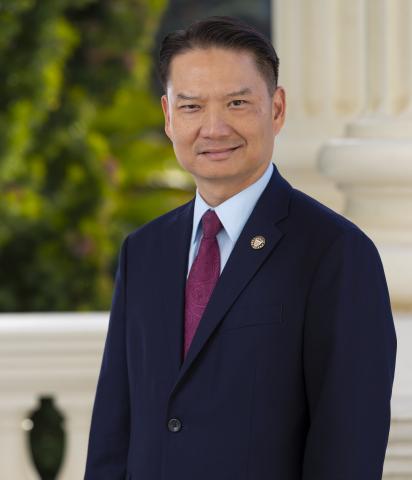
Existing law authorizes the Board of Supervisors of the County of Alameda to establish a hospital authority for the purpose of effecting a transfer of the management, administration, and control of the Alameda Health System. Existing law requires the hospital authority to be governed by a board that is appointed, both initially and continually, by the board of supervisors. Existing law requires the enabling ordinance to specify the membership of the hospital authority governing board, the qualifications for individual members, the manner of appointment, selection, or removal of governing board members, their terms of office, and all other matters that the board of supervisors deems necessary or convenient for the conduct of the hospital authority's activities. Existing law specifies that a hospital authority established pursuant to these provisions, but that does not obtain the administration, management, and control of the medical center or has those duties and responsibilities revoked by the board of supervisors, is not empowered with the powers provided to an independent hospital authority, as specified. This bill would specify that the board of supervisors is authorized to amend the enabling ordinance. The bill would require the enabling ordinance to authorize the membership of the governing board to include, with the approval of the board of supervisors, a representative of any local public entity that contributes financial or other support to the hospital authority, as specified. The bill would authorize, at the board of supervisors' discretion and as specified in the enabling ordinance, the governing board to consist entirely of members of the board of supervisors or to include any number of the members of the board of supervisors or county officers or employees appointed to represent the interests of the county. The bill would prohibit the inclusion of members of the board of supervisors or county employees on the governing board from being a basis to determine that the hospital authority is not an independent entity or that the hospital authority has not obtained the administration, management, and control of the medical center. This bill would also authorize the governing board to delegate day-to-day operational responsibilities to one or more subsidiary bodies it establishes, consisting of members possessing relevant expertise, and requires that delegation to involve reasonable safeguards to ensure that the governing board retains ultimate control over the hospital authority. The bill would authorize the hospital authority to affiliate with, or acquire ownership or control of, additional public or private hospitals, clinics, or programs to further its mission, at the discretion of the governing board. After a hospital authority is created as specified, the bill would authorize the board of supervisors to change the composition of the governing board and to revoke the duties and responsibilities of the hospital authority and transfer the hospital authority back to the county.
Existing law establishes the Medi-Cal program, which is administered by the State Department of Health Care Services and under which qualified low-income individuals receive health care services. The Medi-Cal program is, in part, governed and funded by federal Medicaid program provisions. Existing law requires the department to streamline and simplify existing Medi-Cal program procedures to improve access to lactation supports and breast pumps among Medi-Cal beneficiaries. This bill would require the department to, by July 1, 2027, issue updated Medi-Cal guidance that clarifies Medi-Cal coverage for lactation services. The bill would also require the guidance to, among other things, clarify Medi-Cal coverage policies for a continuum of lactation services, including health education related to lactation, basic lactation support, and clinical lactation consultation. The bill would require the department to seek stakeholder input on draft guidance prior to issuing the guidance. The bill would make the implementation of these provisions contingent to the extent that federal financial participation is available and any necessary federal approvals are obtained.
Existing federal law provides for the federal Supplemental Nutrition Assistance Program, known in California as CalFresh, under which supplemental nutrition assistance benefits allocated to the state by the federal government are distributed to eligible individuals by each county. Existing law requires the State Department of Social Services to maximize all available food choices for CalFresh recipients, as specified. Existing law requires the State Department of Public Health to adopt regulations, on or before June 1, 2028, to define "ultraprocessed foods of concern" and, when defining the term, to consider specified factors, including, among others, whether, based on reputable peer-reviewed scientific evidence, a substance or group of substances are linked to health harms or adverse health consequences. This bill, the SNAP to Thrive: Shop Nutritiously and Preventatively to Thrive Act, notwithstanding the requirement to maximize food choices, would require the State Department of Social Services on or before July 1, 2027, to seek a federal waiver from the United States Department of Agriculture to prohibit CalFresh recipients from using CalFresh benefits to purchase soft drinks, candy, and prepackaged desserts, as defined. If a food product is determined to be an ultraprocessed food of concern, as described above, the bill would require the State Department of Social Services to seek a federal waiver from the United States Department of Agriculture to prohibit CalFresh recipients from using CalFresh benefits to purchase that food product. Upon receipt of a waiver granted by the United States Department of Agriculture for purposes of prohibiting the purchase of soft drinks, candy, prepackaged desserts, or ultraprocessed foods of concern, the bill would require the State Department of Social Services to implement the prohibitions granted within 6 months.
Existing law establishes the Medi-Cal program, which is administered by the State Department of Health Care Services and under which qualified low-income individuals receive health care services through fee-for-service or managed care delivery systems. The Medi-Cal program is in part governed by, and funded pursuant to, federal Medicaid program provisions. Existing law provides for the licensure of hospice agencies by the State Department of Public Health to provide hospice services to an individual who is experiencing the last phase of life due to a terminal illness, as defined. Under existing law, hospice services are covered under the Medi-Cal program, subject to utilization controls and the availability of federal financial participation, as specified. The State Department of Health Care Services administratively requires, effective March 2, 2026, a hospice provider to use a certain online attestation form to notify the department when a Medi-Cal fee-for-service member has elected to receive hospice services, as specified. This bill would codify and recast those departmental procedures relating to the online form. The bill would require the hospice provider to submit the online form within 5 calendar days after the member's election to receive hospice services, and to submit the form in conjunction with counseling, receipt of informed consent, and completion of a separate election notice form, as specified. The bill would make these provisions applicable only to the Medi-Cal fee-for-service delivery system. In the case of Medi-Cal managed care, the bill would require a hospice provider to instead follow its assigned Medi-Cal managed care plan's submission requirements, as specified.
This bill designates April 2026 as Parkinson's Disease Awareness Month in California. It directly affects state officials and the public by formally recognizing the importance of raising awareness for this specific health condition. The primary mechanism is a legislative proclamation that appears in the state statutes to mark the month. This action serves as an official acknowledgment of the disease without changing laws or funding.
Existing law, the Respiratory Care Practice Act, establishes the Respiratory Care Board of California to license and regulate respiratory care practitioners. Existing law authorizes the board to employ an executive office, as specified. Existing law establishes fees for license and examination requirements for respiratory care practitioners, including an initial license fee of no more than $300 and a license renewal fee at $230, as specified. Existing law authorizes the board to increase the license renewal fee, by regulation, to no more than $330. Existing law repeals the existence of the board and the authority for employment of an executive officer on January 1, 2027. This bill would extend the operation of the existence of the board and the executive officer to January 1, 2031, and would delete the initial license fee provision. The bill would increase the license renewal fee to $330 and would authorize the board to increase the license renewal fee, by regulation, to $375. Existing law establishes requirements for licensure as a respiratory care practitioner and generally prohibits an applicant for licensure from being licensed without first successfully passing the National Board for Respiratory Care's Therapist Multiple-Choice Examination, at the cut-off level required to qualify for the Clinical Simulation Examination, and the Clinical Simulation Examination, or any succeeding examinations. This bill would revise the above provision to instead prohibit an applicant from being licensed under these provisions without first successfully passing the National Board for Respiratory Care's Respiratory Therapy Examination, at the cut-off level required to qualify for the Registered Respiratory Therapist credential, or any succeeding examinations. Existing law authorizes the board to order the denial, suspension, or revocation of, or the imposition of probationary conditions upon, a license of a respiratory care practitioner for certain specified acts, including the commission of any fraudulent, dishonest, or corrupt act that is substantially related to the qualifications, functions, or duties of a licensee. Existing law further requires the board to revoke or suspend a license for the conviction of a crime that is substantially related to the qualifications, functions, or duties of a licensee. Existing law deems a crime involving sexual misconduct or attempted sexual misconduct, regardless of whether committed with a patient, to be a substantially related crime and requires the board to revoke a license for sexual contact with a patient or for the commission of, or conviction for, a sex offense, as defined. This bill would additionally require the board to suspend the license of a respiratory care practitioner convicted of specified felonies, regardless of whether the offense was committed in the course of practice, and notwithstanding any other provision. The bill would require the board to revoke the license if the specified conviction becomes final. The bill would authorize the board to decline to impose or to set aside a suspension in the interest of justice and would require the board to rescind a license suspension or revocation if the conviction is overturned, as provided. The bill would authorize a licensee to request a hearing to determine the appropriate level of discipline and would prohibit an administrative law judge from considering expert testimony regarding whether the conviction is substantially related to the practice of respiratory care. The Respiratory Care Practice Act authorizes the board to promulgate regulations defining specified levels of respiratory care, with each requiring a greater degree of training or skill to perform. Existing law specifies the lowest level as basic services, which are tasks or services that do not require a respiratory assessment and only require manual, technical skills, or data collection. Existing law, the Vocational Nursing Practice Act, limits a licensed vocational nurse to basic respiratory tasks and services, as prescribed. Existing law exempts from the Respiratory Care Practice Act specified tasks performed by a licensed vocational nurse. In this regard, existing law authorizes a licensed vocational nurse to perform respiratory tasks and services under specified circumstances that vary depending on the task or service, the nurse's training, demonstrated competency, and employer, and the setting in which the task or service is performed, as provided. Specifically, existing law authorizes a licensed vocational nurse who is employed by a home health agency to perform respiratory tasks and services identified by the board if, on or before January 1, 2028, the licensed vocational nurse has completed patient-specific training satisfactory to their employer, and, on and after that date, the licensed vocational nurse has completed that training in accordance with guidelines promulgated by the board, in collaboration with the Board of Vocational Nursing and Psychiatric Technicians of the State of California. This bill would expand the respiratory tasks and services a licensed vocational nurse is authorized to perform. In this regard, the bill would remove the above requirement that a licensed vocational nurse be employed by a home health agency to perform respiratory tasks and services identified by the board, and would, instead, authorize a licensed vocational nurse to perform these services in expanded settings, including, among others, congregate living health facilities, group homes, and adult residential facilities. The bill would authorize a licensed vocational nurse to perform certain suctioning tasks, as specified. Existing law specifies that the Respiratory Care Practice Act is not intended to limit, preclude, or otherwise interfere with the practice of other licensed personnel carrying out authorized and customary duties and functions. This bill would provide that certain activities are not considered to be practicing respiratory care, including documenting observations and gathering and reporting data to another health care provider, as specified.
Existing law, the Medical Practice Act, establishes the Medical Board of California and sets forth its powers and duties relating to the licensure and regulation of physicians and surgeons. Existing law establishes the Osteopathic Medical Board of California and sets forth its powers and duties relating to the licensure and regulation of osteopathic physicians and surgeons and requires the Osteopathic Medical Board of California to enforce the Medical Practice Act with respect to its licensees, consistent with the Osteopathic Act, as specified. A violation of the Medical Practice Act is a crime. Existing law generally makes the unauthorized practice of medicine a crime. Existing law makes an exception to that criminal provision if a person, before performing services, complies with certain disclosure requirements. Existing law excludes from that exception a list of specified services, including, among others, conducting surgery or any other procedure on another person that punctures the skin or harmfully invades the body. This bill, on and after January 1, 2028, would add the provision of osteopathic manipulative treatment, as defined, to that list of specifically excluded services. By excluding those services from the exception to the unauthorized practice of medicine, the bill would expand the scope of a crime, thereby imposing a state-mandated local program. Existing law, with specified exceptions, makes it a misdemeanor for a person to use the words "doctor" or "physician," the letters or prefix "Dr.," the initials "M.D." or "D.O.," or any other terms or letters indicating or implying that the person is a physician and surgeon, physician, surgeon, or a practitioner under the Medical Practice Act or other law, or to represent or hold themselves out as a physician and surgeon, physician, surgeon, or practitioner under the act or other law without having a valid, unrevoked, and unsuspended certificate as a physician and surgeon under the act. Existing law prohibits a person from using those terms or letters or any other terms or letters indicating or implying that the person is a physician and surgeon, physician, surgeon, or practitioner in a health care setting that would lead a reasonable patient to determine that the person is a licensed "M.D." or "D.O." This bill, on and after January 1, 2028, would also make it a misdemeanor for a person who is not licensed by the Osteopathic Medical Board of California to use the phrase "doctor of osteopathy" or the initials "D.O.," or use the word "osteopath" in a way that implies that they are a licensed osteopath, a licensed doctor of osteopathy, or a physician and surgeon licensed by the board when offering or providing a service to treat a medical or physical condition. By creating a new crime, the bill would impose a state-mandated local program. The California Constitution requires the state to reimburse local agencies and school districts for certain costs mandated by the state. Statutory provisions establish procedures for making that reimbursement. This bill would provide that no reimbursement is required by this act for a specified reason.
(1) Existing law requires the governing board of a school district to give diligent care to the health and physical development of pupils and authorizes the governing board of a school district to employ properly certified persons for this purpose. Existing law requires a school of a school district or county office of education and a charter school to notify pupils and parents or guardians of pupils no less than twice during the school year on how to initiate access to available pupil mental health services on campus or in the community, or both, as provided. Existing law requires the State Department of Education, on or before June 1, 2025, to develop model referral protocols for addressing pupil behavioral health concerns, as provided. This bill would require the department, on or before July 1, 2027, in consultation with appropriate stakeholders, to review and, as necessary, update the model referral protocols to include guidance on providing equity-centered mental health supports in case of a local emergency related to immigration enforcement activities or deportations of pupils or their family members. (2) Existing law requires the governing board or body of a local educational agency that serves pupils in grades 7 to 12, inclusive, before January 31, 2026, to adopt a policy on referral protocols for addressing pupil behavioral health concerns in grades 7 to 12, inclusive, as provided. This bill would require those local educational agencies, on or before July 1, 2028, to review and, as necessary, update that policy to include guidance on providing equity-centered mental health supports in case of a local emergency related to immigration enforcement activities or deportations of pupils or their family members. The bill would authorize an updated policy to either be based on the updated model referral protocols developed by the department or developed in consultation with school and community stakeholders and school-linked behavioral health professionals, and would require the updated policy to, at a minimum, address procedures relating to referrals to behavioral health professionals and support services. By imposing additional duties on local educational agencies, the bill would impose a state-mandated local program. (3) The California Constitution requires the state to reimburse local agencies and school districts for certain costs mandated by the state. Statutory provisions establish procedures for making that reimbursement. This bill would provide that, if the Commission on State Mandates determines that the bill contains costs mandated by the state, reimbursement for those costs shall be made pursuant to the statutory provisions noted above.
Existing law establishes the Medi-Cal program, which is administered by the State Department of Health Care Services and under which qualified low-income individuals receive health care services. The Medi-Cal program is, in part, governed and funded by federal Medicaid program provisions. Under existing law, to the extent required by the federal government and effective no sooner than required by the federal government, behavioral health treatment (BHT) is a covered service under the Medi-Cal program for individuals under 21 years of age. This bill would require the department, by July 1, 2027, to ensure that certain individuals providing BHT services under Medi-Cal undergo criminal background checks. The bill would require the department to utilize existing stakeholder forums to seek stakeholder feedback and offer stakeholder comment opportunities to inform changes to coverage and billing policy for BHT services. The bill would encourage the department to affirmatively reach out to specified stakeholders as appropriate based on the topic at issue to ensure adequate feedback. Under the bill, stakeholder feedback would include, among other topics, clinical guidelines for the provision of BHT services, treatment plan requirements, requirements for the provision of center-based services compared to services provided elsewhere, and supervision of unlicensed and uncertified professionals, as specified. The bill would require the department to maintain clear billing and coverage guidance for BHT services, as specified. The bill would require the department, on or before January 1, 2029, to publish on its internet website utilization data for BHT services, a synopsis of changes made as a result of stakeholder feedback, and recommendations for actions necessary to ensure that Medi-Cal reimbursement practices align with federal Medicaid program integrity requirements.
Tags
Elections
Existing law, the Knox-Keene Health Care Service Plan Act of 1975, provides for the licensure and regulation of health care service plans by the Department of Managed Health Care and makes a willful violation of the act a crime. Existing law also provides for the regulation of health insurers by the Department of Insurance. Existing law, except as provided and under certain circumstances, prohibits a person who manufactures a prescription drug from offering a discount, repayment, product voucher, or other reduction in an individual's out-of-pocket expenses associated with their health insurance or health care service plan. Existing law generally imposes specified cost sharing limits on covered prescription drugs. This bill would require a health care service plan or health insurer, when calculating an enrollee's or insured's overall contribution to an out-of-pocket maximum or cost sharing requirement under the plan contract or insurance policy, to count any amount paid by the enrollee or insured or on behalf of the enrollee or insured for a covered drug toward the enrollee's or insured's cost sharing, except as provided. The bill would prescribe an administrative penalty for each violation by a health insurer that is enforceable by the Insurance Commissioner after appropriate notice and opportunity for hearing. Because a willful violation of these provisions by a health care service plan would be a crime, the bill would impose a state-mandated local program. The California Constitution requires the state to reimburse local agencies and school districts for certain costs mandated by the state. Statutory provisions establish procedures for making that reimbursement. This bill would provide that no reimbursement is required by this act for a specified reason.