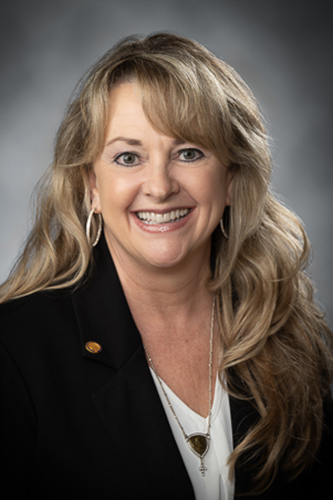
Photo of Laura Kimble
R West Virginia House · District 71

Rep. Laura Kimble

Compare
Total votes
2,380
all sessions
Attendance
100%
11 missed
Higher than 95% of chamber peers
With party
87%
of cast votes
Lower than 97% of chamber peers
Bipartisan score
7%
crosses aisle rarely
Higher than 97% of chamber peers
Sponsored
556
bills & resolutions
Higher than 91% of chamber peers
Committees
5
assignments
556 bills and resolutions

Sponsored bills

Total
556
Primary
99
Co-sponsor
457
This page
556
matching current filters
Co-sponsor HB 4433
Signed into law · West Virginia House · Co-sponsor
Prohibiting Human Smuggling and Trafficking

Maddy summaryHB 4433 amends West Virginia law to create new criminal offenses for human smuggling (transporting undocumented people to evade enforcement) and human trafficking (recruiting or moving people for forced labor or sexual exploitation). It specifically targets individuals who transport adults or minors for these purposes, defining key terms like "coercion" and "forced labor" to clarify illegal conduct. The bill establishes penalties for these crimes, allows asset forfeiture of property used in trafficking, and requires restitution for victims. It also includes an exemption permitting medical, mental health, and legal services for undocumented individuals without criminal liability.

Signed into law Jun 29, 2026 1 co-sponsor
Primary HB 4965
Signed into law · West Virginia House · Lead sponsor
Relating to patient-centered treatment flexibility within the Public Employees Insurance Agency

Maddy summaryHB 4965 allows state employees and retirees covered by the Public Employees Insurance Agency (PEIA) to switch to an alternative medical treatment for the same diagnosed condition without needing new pre-approval, provided the alternative is medically appropriate and costs no more than the originally authorized treatment. The bill requires healthcare providers to document the medical necessity of the switch and ensures PEIA cannot deny coverage solely for not having separate pre-approval. It does not change existing covered benefits or affect treatments for new conditions, and PEIA may still deny claims for fraud or improper billing. This policy aims to reduce delays in care while maintaining cost control for the insurance program.

Signed into law Jun 29, 2026 0 co-sponsors
Primary HCR 33
In committee · West Virginia House · Lead sponsor
Requesting the Joint Committee on Government and Finance to study women’s collegiate sports programs in West Virginia

Maddy summaryThis bill requests the Joint Committee on Government and Finance to study women's collegiate sports programs in West Virginia, focusing on financial sustainability, name image and likeness impacts, and Title IX obligations. The study will examine current funding levels, endowment feasibility, revenue-sharing models, and operational efficiency methods to support female student-athletes. The committee must submit a report by January 1, 2027, to state officials with findings, conclusions, and potential legislative recommendations. Funding for the study will come from existing legislative appropriations to the committee.

In committee Mar 14, 2026 0 co-sponsors
Co-sponsor HB 4602
Passed · West Virginia House · Co-sponsor
Relating to requiring the Department of Human Services to establish a pilot program to contract for supplemental caseworker aide services for the Bureau for Social Services

Maddy summaryHB 4602 would require West Virginia's Department of Human Services (DHS) to create a 15-month pilot program contracting with private companies to provide administrative support staff for caseworkers in the Bureau of Social Services. The program would target districts with high caseloads, staffing vacancies, or high rates of children placed out-of-state in foster care, using technology to free up caseworkers' time for direct family interactions. DHS must maintain full oversight of all cases, ensure contracted aides meet similar qualifications as staff, and submit a report to the legislature on outcomes and recommendations. This pilot aims to improve caseworker capacity without changing existing staffing requirements or permanent agency structure.

Passed Mar 13, 2026 1 co-sponsor
Co-sponsor HB 4603
Passed · West Virginia House · Co-sponsor
Relating to the creation of the process of obtaining and adjudicating a pre-adjudicatory alternative disposition

Maddy summaryHB 4603 creates a new process for resolving certain criminal and juvenile cases without a formal court trial. It establishes a system allowing courts to offer alternatives like community service or counseling instead of a conviction for eligible cases, such as criminal charges that could lead to jail time or juvenile proceedings. The bill amends existing West Virginia law to define and incorporate this "pre-adjudicatory alternative disposition" process, specifying which cases qualify and how they are handled. This change aims to provide non-punitive resolutions for qualifying cases while streamlining court proceedings.

Passed Mar 13, 2026 1 co-sponsor
Co-sponsor HB 4986
Passed · West Virginia House · Co-sponsor
Relating to providing additional ground for abandonment finding in an adoption proceeding

Maddy summaryHB 4986 amends West Virginia law to clarify when parental abandonment is presumed, especially for incarcerated parents. It states that abandonment is presumed when a parent is jailed for a significant portion of the child's minority (considering the child's age and need for stability) or for serious crimes like sexual assault, murder, or violent offenses. The bill also requires child welfare agencies to seek termination of parental rights when a child has been in foster care for 15 of the last 22 months, or when a court finds the child abandoned, abused, or when a parent committed specific violent or sexual crimes against the child. This directly affects parents facing incarceration for certain offenses and children in foster care or abuse cases.

Passed Mar 5, 2026 1 co-sponsor
Co-sponsor HB 5660
Passed · West Virginia House · Co-sponsor
Updates to obtaining a license to carry deadly weapons statute

Maddy summaryHB 5660 amends West Virginia's statute governing concealed weapons licenses, updating the process for obtaining a permit to carry deadly weapons (specifically pistols and revolvers). It affects both West Virginia residents (requiring a $50 fee) and nonresidents (requiring a $100 fee), who must submit detailed applications verifying citizenship/residency, age (21+), criminal history (no recent felonies/misdemeanors involving violence or domestic abuse), and background checks. The bill specifies required applicant information including personal details, proof of lawful status, and compliance with federal firearm restrictions. It also waives the weapon-handling qualification requirement for renewal applicants. This legislation modifies existing licensing procedures without changing the core eligibility criteria.

Passed Mar 4, 2026 1 co-sponsor
Co-sponsor HB 5413
Passed · West Virginia House · Co-sponsor
Relating to the Central Abuse Registry

Maddy summaryHB 5413 creates a Central Abuse Registry managed by the West Virginia State Police to track individuals convicted of abuse, neglect, or misappropriation of property involving children, incapacitated adults, or adults receiving behavioral health services in specific settings like residential care facilities, day care centers, or home care. It requires registrants to provide personal details (name, DOB, SSN) and pay an annual $125 fee to the circuit clerk, with fees funding mental health services for State Police employees. The registry combines existing requirements, so those already registering as sex offenders only pay one $125 fee instead of separate fees. Failure to pay the fee does not violate supervised release, but unpaid fees may result in a recorded judgment lien.

Passed Mar 4, 2026 1 co-sponsor
Co-sponsor HB 4352
Passed · West Virginia House · Co-sponsor
Prohibiting cameras and recording devices in bedrooms and bathrooms of foster children

Maddy summaryHB 4352 prohibits cameras and recording devices in the bedrooms and bathrooms of foster children in West Virginia foster homes. The bill directly affects foster children and their caregivers, banning all such devices except under specific medical exemptions. Exemptions apply only if a child has a medical diagnosis of severe physical, behavioral, cognitive, or psychological disability, and even then, any permitted devices must be placed visibly - not hidden. The law requires foster homes to maintain privacy in these personal spaces while allowing limited medical monitoring with clear visibility.

Passed Mar 4, 2026 1 co-sponsor
Co-sponsor HR 21
In committee · West Virginia House · Co-sponsor
Recognizing President Donald J. Trump for reforms benefiting West Virginia

Maddy summaryThis House resolution formally recognizes President Donald J. Trump for various policies and actions that the West Virginia House of Delegates claims have benefited the state. The document highlights specific initiatives including regulatory reforms in the energy sector, tax relief measures, funding for rural healthcare, and programs aimed at reducing prescription drug costs and establishing investment accounts for newborns. It also cites border security improvements and drug control efforts as contributing factors to public safety and economic well-being. The resolution expresses appreciation for these actions and requests that the formal recognition be sent to the President.

In committee Mar 3, 2026 1 co-sponsor
Showing 11 to 20 of 556 bills