Maddy summaryHB 5510 removes a requirement that private wedding venues in West Virginia must own or lease at least two acres of land in a rural area to operate. This change directly affects private wedding venues, particularly those in rural locations that previously faced this land-use barrier. The bill amends West Virginia Code §60-7-2 (relating to private club licenses) to eliminate the two-acre minimum, simplifying licensing for these venues. The policy change takes effect July 1, 2026, after passing through legislative committees.
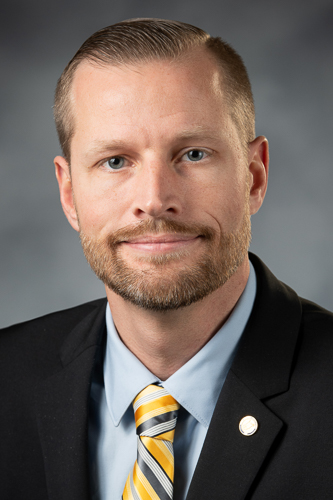
Rep. Jordan Maynor
Sponsored bills
Maddy summaryHB 4588 requires West Virginia's State Treasurer to participate in a federal tax credit program that allows individuals to receive tax credits for contributions to scholarship organizations. The bill mandates the Treasurer to annually identify and publish a list of qualified nonprofit scholarship organizations and eligible schools meeting federal and state requirements. Eligible schools must comply with West Virginia education laws, and students must be eligible for public school enrollment under federal criteria. Scholarship funds can cover elementary and secondary education expenses as defined by federal law, with the Treasurer accepting applications year-round for organization inclusion.
Maddy summaryHB 4010 establishes a state loan program to provide financial assistance for constructing airplane hangars at local airports in West Virginia. It directly affects counties, municipalities, and regional airport authorities that own or operate airports, allowing them to access state loans for hangar planning, construction, or improvements. The bill creates a pilot project with specific eligibility standards (considering site readiness, economic impact, and market demand) and requires the transportation division to set loan terms, limit participating airports based on funding, and report annually to the Joint Committee on Government and Finance. This program aims to support airport infrastructure development to enhance economic opportunities in local communities.
Maddy summaryThis is a ceremonial resolution (HCR 13) honoring the late Senator Tony Eugene Whitlow, a longtime West Virginia legislator who served in the House (1970-1982) and Senate (1984-1992), including as Senate President pro Tempore. The resolution commemorates his life, military service, public career, family, and community contributions, directing the Clerk to send a copy to his surviving family members. It has no policy provisions or direct impact on constituents.
Maddy summaryHB 5203 prohibits West Virginia municipalities from issuing any local identification card specifically for voting in municipal elections. It requires that any identification used for voting must already be authorized by state law for statewide elections, preventing cities from creating their own voting IDs. The bill directly affects local governments that might have considered adopting unique municipal ID systems for election purposes. This ensures municipal elections follow the same voter ID standards as state elections, without creating additional local requirements.
Maddy summaryThis House resolution formally recognizes President Donald J. Trump for various policies and actions that the West Virginia House of Delegates claims have benefited the state. The document highlights specific initiatives including regulatory reforms in the energy sector, tax relief measures, funding for rural healthcare, and programs aimed at reducing prescription drug costs and establishing investment accounts for newborns. It also cites border security improvements and drug control efforts as contributing factors to public safety and economic well-being. The resolution expresses appreciation for these actions and requests that the formal recognition be sent to the President.
Maddy summaryThis House Resolution honors the life and legacy of the late West Virginia legislator Larry D. Kump, who passed away on February 28, 2026. The resolution formally expresses the House of Delegates' condolences to Kump's family and acknowledges his service as a representative for Berkeley County across three different terms. It recognizes his career in criminal justice and mediation, his commitment to limited government, and his role as a devoted family member and church leader. The document is a ceremonial tribute rather than a law that changes policy or affects public programs.
Maddy summaryHB 4500 authorizes Berkeley County Commission to levy a special excise tax on sales of tangible personal property and services within the Berkeley County Economic Opportunity Development District. This tax would fund economic development initiatives in the designated district, directly affecting businesses operating within its boundaries and residents who purchase taxable goods or services there. The bill specifies that the district will remain active until 2054, unless terminated earlier under existing law, and aligns with similar provisions for other counties’ economic districts. The tax is limited to sales within the district’s defined boundaries and must be approved through required legislative processes.
Maddy summaryHB 5176 creates a searchable online database managed by the West Virginia State Police for individuals convicted of specific animal cruelty offenses, including violations of sections like §61-8-19 (cruelty to animals). The database will include names, birth dates, offense details, and county of conviction for those convicted of listed misdemeanor or felony animal abuse crimes. Convicted individuals must pay a $125 annual fee (to be paid to their county State Police office) to maintain their listing, with fees deposited into a dedicated State Police fund. Removal from the database is possible after 5 years for misdemeanors or 15 years for felonies (with proof of rehabilitation), or immediately if the conviction is expunged or pardoned.
Maddy summaryHB 5596 amends West Virginia law to redirect certain court costs from criminal convictions into the West Virginia State Police Forensic Laboratory Fund. Specifically, it adds $20 for misdemeanor convictions and $20 for felony convictions to be deposited into the fund, plus an additional $50 for any conviction where the forensic lab's resources were used. These costs, which would otherwise go to other funds like courthouse improvements, are now directed to support the forensic lab's operations. The bill affects individuals convicted of misdemeanors or felonies in West Virginia court proceedings.