Maddy summaryHB 2594 ensures homeless children and youths in Washington state have equal access to free public education by removing barriers like residency requirements, documentation delays, and fees. It requires school districts and the Superintendent of Public Instruction to adopt policies that prevent segregation, identify homeless students, and maintain enrollment in their "school of origin" (the school they attended while housed). The bill mandates a state education plan addressing specific obstacles - such as missing immunization records, dress codes, or lack of birth certificates - and ensures homeless students can access all programs, including preschool, extracurriculars, and career training, on the same basis as other students.
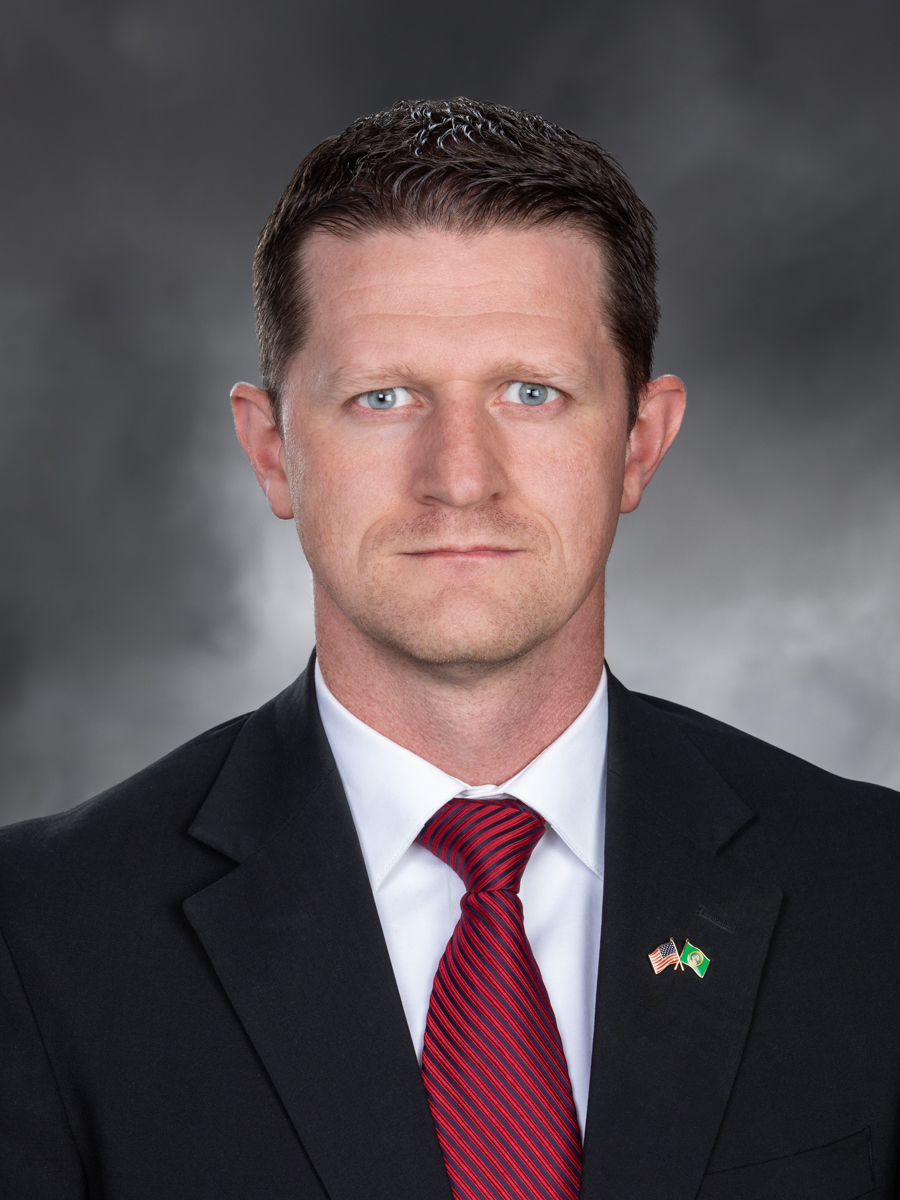
Rep. Joel McEntire
Sponsored bills
Maddy summaryHB 2426 allows pollution control appeal hearings to use alternative board configurations, directly affecting businesses or individuals appealing environmental permits. The bill permits the hearings board to hear cases through an administrative appeals judge (meeting existing qualifications), a land use board member, or a single qualified member - only with all parties' consent and unanimous board approval. It requires these alternatives to prioritize efficient use of administrative resources. The change aims to streamline processing of appeals without altering the board’s core authority or decision-making standards.
Maddy summaryThis bill is a House resolution that formally recognizes Representative Virginia "Jenny" Graham for her public service in the Washington State House of Representatives. It highlights her eight-year tenure, her advocacy for public safety, and her work on community safety and veterans' issues. The resolution does not create new laws or policies but serves as an official acknowledgment of her contributions and legacy.
Maddy summaryThis bill is a House resolution that formally honors John Michael Sattgast for his 35 years of dedicated service as a communications professional for the House Republican Caucus in the Washington State Legislature. It recognizes his work producing over 4,000 radio stories and coordinating media coverage for state representatives, as well as his leadership roles with the National Conference of State Legislatures. The resolution acknowledges his contributions to sharing legislative history and public information, noting his receipt of the 2023 Legislative Staff Achievement Award. This measure serves as a commemorative tribute rather than establishing new policy or affecting government operations.
Maddy summaryThis bill formally acknowledges the service of Representative Steve Tharinger to his district and the Washington state legislature. It recognizes his long career in public service, including his time as a Clallam County Commissioner, his work on the House Capital Budget Committee, and his advocacy for environmental protection and healthcare. The resolution serves as a commemorative tribute to his contributions and personal qualities rather than establishing new laws or policies.
Maddy summaryHB 2534 (Promoting educational stability for children of military families) helps military-connected children enroll in Washington schools more smoothly when their families relocate due to military orders. It allows schools to accept enrollment applications before the child arrives in Washington, using military orders as proof of relocation (e.g., transfers to WA or bordering states, deployments), and requires parents to provide documentation within 90 days. The bill ensures schools transfer special education plans (like IEPs or 504 plans) from previous states and provide comparable services without delay. This directly affects military families moving to Washington and public school districts handling their enrollments.
Maddy summaryHB 2107 requires Washington construction site inspectors to provide employers or owners with written notice within 10 working days when they identify an immediate safety hazard during inspections that could cause worker injury. This applies specifically to residential building and general construction projects under the North American Industry Classification System. The law, effective until June 30, 2026, mandates this notice but does not change inspectors' existing authority or the employer's obligation to correct hazards. It also requires the Department of Labor to report by December 1, 2026, on instances where timely notice wasn't given and the reasons for non-compliance.
Maddy summaryThis resolution (HR 4692) acknowledges the 84th anniversary of Executive Order 9066, which led to the forced relocation and internment of over 120,000 Japanese Americans during WWII, including 12,000 from Washington State. It recognizes Japanese American veterans, incarcerees, and civil rights activists from Washington, and urges reflection on the principle "with liberty and justice for all," without creating new policies or requiring government action.
Maddy summaryHJM 4012 is a Washington State House Joint Memorial urging Congress to pass the Major Richard Star Act (H.R. 2102), which would amend federal law to extend "full concurrent receipt" benefits to combat-injured veterans regardless of their years of service. Currently, veterans with less than 20 years of service who are medically retired due to combat injuries receive less federal disability compensation than those with 20+ years, creating inequity. The memorial requests Congress schedule a vote on H.R. 2102 to resolve this disparity and fulfill the nation's obligation to all combat-injured veterans. This is a procedural request to the federal government, not a state law.
Maddy summaryHB 2188 requires Washington's Department of Labor and Industries to publicly disclose details when it limits workers' compensation insurance rate increases below actuarial recommendations. It directly affects employers in specific risk classes (like manufacturing or construction) whose rates are artificially capped, as well as the public and lawmakers. The bill mandates publishing three key details: the limited rate classes, the actuarial rate without limits, and how other classes absorb the cost difference. This aims to clarify hidden cost shifts and rebuild transparency in the state's workers' compensation program, which has used contingency reserves to suppress rate hikes for three years.