

Maddy summaryThe Pray Safe Act of 2025 establishes a Federal Clearinghouse within the Department of Homeland Security to provide research-backed safety and security resources for houses of worship (like churches, mosques, and synagogues), faith-based organizations, and nonprofit groups deemed at risk of threats. The clearinghouse will compile evidence-based safety guidelines, list federal and state grant programs for security improvements, and offer training materials on measures like facility hardening and incident response. It requires annual updates to Congress and expires four years after enactment. The bill directly supports these organizations by centralizing accessible safety resources and grant information without creating new funding.
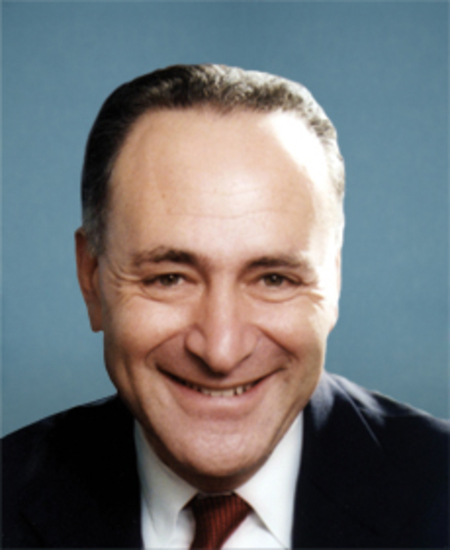
Sen. Charles E. Schumer
Sponsored bills
Maddy summaryThis bill establishes the New York-New Jersey Watershed Restoration Program to coordinate federal, state, and local efforts for ecosystem restoration across the New York-New Jersey Harbor watershed. It directly affects state/local governments, nonprofits, tribal entities, and communities experiencing environmental injustice by creating a voluntary grant program that provides up to 90% federal funding for projects improving water quality, habitat, and climate resilience - particularly for small, rural, or disadvantaged communities. Key mechanisms include requiring coordination with existing plans (like the Hudson River Estuary Program), prioritizing projects that advance environmental justice, and mandating annual reports to Congress on funded activities. The program emphasizes measurable outcomes through science-based strategies and requires matching funds for most projects (50% federal share). It authorizes $20 million annually for fiscal years 2026-2031, with 75% dedicated to grants.
Maddy summaryThis bill requires the Federal Trade Commission (FTC) to conduct a one-year study on neural data privacy and governance, including risks of behavioral manipulation and gaps in current laws. The study will analyze how neural data (from brain-monitoring devices) and related biometric data are collected, used, and transferred, with recommendations for future privacy protections. It directly affects the FTC (which must complete the study) and federal agencies (which will later receive guidance on using neural technology). The bill does not create new regulations but sets the stage for potential future policy changes based on the FTC's findings.
Maddy summarySRES 402 is a Senate resolution recognizing Lloyd Ashburn Williams for his decades of work advancing Harlem's economic, cultural, and social development. It honors his leadership as CEO of the Greater Harlem Chamber of Commerce, co-founding Harlem Week, and advocacy for minority businesses, affordable housing, and community initiatives. The resolution has no binding effect or policy changes - it solely commemorates Williams' legacy following his passing in August 2025. It directly affects no individuals or communities through legislative action, as it is a ceremonial tribute.
Maddy summaryThe Protect America’s Workforce Act (S 2837) directly affects federal employees and their labor unions by reversing two executive orders that limited their collective bargaining rights. It nullifies Executive Orders 14251 and 14343, which had excluded certain federal workers from labor-management programs, and prohibits federal funding for any efforts to implement those orders. The bill ensures that all existing collective bargaining agreements between federal agencies and employee unions remain fully enforceable through their original terms, as long as they were in effect as of March 26, 2025. This preserves current workplace agreements without creating new obligations or altering existing labor-management processes.
Maddy summaryThe FAMILY Act (S 2823) would establish a federal paid family and medical leave insurance program that provides wage replacement benefits for eligible workers who need time off for family or medical reasons. It directly affects workers who need leave to care for a family member with a serious health condition, address their own serious health condition, or deal with family violence or other qualifying acts of violence. The program would pay a percentage of an individual's average earnings (up to 85% for lower earners), with maximum monthly benefits of $4,000 and minimum benefits of $580 in 2026, while requiring employers to maintain health coverage during leave. The Social Security Administration would administer the program through a new Office of Paid Family and Medical Leave, with benefits available starting 18 months after enactment.
Maddy summaryS 2784, the Congressional Tribute to Constance Baker Motley Act of 2025, is a commemorative resolution honoring civil rights pioneer Constance Baker Motley. It authorizes the posthumous presentation of a Congressional gold medal to her son, Joel Motley III, and niece, Constance Royster, recognizing her historic role as the first African-American woman on the LDF legal team for *Brown v. Board of Education*, her service as a federal judge, and her civil rights advocacy. The bill directs the Treasury Secretary to design and strike the medal, with proceeds from bronze duplicates covering costs. It does not create new laws or affect any policies, as it solely serves to commemorate Motley's legacy.
Maddy summaryS 2777, the Small Business RELIEF Act, exempts small businesses from import duties imposed under Executive Order 14257 (related to national emergencies) for goods they import. It requires the President to refund all duties paid under that order within 90 days of the bill's enactment. The bill directly affects small business concerns as defined by the Small Business Act (15 U.S.C. 632), which typically covers businesses with fewer than 500 employees. This policy change removes a financial burden on qualifying small importers and provides retroactive refunds for past payments.
Maddy summaryThis bill would make several administrative changes to the Social Security Administration, including exempting it from the jurisdiction of the Department of Government Efficiency (DOGE) and certain executive orders, restricting political appointees from accessing beneficiary data systems, and preventing closure of field offices while requiring maintenance of staff levels. It also creates new offices within the SSA for civil rights, transformation, and analytics, and provides additional funding for administrative costs and customer experience improvements. These provisions would directly affect how the SSA manages its operations, protects beneficiary data, and delivers services to beneficiaries. The bill's title is misleading as it does not address billionaires or their relationship with Social Security.
Maddy summaryS 2746, the "Produce Epstein Treasury Records Act," requires the U.S. Treasury Secretary to submit physical copies of financial transaction records related to Jeffrey Epstein and his associates within 30 days of the bill’s enactment. It mandates the Treasury to provide a list of financial institutions that filed these records, identify all individuals/entities involved in transactions with Epstein (including banks like JPMorgan and Deutsche Bank, and associates like Ghislaine Maxwell), and detail the total transaction value by institution. The bill also requires reports on Treasury investigations into financial institutions’ handling of Epstein-related accounts. These records and reports would be submitted to the Senate Committees on Finance and Banking. The legislation focuses on transparency around Epstein’s financial networks, not on legal outcomes.