Public schools; indoor air quality; industry-recognized uniform inspection and evaluation. Adds several items that are required to be included in the industry-recognized uniform inspection and evaluation of the heating, ventilation, and air conditioning system that is required at least every four years for each public elementary and secondary school building, including measurement of radon levels in the air and testing for moisture incursion. The bill has a delayed effective date of July 1, 2027.
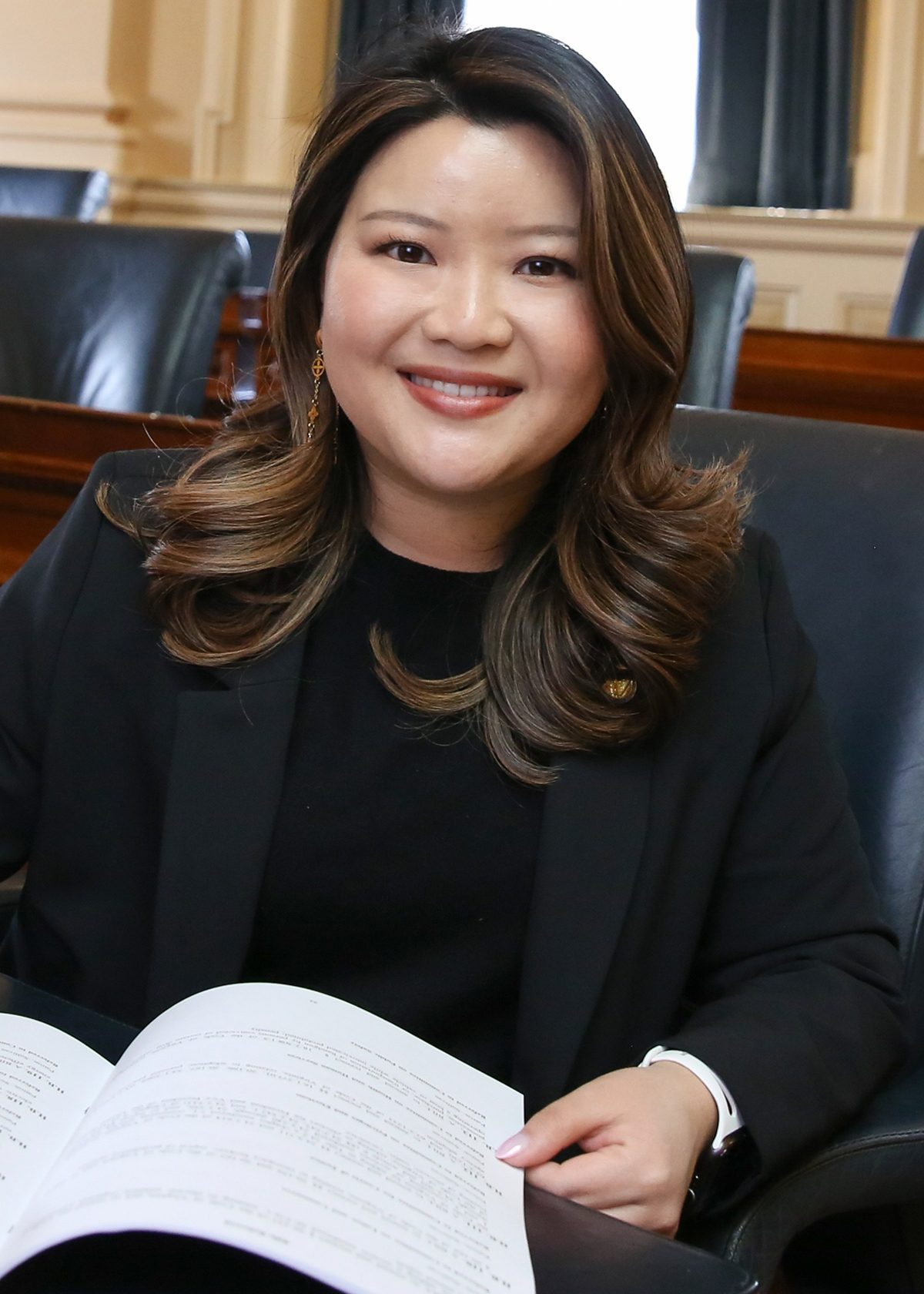
Del. Irene Shin
Sponsored bills
Local approval of data centers; temporary moratorium. Prohibits final approval of any application for a rezoning, special exception, special use permit, site plan, or plan of development for the siting of a new data center by a locality until the earlier of (i) the fulfillment of all pending requests for interconnection to distribution service by an electric utility customer that is a data center or (ii) July 1, 2028.
State correctional facilities; participation of prisoners in employment and educational programs; reentry planning. Expands the program assignments in which the Director of the Department of Corrections may place a prisoner while such prisoner is confined in a state correctional facility. The bill requires the Director to place a prisoner in an appropriate program assignment within (i) 90 days of the arrival of a prisoner sentenced to a new term of confinement to a state correctional facility or (ii) 60 days of a prisoner already in custody being transferred to a new state correctional facility and provides that participation in such program assignments shall be for an average of 30 hours per week, calculated individually across the calendar year. Finally, the bill expands upon the requirements for a prisoner's reentry plan, including requiring an assessment, if necessary, of a prisoner's readiness to take a high school equivalency test and any modifications needed for the prisoner to take or improve upon such test, and making available peer and group educational programs developed and led by qualified prisoners.
Transportation network companies; minimum compensation; civil penalty. Establishes minimum compensation rates for TNC partners. The bill also prohibits gratuities from passengers from being included in TNC partner compensation calculations, authorizes TNC partners to collect gratuity in cash or electronically, and prohibits transportation network companies from limiting the amount that can be paid as gratuity through such companies' digital platforms. The bill requires the Department of Motor Vehicles (DMV) to establish a process for reporting violations and to investigate claims. The bill authorizes enforcement by civil action or by civil penalties assessed by the DMV Commissioner.
Special license plates; QUAIL FOREVER. Authorizes the issuance of revenue-sharing special license plates for supporters of Quail Forever bearing the legend QUAIL FOREVER. The bill exempts such special license plates from requirements related to the minimum number of prepaid applications and the minimum number of active license plates after five years of issuance for special license plates.
Department of Medical Assistance Services; Medicaid waivers; consumer-directed services; employer of record. Directs the Department of Medical Assistance Services (DMAS) to modify the program rules for consumer-directed services available through certain Medicaid waivers to allow an individual receiving services to serve as the employer of record (EOR) for his own service delivery and designate another individual to perform all or a portion of the duties of the EOR on the individual's behalf when the individual receiving services is unable to perform such duties or direct his own care. The bill specifies that when an individual (i) has not yet reached the age of majority, (ii) is ineligible to use his existing employer identification number (EIN) to facilitate the taxation of benefits, or (iii) is otherwise determined to be ineligible by DMAS by administrative rule, the EIN shall be assigned to the individual receiving services and shall not be transferred to another individual. Under the bill, DMAS has the authority to limit such amendments to specify that an individual receiving services may make such designation no more than twice per calendar year.
Virginia Residential Landlord and Tenant Act; prohibited provisions in rental agreements; landlord's maintenance responsibilities. Prohibits a rental agreement from containing any provision stating that the tenant agrees to pay (i) any fee for the maintenance of the premises, including the maintenance or provision of heating and cooling systems, pest control, trash disposal, common area utilities, and mail or package delivery; (ii) a fee for internet, cable, or any other utilities or services that amount to more than the cost paid by the landlord; or (iii) for the maintenance or security of the common areas. The bill also repeals the provision allowing the landlord and tenant to agree in writing that the tenant may perform certain duties typically assigned to the landlord and also specified repairs, maintenance tasks, alterations, and remodeling, but only if the transaction is entered into in good faith and not for the purpose of evading the obligations of the landlord and if the agreement does not diminish or affect the obligation of the landlord to other tenants in the premises.
Local ordinances; regulation of pet shops. Authorizes the governing body of any locality to, by ordinance, regulate or prohibit the sale of animals in a pet shop. Such ordinance may distinguish between certain types of pet shops and include provisions for special licensing, inspections, reporting, restrictions, or prohibitions on the sale of certain types of animals. The bill also includes certain existing statewide provisions related to pet shops in the list of sections for which a locality may adopt parallel or more stringent ordinances. The provisions of the bill do not become effective unless reenacted by the 2027 Session of the General Assembly.
Workplace violence policy required for certain employers; civil penalty. Requires any employer of 100 or more employees to develop, implement, and maintain a workplace violence policy no later than January 1, 2027. The bill includes requirements for such a policy, such as procedures and methods for employee reporting of incidents and post-incident investigations. Employers subject to the bill are required to maintain documentation of workplace violence incidents for not less than five years. An employer that violates the provisions of the bill shall be subject to a civil penalty of not more than $1,000 per violation. The bill prohibits retaliation from an employer on the basis of reporting a workplace violence incident and provides that any employee who makes a report of workplace violence shall be immune from civil liability. The bill has a delayed effective date of January 1, 2027.
Legal holidays; Indigenous Peoples' Day. Replaces Columbus Day, the second Monday in October, with Indigenous Peoples' Day as a state holiday.